



Thank you dear subscribers, we are overwhelmed with your response.
Your Turn is a unique section from ThePrint featuring points of view from its subscribers. If you are a subscriber, have a point of view, please send it to us. If not, do subscribe here: https://theprint.in/subscribe/
Across the world, water stress is rising. Rainfall patterns are changing. Droughts are becoming more frequent. Glaciers are melting. Groundwater is being over-extracted. Rivers and aquifers are getting polluted. The population is growing. Urbanization is increasing. Water stress is rising.
India’s water crisis is part of a global problem, but it is more intense and complex. Groundwater is overused. Surface water is underused. Wells are drying. Cities pull water from distant rivers and rural aquifers, draining villages. This is poor balance and mismanagement.
Not long ago, water management was woven into village life. Water was managed efficiently using local materials, community knowledge, and ecological understanding.
Village design was not incidental. Hydrological planning was part of everyday life.
Courtyards were of earth, lime, cow dung, and stone materials. A tanka, an underground circular or rectangular water storage tank, was built with lime and local stones within or beneath the courtyard. Rainwater was guided through small channels into the tanka. Water stayed pure, slightly alkaline, cool, protected, and easily accessible.
Roofs of lime-plastered surfaces were slightly porous and textured. They slowed rainwater and directed overflow to tankas, from where it went in the soil and then to the aquifer and finally to the well, or during heavy rains, the overflow went to the well.
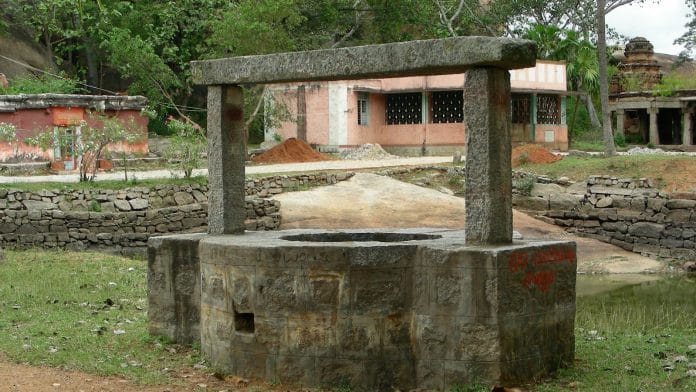
Wells were shared responsibility and collective care. They were sustained by an interconnected system of roofs, courtyards, and trees like neem and khejri. Roofs collected water, courtyards absorbed it, and wells stored it. Their use was fair. Over-extraction was limited. Neighbors talked, planned, and decided together.
Rules were agreed upon. Conflicts were fewer.
Trees around the wells and around the village served practical, ecological, and social purposes: offering shade, protecting the soil, and helping the earth return water back to itself. Planting kejri and neem extensively, along with grasses, formed an eco-ring around the well and around the village.
Times changed. Water management shifted from a shared community responsibility to a centralized system under government. Water reached homes through taps, reducing the need for collective engagement. In this transition, traditional knowledge systems weakened. And the link between roofs, courtyards, wells, and trees broke.
Cement roofs, especially RCC, were hard and impermeable. Water ran off very fast and was lost or drained outside the village.
Courtyards of cement and tiles became a sign of progress, but they did not let water percolate. Cement companies built vast distribution networks. Even remote villages could now procure cement easily, and construction with it came out to be cheaper than local materials.
Trees disappeared. Despite Khejri being declared the state tree of Rajasthan in 1983, its numbers declined due to felling and land-use change.
Wells were forgotten. Some dried up , some became waste dumps.
This way , the link between the roof, courtyard, and well was broken. We started losing rainwater. runoff, and even water that comes out of the earth during mining. It was not only a water crisis. It was a design failure.
Now that wrongs done in a hurry are being realized, it’s pertinent to set the loop right. Steps are engineering roofs to harvest rainwater, making underground tanks, and laying pipelines to transfer roof water to tankas (tanks). Decompacting courtyards, planting neem and khejri, and returning to wells.
We will have to select a drying village and map it with katcha houses, pucca houses, schools, temples, wells, trees, etc. Mark the areas that need corrections. Create awareness amongst people and governments. Hold community events and select ground teams.
Roofs, courtyards, and trees would help the wells stay alive. A healthy well is a visible sign of the health of the village ecosystem.
India’s water crisis cannot be solved by supply alone. It calls for a shift toward decentralized management, the revival of old and traditional systems, and a conscious rebuilding of our relationship with water not as a resource to be extracted but as a shared inheritance to be cared for.
Yet there is a fundamental question. If villages are to lead this regeneration, are we equipping their youth with the kind of education that makes it possible?
For decades, rural education has prepared young people to leave rather than to stay, to seek opportunity elsewhere rather than to reimagine the potential of where they are.
If the future of water lies in the hands of villages, then the future of villages lies in the minds we are shaping today. What kind of education can nurture not just employability, but stewardship? What would it mean to educate for regeneration, for belonging, for responsibility toward one’s own landscape?
These are questions we have not yet fully asked, let alone answered. And perhaps they are where the work must begin.
These pieces are being published as they have been received – they have not been edited/fact-checked by ThePrint.