





Thank you dear subscribers, we are overwhelmed with your response.
Your Turn is a unique section from ThePrint featuring points of view from its subscribers. If you are a subscriber, have a point of view, please send it to us. If not, do subscribe here: https://theprint.in/subscribe/
India’s innovation story is stronger than we think — and more fragile than we admit. India speaks confidently about becoming a global knowledge and innovation power — from startups and artificial intelligence to scientific temper and innovation-led growth. There is good reason for that confidence. Despite limited per-capita investment in research, education, and infrastructure, India ranks 38th on the Global Innovation Index (2025).
More tellingly, global assessments show that India’s innovation outputs rank higher than its inputs. In simple terms, India does a lot with constraints. Scientists, engineers, and entrepreneurs generate meaningful outcomes despite comparatively low levels of investment.
Yet when India is compared with smaller countries that lead in scientific breakthroughs, patents, and research impact, a gap remains. That gap is not best explained by intelligence or ambition. It is better explained by how early — and how consistently — curiosity and inquiry are cultivated.
What international comparisons tell us
International assessments such as PISA do not test rote recall; they evaluate whether 15-year-olds can identify scientific questions, interpret evidence, and apply reasoning to real-world situations.
When India last participated in 2009, student performance was well below the OECD average. Since then, India has largely stayed out of these comparisons, focusing instead on examination performance.
This matters because scientific progress depends on asking good questions, testing ideas, and revising thinking — habits that must be built long before university or research laboratories.
Patents show how much scale India could unlock
Patent data reinforces this story of efficiency and opportunity. According to the World Intellectual Property Indicators 2025, India recorded its eighth consecutive year of growth in patent applications, with 2024 seeing a 16.5% increase — the third straight year of double-digit growth. Crucially, this growth was driven primarily by resident filings, signalling strong domestic innovative activity.
In absolute terms, India files tens of thousands of patent applications each year. This is far fewer than patent powerhouses such as China — which files well over a million annually — or countries like the United States, Japan, and the Republic of Korea, each filing hundreds of thousands.
Read in context, this comparison is revealing rather than discouraging. If India can sustain rapid, resident-driven patent growth despite low per-capita investment, the opportunity ahead is one of scale, not capability. Even modest improvements in how we nurture questioning and experimentation could yield disproportionately large gains.
Those conditions begin in classrooms. What happens in classrooms today quietly shapes how far India’s innovation story can go tomorrow.
From “why?” to silence
Every child begins school curious. They ask “why?” — about shadows, insects, machines, and the world around them.
Then the responses change. Don’t ask so many questions. Just do what you’re told. That’s not important right now. When questions slow things down, they are discouraged. Children learn that curiosity is inconvenient.
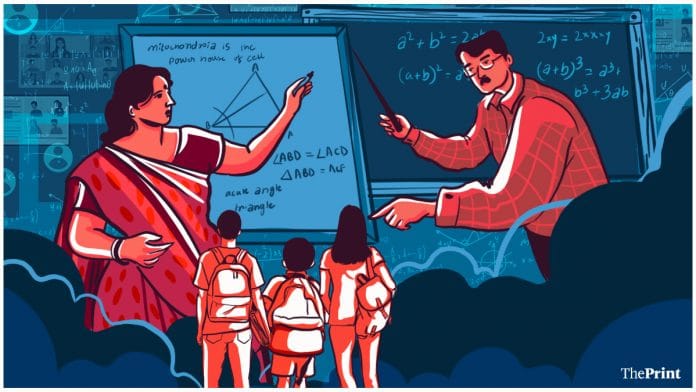
In classrooms, teachers — under pressure to finish syllabi and manage large classes — are expected to deliver content efficiently. Textbooks become scripts. Accuracy is rewarded. Exploration is postponed.
Curiosity quietly becomes a risk.
Adolescence and the growing fear of questioning
This suppression intensifies during adolescence, precisely when young people begin forming their identities. Teenagers question rules, challenge assumptions, and critique ideas. Too often, adults interpret this as rebellion rather than development.
But questioning is not defiance. It is how individuals learn to think independently.
No wonder curiosity fades. When questions are discouraged early and suppression deepens in adolescence, the habit of inquiry withers — even though the capacity remains.
From curiosity to exam survival
By middle school, board exams dominate priorities. The routine becomes predictable: finish the syllabus, practise past papers, and prepare students to score safely. With large class sizes, open-ended inquiry becomes structurally difficult.
Coaching culture reinforces the message: don’t ask why; write what the examiner wants.
Students stop asking “How does this work?” and start asking “Will this come in the exam?”
Curiosity is a national asset
Reviving curiosity does not require expensive laboratories or new slogans. It requires classrooms where students can ask questions without fear, where mistakes are treated as information, and where reasoning matters as much as results.
India’s innovation data tells a hopeful story. The country already generates meaningful output with limited inputs. What it lacks is not intelligence or ambition, but a system that consistently protects curiosity.
If India wants to move from efficient innovation to transformative innovation, the path forward is clear.
We must stop training curiosity out of our children — and start treating it as one of the country’s most valuable resources.
These pieces are being published as they have been received – they have not been edited/fact-checked by ThePrint.