




SIR was a common issue in most states, with Assam and West Bengal, the two border states with Bangladesh, being the most vocal on this subject. In Assam, it was the Congress-led opposition; in West Bengal, it was the ruling TMC that left no stone unturned in opposing the constitutionally valid and much-needed exercise. But the election results tell an entirely different story. Any marginal effect SIR may have had on the results in West Bengal or Assam has been drowned in the overwhelming mandate given to the BJP by voters in both states. SIR or no SIR, in the given scenario, the BJP would have won in West Bengal and Assam hands down. Hopefully, this will be the end of the debate on this subject.
The record-breaking voter turnout in nearly all the states is indeed a very positive sign for the future. In West Bengal, it was close to 92%, and for others, it was in the high eighties. This clearly shows the vibrancy of democracy in India. Equally important is the fact that polling was very peaceful, barring a few aberrations in West Bengal. But even there, compared to previous state and panchayat elections, the 2026 elections have set a new benchmark for peaceful polling. This should be the start of a new chapter in India’s democratic credentials, where people from all strata of society can come out and vote freely without fear. Those who have been trying to malign the Election Commission of India need to hang their heads in shame. The central forces deployed in various states, in particular in the violence-prone West Bengal, deserve a special mention for their meritorious service.
There will be a lot of fact- and figure-crunching over the next few days, with various interpretations from both vested interests and genuine analysts. While Assam, Kerala, and Puducherry voted as per expectations, it is the two states of West Bengal and Tamil Nadu that have surprised everyone, and no one more than the political parties that were in power in these states.
Tamil Nadu
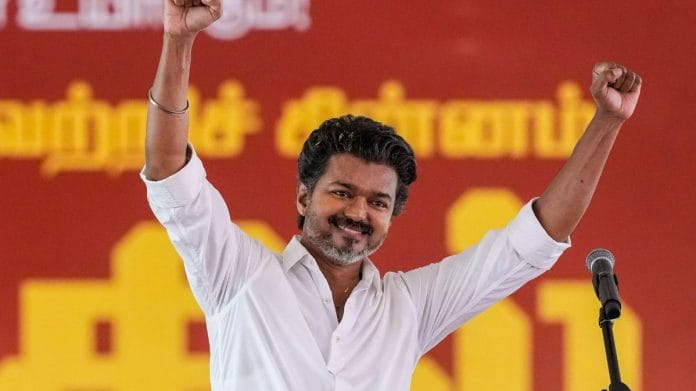
Joseph Vijay Chandrashekhar led his party, Tamilaga Vettri Kazhagam (TVK), to victory on his debut. For a party that was formed only in February 2024, it is indeed a great debut against the traditionally entrenched DMK and AIADMK. TVK, when translated to English, means “Tamil Nadu Victory Federation.” For too long, Tamil Nadu was all about Brahmins against Dravidians with an occasional call for Tamil Elam. Vijay’s party’s slogan, “Pirappokkum Ella Uyirkkum” (All are equal by birth), is indeed a refreshing change.
Vijay’s decision to go solo despite offers of alliances from DMK, AIADMK, and even BJP speaks volumes for his understanding of the prevailing mood of the people in the state. After decades of rule by the DMK and AIADMK, a change in guard with a fresh approach augurs well for the highly industrialised and productive state. One hopes that the separatist and confrontational approach followed by the DMK will be replaced by a mutually beneficial cooperative working model between the state and the Centre in the national interest. The onus will rest on both – the new state government and the Centre.
West Bengal
The most anticipated contest in these elections was in West Bengal, where the BJP was the challenger to the deemed undefeatable TMC led by Mamta Banerjee. On one hand, the Centre-State relationship had plummeted to a new low; on the other, the political rivalry between the two aggressive parties scaled new heights. The overall environment in the state, political, governance, communal, developmental, and social, was at a nadir. The state’s populace emerged as the primary victim of such a scenario. But the state government appeared to be immune to their plight. West Bengal can now look to some fast-track development in line with the rest of the country.
Furthermore, the state government resisted cooperation with the central government on several significant national issues. These included a governance model based on muscle power of TMC cadres, continuing illegal immigration from Bangladesh and their absorption in the state through devious means, blatant Muslim appeasement at the cost of Hindus, growing demographic concerns, an overtly aggressive local Muslim leadership with TMCs’ blessings, opposition to the Centre’s welfare schemes, opposition to policy issues like CAB, delimitation and NRC, non-cooperation of the state on matters of national security, the threat of the insider-outsider concept in the state, and the continuous vitriolic and venomous political discourse. The state failed to appreciate and cooperate in addressing the additional national concerns that arose because of the recent events and changes in Bangladesh. Without a doubt, all these will now be addressed with priority.
Other Takeaways
When the state and central machinery work together towards the common goals in the national interest, success is nearly a foregone conclusion in most cases. There is a strong case to work towards this end. With TVK in power in Tamil Nadu and the BJP itself in West Bengal, two of the erstwhile more difficult states can now be motivated to work in tandem with the central government. The lead will have to come from the Centre, and the state governments must set aside their mostly perceived reservations on the intentions of the central government. Both must look at a win-win situation for the betterment of all concerned.
The near absence of a viable political opposition at the national level is not a good sign for any democracy. The I.N.D.I. alliance promised a lot but has delivered very little. The future looks rather bleak for this alliance of opportunism, and it poses no serious threat to the BJP-led NDA at the Centre in the foreseeable future. Congress, the only party that can either develop into a national opposition or take a lead in stitching a viable opposition, has neither the will nor the leadership to achieve this distinction. This implies that the BJP-led NDA government will have to work together with the states in the future for years, perhaps decades. The BJP needs to pioneer a new framework for Centre-State cooperation that prioritizes fairness, consultation, and institutional trust.
One of the more important tasks that the BJP government in West Bengal will have is to find ways and means to restore the state to its days of glory, when it excelled in almost all fields, from education, engineering, industrial production, culture, literature, arts, and progressive thinking, among many others. This will entail a change in the mindset and working culture of the state, and implementation of confidence-building measures in the state’s institutions and the public at large. This will be a humungous task, but one that cannot be delayed or ignored. West Bengal’s return to being ‘cultured’ after being ‘uncultured’ for over six decades will be an asset for the nation in more ways than one.
These pieces are being published as they have been received – they have not been edited/fact-checked by ThePrint.