




Your Turn is a unique section from ThePrint featuring points of view from its subscribers.
If you are a subscriber, have a point of view, please send it to us. If not, do subscribe here: https://theprint.in/subscribe/
There are moments in global affairs when rhetoric rises like foam—and reality cuts through like a knife.
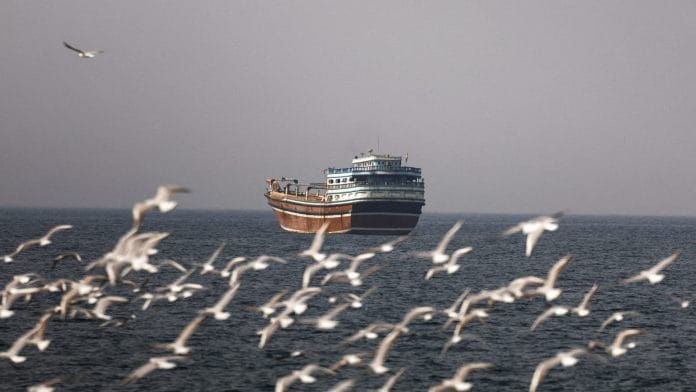
The recent spectacle over India’s passage through the Strait of Hormuz is one such moment. Social media is awash with chest-thumping claims of “benevolence,” as if global shipping lanes were opened by acts of kindness. One almost expects oil tankers to carry thank-you notes.
Let us get one thing straight.
The Strait of Hormuz is not a charity corridor. It is the artery through which nearly a fifth of the world’s energy flows. When that artery clogs, the global economy gasps.
And right now, it is dangerously close to cardiac arrest.
The ongoing Iran–US–Israel conflict has already sent oil prices soaring by nearly 50%, disrupted maritime traffic, and left hundreds of ships stranded in limbo.
Daily vessel movement has collapsed from over a hundred ships to a trickle.
This is not geopolitics. This is economic warfare.
And in the middle of this chaos, India has quietly done what serious nations do—protect its people.
The Government’s Quiet Competence
While television studios shout and WhatsApp forwards sermonise, the Indian government has been doing the unglamorous work of statecraft.
Indian tankers are moving. LPG cargo is being secured. Strategic supplies are being prioritised.
High-level reviews are being conducted to ensure that energy shortages do not spiral into domestic crises.
Most importantly, India has managed what many thought impossible:
It has secured passage through Hormuz while maintaining working relationships with Iran, Israel, and the United States.
This is not diplomacy. This is tightrope walking over a geopolitical volcano.
And it is working.
India has been classified among a handful of “friendly nations” allowed passage by Iran—even as others are blocked.
Not because of sentiment.
Because of leverage.
The Opposition’s Predictable Theatre
But no Indian crisis is complete without the Leader of the Opposition discovering a microphone.
Instead of acknowledging a complex diplomatic success, we are treated to the usual sermon:
India must “take a stand.”
India must “choose a side.”
India must “speak loudly.”
This is the foreign policy equivalent of shouting instructions from the passenger seat during a Formula One race.
Choosing sides in a conflict like this is not moral clarity. It is strategic suicide.
Should India antagonise Iran—the very country sitting astride its energy lifeline?
Should it alienate Israel—a critical defence partner?
Or distance itself from the United States—the world’s largest economy?
The Opposition offers outrage.
The government offers outcomes.
The Myth of Benevolence
The narrative being pushed—that Iran is acting out of goodwill towards Indian people—is charming. It is also nonsense.
Iran has made it clear that only “non-hostile” nations will be allowed passage.
Translation:
This is not kindness.
This is conditional access in a war zone.
Even reports suggest that ships are navigating restricted routes, sometimes under implicit toll-like conditions.
In other words, this is not a gift.
It is a transaction.
And India has negotiated it well.
What Lies Ahead: The Dangerous Months
The coming weeks will not be easy.
The conflict is widening. Houthi forces have already entered the fray, raising the risk of attacks on additional shipping routes.
The Red Sea could become the next choke point.
Insurance costs will rise.
Energy prices will remain volatile.
Supply chains will strain.
India, which imports nearly 60% of its LPG—most of it from the Middle East—remains exposed.
But there is a crucial difference.
India is not reacting blindly.
It is adapting strategically.
Expect three moves in the months ahead:
- Diversification of energy sources—accelerating deals beyond West Asia.
- Strategic reserves management—to cushion domestic shocks.
- Diplomatic balancing—continuing engagement with all sides without ideological posturing.
This is not dramatic.
It is effective.
The Final Reality Check
In a world where missiles fly and shipping lanes close overnight, survival is not about slogans.
It is about competence.
It is about keeping a billion-plus people supplied with energy, food, and stability—while the world burns.
India has done that.
Not perfectly.
But decisively.
And that is worth acknowledging.
These pieces are being published as they have been received – they have not been edited/fact-checked by ThePrint.