





Thank you dear subscribers, we are overwhelmed with your response.
Your Turn is a unique section from ThePrint featuring points of view from its subscribers. If you are a subscriber, have a point of view, please send it to us. If not, do subscribe here: https://theprint.in/subscribe/
My little daughter Maryam is fond of drawing marine creatures. Octopuses, jellyfish, fish with impossible colours; her imagination swims easily in the sea. Recently, while she was drawing a jellyfish, I found myself speaking to her about another ancient resident of the ocean: Turtles.
She is six now; the same age at which I first heard about them.
The story goes back to my childhood in the Andaman and Nicobar Islands. My father, an employee of the Forest Department, was posted in a place called Mayabunder. School holidays often carried us northward from our home in Port Blair to Mayabunder. For children, every journey is an expedition. Every beach is a promise.
During one such holiday, my father took us to a nearby beach called Karmatang Beach. There was another excitement floating in the air like salt spray: we were told we might see turtles there. Karmatang is known as the “Turtle Paradise of India.”
I still remember fragments of conversations between my father and his close friend and colleague, Vishwadevan Uncle. Adults often speak in names before children understand meanings. I remember hearing places like Cuthbert Bay, beaches in Diglipur, and Galathea Bay. At that age, they sounded musical like secret stations in a storybook map. Little did I know then that our islands were among the most important sea turtle habitats in the world.
The Andaman and Nicobar Islands are the only place in India where four species of Sea Turtles nest together: the Leatherback, Green Turtle, Hawksbill, and Olive Ridley. Creatures older than kingdoms, older than borders, older perhaps than many mountains we proudly stand upon. They arrive silently from vast oceans, crossing invisible highways beneath the sea, returning faithfully to the same shores where their lives began.
The most majestic among them is the Leatherback Turtle, the giant nomad of the oceans. Unlike other turtles, its shell is not hard but leathery, like an ancient shield weathered by centuries of storms. In the Islands, their most important nesting ground is ‘Galathea Bay’ in the Great Nicobar Island. Every year, nearly a thousand nests appear there beneath the sand. These turtles travel across the Indian Ocean, touching waters near Africa and Australia before returning home. Yet despite such endurance, they remain critically endangered. Survivors surviving survival itself.
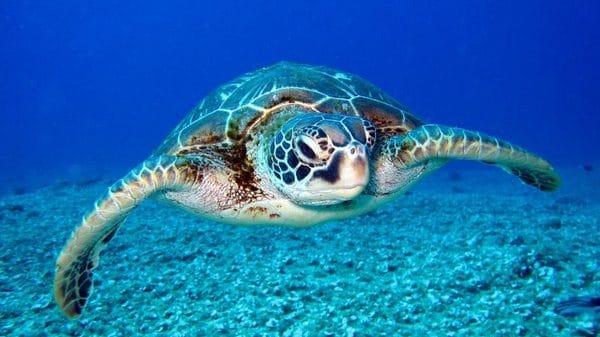
Then comes the Green Turtle, perhaps the one most closely woven into my childhood memories. It is the most common nesting turtle in the islands, found across more than eighty beaches. Karmatang Beach, Kalipur Beach, and Ramnagar Beach are among their cherished nesting grounds. Green Turtles graze on seagrass meadows like slow-moving underwater cattle, calm and graceful in a restless world.
The Hawksbill Turtle is smaller and secretive, with amber-patterned shells found near coral reefs but endangered. The Andaman and Nicobar Islands hold India’s largest remaining population of this species. Coral reefs are their kingdoms; when reefs die, a civilization collapses beneath the waves.
And then there is the Olive Ridley famous for its arribadas, the spectacular mass nesting events seen on mainland India’s eastern coast. In the Islands, they nest in smaller numbers, especially around Cuthbert Bay and Kalipur Beach.
I first read about these turtles in old library books. Over time, I came to feel that beaches protect turtles the way libraries protect books; silently, patiently, faithfully. Back then, Galathea Bay existed in my imagination almost like those library pages themselves: distant, and sacred. But some places do not remain stories forever. They return to us, often carrying questions larger than memory.
Years later, Great Nicobar, Galathea Bay, and the Turtles are in news now. Galathea is not merely a beach. It is a cradle where giant Leatherback Turtles emerge from dark waters under moonlit skies to continue a cycle older than human ambition.
And that is perhaps the question before us today. How much concrete must a coastline carry before it forgets the language of turtles?
Modern economic development often arrives like an impatient tide that is loud, glittering, and hungry. Ports, resorts, highways, shipping corridors: they promise growth, speed, and prosperity. But nature does not negotiate in the language of quarterly profits.
A nesting beach destroyed in a season may take centuries to heal.
A species lost is a library burned forever.
The turtles ask for very little. Dark beaches, quiet nights, safe seas. And yet even that is becoming difficult.
When I watch Maryam drawing jellyfish and listening wide-eyed to stories of turtles, I realise childhood wonder is itself endangered.
Every child deserves the excitement of hearing that turtles may emerge from the sea tonight.
Every child deserves beaches where footprints are not only human.
Every child deserves the possibility of awe.
I hope these turtles of Great Nicobar survive the century of speed around them.
I hope the Leatherbacks still return to Galathea Bay long after our arguments over development are forgotten.
And I hope somewhere, years from now, another six-year-old child stands on a quiet Andaman beach, staring into the dark sea, waiting for the sand to move.
These pieces are being published as they have been received – they have not been edited/fact-checked by ThePrint.