





Thank you dear subscribers, we are overwhelmed with your response.
Your Turn is a unique section from ThePrint featuring points of view from its subscribers. If you are a subscriber, have a point of view, please send it to us. If not, do subscribe here: https://theprint.in/subscribe/
We are currently the most informed generation in human history, but we are also the most distracted. Our digital footprints are massive, yet our internal foundations often feel remarkably thin. While we have completely mastered the art of gathering material things and digital validation, we consistently struggle with the simple art of just being human.
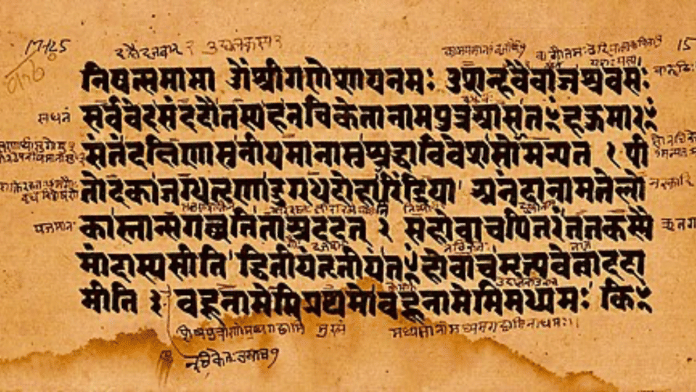
In a fast-paced world where human attention has become a heavily traded commodity, we do not need to look forward for solutions. Instead, we can look back. The Katha Upanishad is not an ancient relic meant to sit on a dusty shelf. It is, in reality, a high-performance field guide for the modern mind that addresses the daily mental commotion of being human. It provides a timeless toolkit to find the signal within the endless noise.
Long before Silicon Valley algorithms were engineered to keep us scrolling through the night, this ancient text identified two distinct paths that we face every single morning: Preya and Shreya. Preya, the pleasant, is the path of least resistance. It is the instant hit of a notification, a like, or sudden social validation. It acts as a temporary high that feels good for a fleeting second but ultimately leaves you hungry for more. Shreya, the good, is the path of long-term purpose. It is rarely easy, but it builds lasting character, resilience, and genuine peace.
Consider the classic trap of the infinite scroll. Many of us reach for our phones before we have even stepped out of bed. We immediately consume outrage, vanity bites, and endless updates. These habits provide a quick spike of engagement but leave the mind deeply agitated for the rest of the day. Wisdom is simply the hard-earned ability to pause and choose what is good over what is merely pleasant. When you consciously choose deep work over distracted browsing, you are actively practicing Shreya. In doing so, you move from being a passive consumer to becoming the primary creator of your own life.
If you have ever found yourself reaching for your phone or opening a new browser tab without knowing why, you have experienced a completely driverless moment. To audit this unsettling internal state, the Katha Upanishad uses a brilliant architectural metaphor of a chariot. The horses represent your senses, which naturally want to run toward every shiny object that crosses their path. The reins represent your mind; if the reins are left loose, the wild horses immediately take total control. The charioteer represents your intellect, which is your inner power of discernment and focus.
We see this play out in the modern corporate circus every day. Think of a manager who spends their entire day merely reacting to an overflowing inbox or a barrage of instant messages. Their senses are constantly pulled apart by the fear of missing out. Because their inner intellect is asleep, they spend their career reacting to stimuli instead of responding with strategic clarity. The ultimate goal of this philosophy is to wake up the driver. When your intellect is awake, your senses stop being liabilities and become genuine assets. You begin to use technology as a deliberate tool, rather than allowing it to drag your life into a ditch.
It is fascinating to see how contemporary productivity thought directly mirrors these ancient insights. Today, professionals regularly look to modern guides like Cal Newport and his framework of Deep Work to navigate digital noise. Newport argues that the ability to focus without distraction is a rare, valuable skill that must be trained intensely.
This is exactly what the Katha Upanishad proposed thousands of years ago. While modern authors use the clinical language of cognitive science, the Upanishad relies on the vivid metaphor of the charioteer and the horses. Both arrive at the exact same conclusion: if you do not master your attention, the world will gladly master it for you. For the contemporary seeker, reading this ancient text is like reading the original source code for every focus strategy available on shelves today.
To make these ancient hacks work in modern offices, a seeker must perform a regular forensic check-in. You can use three simple checkpoints to navigate the daily commotion. First is the impulse check: when you feel the sudden urge to react, ask if you are being led by the pleasant or the good. Are you chasing a quick hit of validation, or moving toward a deeper purpose? Second is the reins check: periodically stop and observe who is holding the reins. If your mind is frantically jumping from one worry to another, the reins are loose. Bringing your attention firmly back to the present moment is how you tighten them. Third is the driver check: is your intellect actively making choices, or is it running on autopilot? Habit is the driver of the unconscious mind, but deliberate discernment is the driver of the seeker.
Many people mistakenly believe that seeking clarity means leaving the corporate world behind to find a quiet space. The Katha Upanishad suggests the exact opposite. You can absolutely be involved in a fast-paced career and remain anchored in a silent core. The text famously mentions the razor’s edge. This is not an impossible demand for perfection; it is a call for dynamic balance. It is about being fully present in the commotion of life, but not becoming a victim of it.
When an architect is designing a highly complex structure, they achieve a state of total, anchored focus. They are not distracted by the construction noise around them. The Upanishad invites us to expand this high-performance state to our entire lives. You can handle an incredibly demanding career while maintaining a quiet, untouchable room within the heart.
Ultimately, this inner journey ends with a profound realization. You are not the chariot, and you are not even the driver. You are the one for whom the entire journey is being made. When you stop identifying with the speed of the horses, the mental commotion naturally subsides. You identify instead with the deep peace of the master. This is the ultimate art of remaining steady in a world that never stops moving.
The text issues a simple, timeless command to the modern professional: Arise! Awake! Arising means stepping out of the digital trance. Awaking means noticing exactly when your mind has been hijacked by external forces. By auditing our daily distractions, we stop being victims of circumstance and transform ancient wisdom into a highly practical modern manual.
These pieces are being published as they have been received – they have not been edited/fact-checked by ThePrint.