


Thank you dear subscribers, we are overwhelmed with your response. Your Turn is a unique section from ThePrint featuring points of view from its subscribers. If you are a subscriber, have a point of view, please send it to us. If not, do subscribe here: https://theprint.in/subscribe/
What good is an economics education if a student can explain poverty and unemployment but cannot understand a bank loan, calculate the actual cost of an EMI or prepare a household budget?
For decades, Indian school education has taught students about economic development, production, markets and public welfare. Yet the financial decisions that ordinary families make every day have received relatively little attention in mainstream textbooks.
That is beginning to change.
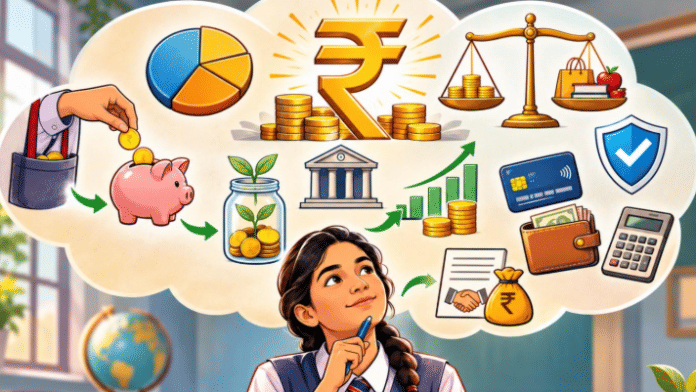
The National Council of Educational Research and Training (NCERT) has introduced two important chapters in its Class 9 Social Science textbook, Understanding Society: India and Beyond, Part II. “Managing Your Personal Finances” and “From Ideas to Startups” bring savings, investment, taxation, borrowing and entrepreneurship into the classroom.
This is a welcome reform. More importantly, it acknowledges something our education system has often overlooked: students must learn how the economy works for them, not merely how the economy works.
Sanjeev Sanyal has identified the real significance
Economist Sanjeev Sanyal, a member of the Economic Advisory Council to the Prime Minister, drew attention to these chapters through posts on X on 3 November 2026.
“The idea is to provide them with useful life skills,” Sanyal wrote while explaining the introduction of fixed deposits, mutual funds, EMIs, taxation and risk-return concepts.
His observation deserves attention.
For a country aspiring to become a developed economy by 2047, financial literacy cannot remain the privilege of commerce graduates, business professionals or investors. It must become part of general education.
A teenager may not immediately open a demat account or apply for a bank loan. But understanding financial responsibility before entering adulthood can prevent costly mistakes later. NCERT has therefore made a sensible educational choice by introducing these ideas at the secondary-school level.
From pocket money to EMIs: Economics enters everyday life
Consider the textbook’s example of purchasing a refrigerator.
Its cash price is ₹30,000. However, buying it through twelve monthly instalments of ₹3,000 raises the total expenditure to ₹36,000.
The additional ₹6,000 illustrates a fundamental financial lesson: manageable monthly payments do not necessarily mean an economical purchase.
Such examples can teach more than several pages of abstract definitions. Students will also learn about inflation, compound interest, savings instruments, insurance and the relationship between investment risks and potential returns.
This does not mean encouraging children to enter stock markets prematurely. It means helping them recognise the difference between saving and investing, understand uncertainty and appreciate financial planning.
The inclusion of income tax and GST is equally important. Taxation should be understood not merely as a deduction from personal income but as a contribution towards public infrastructure, services and national development.
Financial knowledge, properly taught, can strengthen responsible citizenship.
Sanyal’s entrepreneurship argument deserves serious attention
The second chapter, “From Ideas to Startups,” may have even greater long-term significance.
Sanyal welcomed its positive treatment of entrepreneurship, innovation and risk-taking. He contrasted this approach with earlier textbook portrayals that, in his assessment, emphasised hoarding and black markets.
His larger point is important, even if comparisons with earlier textbooks require historical context. For too long, Indian education has often encouraged students to think primarily about securing employment. Creating employment deserves equal recognition.
The new chapter introduces business planning, profit-and-loss accounts, pricing, marketing and basic enterprise management.
A lemonade stall at a school festival becomes an opportunity to understand investment, expenditure, revenue and profit. These are simple exercises, but their educational implications are substantial.
Students begin to understand that businesses are created through ideas, planning, effort, calculated risks and responsible decisions.
They also learn that failure, uncertainty and competition are part of economic life. India needs such entrepreneurial awareness, particularly when startups, family enterprises and micro, small and medium enterprises play an important role in generating employment.
NCERT deserves credit, but classroom implementation will matter
This reform also reflects the broader educational direction of the National Education Policy 2020 and the National Curriculum Framework for School Education 2023.
Both emphasise meaningful learning, critical thinking and the application of knowledge. NCERT deserves appreciation for translating these priorities into accessible textbook content.
However, introducing chapters is only the beginning.
Teachers must be equipped to explain investment risks, taxation, borrowing and entrepreneurship accurately. Classroom activities must reflect rural as well as urban experiences. Students should also learn about digital financial fraud, misleading investment schemes and excessive debt.
Financial literacy must never become an invitation to reckless speculation. Its purpose should be informed judgement.
Financially literate students can build a stronger India
India’s journey towards Viksit Bharat 2047 requires more than technological advancement and economic expansion. It requires citizens who understand financial choices and economic responsibilities.
A student who learns to prepare a budget today may become a financially responsible professional tomorrow. Another who understands the fundamentals of enterprise may eventually create employment for others.
Sanyal is right to recognise the significance of these changes, and NCERT deserves credit for making them part of school education.
The ultimate success of this reform will not be measured by how many financial terms students memorise. It will be measured by whether they learn to make better decisions.
India does not need students who merely know the definition of money. It needs young citizens who understand its value, responsibilities, opportunities and risks.
That is the real promise of NCERT’s new economics lessons.
These pieces are being published as they have been received – they have not been edited/fact-checked by ThePrint.