





Thank you dear subscribers, we are overwhelmed with your response.Your Turn is a unique section from ThePrint featuring points of view from its subscribers. If you are a subscriber, have a point of view, please send it to us. If not, do subscribe here: https://theprint.in/subscribe/
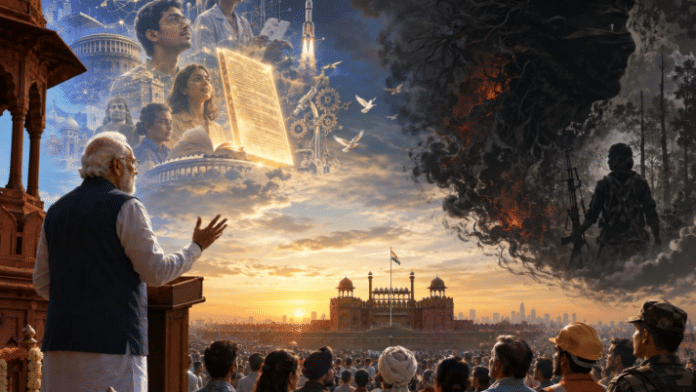
Prime Minister Narendra Modi’s use of the phrase “Dimagi Naxal” from the Red Fort has triggered a sharp political and intellectual debate. Writing in ThePrint, Shruti Vyas argues that the expression turns the Indian mind itself into an object of suspicion. She contrasts it with earlier national slogans such as Jai Jawan, Jai Kisan and Jai Vigyan and suggests that Modi has added to the national vocabulary not an aspiration, but an enemy to be identified and isolated.
The argument is forceful, but it misses the context in which Modi used the expression. The Prime Minister was not speaking about intellectuals, universities, journalists or ordinary political dissent. He was speaking about Naxalism and Maoist violence. The most important word in “Dimagi Naxal” is not Dimagi. It is Naxal.
Modi’s words must be read in context
In his Independence Day address, Modi referred to the damage caused by Naxalism and Maoism over several decades. He spoke of young lives destroyed, regions kept away from development and thousands of police and security personnel killed while fighting the insurgency. He then distinguished between the armed Naxal and the ideological Naxal.
His argument was simple. Armed Naxalism may be declining, but the ideas that justify violence, anarchy and armed revolution can survive even after the gun is weakened. It is this ideological space that Modi called the world of the “Dimagi Naxal”.
One may disagree with the terminology. One may question how widely the expression should be used. But it is unfair to interpret it as an attack on the Indian mind itself.
Criticism of Modi is not Naxalism
A professor who criticises Modi is not a Dimagi Naxal. A journalist who questions the government is not one. A student protesting unemployment or examination failures is not one. An opposition leader attacking government policy is not one. Democracy requires criticism. Universities require debate. Journalism requires scrutiny. Political opposition is part of the constitutional system.
The distinction begins elsewhere. It begins when intellectual arguments are used to justify political violence, romanticise armed revolution or present organisations that reject constitutional democracy as heroic movements of liberation.
Academic status does not make such arguments immune from scrutiny. The issue is not where someone teaches or writes. The issue is what kind of violence that person is defending or legitimising.
Violence also needs an intellectual justification
Armed movements do not survive only through weapons. They also survive through narratives. Someone has to explain the gun. Someone has to turn murder into “resistance”. Someone has to present armed revolution as emancipation. Someone has to describe the destruction of public institutions as part of a larger struggle. Someone has to make the perpetrator appear morally superior to the victim.
This is where Modi’s phrase deserves serious consideration. India has seen Maoist violence directed not only against the State but also against civilians, tribal communities, roads, schools and other public infrastructure. If the person carrying the weapon is clearly recognised as part of an armed movement, why should the ideology that repeatedly justifies such violence escape examination?
That is the question behind “Dimagi Naxal”.
Universities need freedom, but ideas can still be challenged
Universities must remain among the freest intellectual spaces in India. Students should be able to read Marx, Mao, Gandhi, Ambedkar, Savarkar and Aurobindo. They should debate nationalism, socialism, Hindutva, capitalism and the failures of governments without fear. Studying Maoism does not make anyone a Naxal. Researching tribal grievances does not make anyone anti-national. Criticising excesses by the State is a legitimate academic and democratic function.
But academic freedom cannot mean freedom from criticism.
If armed revolution is romanticised, if terrorism is presented as resistance, or if violence against democratic institutions is defended as morally legitimate, such arguments must be challenged. Universities should protect dissent, but they are not required to protect every ideological position from public scrutiny.
Historical memory also requires honesty
The debate has another dimension. India often demands complexity when discussing its past, and rightly so. But complexity should not become an excuse for sanitising destruction. If a ruler destroyed temples, historians should record it. If a regime persecuted communities, those victims should not disappear from the narrative simply because the subject is politically sensitive. Historical scholarship should neither demonise nor glorify. It should record evidence.
The same principle applies to contemporary violence. If terrorists kill civilians, the discussion cannot focus only on explaining the terrorist. If Maoists kill security personnel or tribal citizens, revolutionary vocabulary cannot make those deaths less significant.
Understanding violence is necessary. Romanticising it is not.
The phrase should not become a political shortcut
There is, however, a danger that the Modi government and its supporters must recognise. If “Dimagi Naxal” is used for every critic of the government, the expression will lose its meaning.
A serious term related to violent ideology cannot become another social-media insult. If every dissenter, historian, activist or opposition leader is casually described as a Dimagi Naxal, then legitimate concerns about intellectual intimidation will become justified.
The phrase must remain connected to the ideological defence, propagation or normalisation of Naxalite violence and political anarchy. That is a much narrower category than dissent.
Modi is warning against the idea behind the gun
Modi is not asking India to distrust thinking people. His own political vocabulary repeatedly celebrates innovation, technology, artificial intelligence, startups and the intellectual capacity of young Indians.
There is no contradiction between promoting the Indian mind and opposing an ideology that justifies political violence. India needs more thinking, more debate, better universities and stronger journalism. But intellectual freedom does not require intellectual innocence.
The armed Naxal is visible because he carries a weapon. The ideological defence of that weapon is harder to recognise. That is why Modi’s phrase has caused discomfort. But discomfort alone does not make the argument wrong. India should defend the freedom to think. It should also retain the freedom to question ideas that justify violence.
That is the debate “Dimagi Naxal” should begin.
These pieces are being published as they have been received – they have not been edited/fact-checked by ThePrint.