




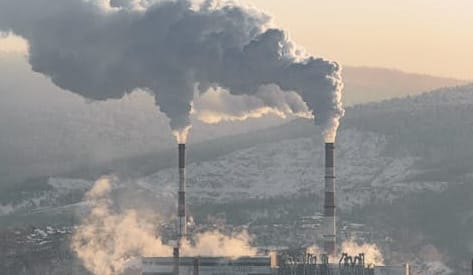

On a winter morning, the air in Byrnihat does not merely appear hazy. It feels heavy. Residents have become accustomed to waking up under a blanket of smog that obscures the surrounding hills. For many families, coughing has become routine, respiratory illnesses have become more frequent, and wearing a mask is no longer associated only with the pandemic.
It is a part of daily life. This is not a story of a spectacular environmental catastrophe. There was no explosion, no reactor meltdown, and no evacuation order. There are no abandoned buildings or exclusion zones. Life continues. Factories operate, trucks move relentlessly across state borders, markets remain busy, and children go to school.
That is precisely what makes Byrnihat so unsettling. There is a temptation to call it the “Chernobyl of India.” The phrase is dramatic and immediately captures attention. But it is also scientifically inaccurate.
The 1986 Chernobyl disaster was a nuclear accident that released radioactive material across Europe in a matter of hours. Byrnihat suffers from something different. Its crisis has accumulated gradually through years of industrial emissions, vehicular pollution, construction dust, and weak environmental governance.
The comparison that truly matters is not with a nuclear disaster but with the many industrial towns across the developing world where pollution has quietly become an accepted cost of economic growth.
Situated on the border of Assam and Meghalaya, Byrnihat has emerged as one of the most
important industrial clusters in the Northeast. Cement plants, ferroalloy factories, distilleries, steel-processing units, beverage manufacturers, pharmaceutical facilities and numerous medium-scale industries have transformed the local economy. Thousands depend on these industries for employment, directly or indirectly. The town also functions as a crucial logistics corridor connecting Guwahati with Meghalaya. Industrialisation has undoubtedly brought opportunities.
It has generated employment, strengthened regional supply chains, attracted investment and supported urban expansion. Few would dispute that industrial growth remains essential for India’s aspiration to become a global manufacturing economy.
Yet every model of development eventually faces a fundamental question.
Who bears its hidden costs? According to the 2024 World Air Quality Report published by IQAir, Byrnihat recorded an annual average PM2.5 concentration of 128.2 micrograms per cubic metre, making it the world’s most polluted metropolitan area for that year.
The figure is more than twenty-five times higher than the World Health Organization’s recommended annual guideline of 5 micrograms per cubic metre. These are not merely numbers on an environmental dashboard.
PM2.5 particles are small enough to penetrate deep into human lungs and even enter the
bloodstream. Medical research has consistently associated prolonged exposure with asthma, chronic obstructive pulmonary disease, cardiovascular diseases, stroke, lung cancer and premature mortality. Children, older adults and pregnant women remain particularly vulnerable.
Recent reports from local healthcare providers indicate a steady increase in respiratory
illnesses among residents. Doctors have observed growing numbers of patients complaining
of breathing difficulties, persistent coughs and allergic conditions. While individual illnesses
cannot always be attributed exclusively to pollution, decades of epidemiological research
leave little doubt that prolonged exposure to highly polluted air substantially increases health risks.
Unlike Delhi, however, Byrnihat rarely dominates national headlines. Every winter, television studios debate Delhi’s air quality, schools close temporarily, emergency measures are announced and pollution becomes a national conversation. Smaller industrial towns rarely receive similar attention despite facing equally severe or, in some cases, even worse pollution levels.
This disparity reflects a larger problem in India’s environmental discourse. Visibility often determines urgency. When pollution affects the national capital, it becomes a political issue. When it affects industrial towns inhabited largely by workers, transporters, vendors and lower-middle-class families, it is often treated as an unfortunate but inevitable consequence of development.
That assumption deserves to be challenged. Economic growth and environmental protection are not mutually exclusive objectives. Countries that industrialised successfully did not ultimately choose between development and clean air. They recognised that long-term prosperity depends upon protecting public health, investing in cleaner technologies and enforcing environmental regulations consistently.
India’s own environmental framework is reasonably comprehensive on paper. The Air
(Prevention and Control of Pollution) Act, environmental clearance mechanisms and
pollution control boards establish an institutional architecture for regulating emissions. The
problem frequently lies in implementation.
Byrnihat presents an additional governance challenge because it straddles the Assam-
Meghalaya border. Industries fall under different administrative jurisdictions while pollution
moves freely across them. Air does not recognise state boundaries. Regulatory fragmentation therefore creates opportunities for gaps in monitoring, coordination and enforcement.
The solution cannot be found through isolated interventions by individual departments.
Assam and Meghalaya should establish a permanent joint clean-air task force for the Byrnihat industrial region. Continuous emissions monitoring should become mandatory for highly polluting industries.
Air quality data should be publicly available in real time and communicated in language that ordinary citizens can understand. Independent environmental audits must be conducted regularly, with meaningful penalties for repeated violations rather than symbolic fines.
Industrial responsibility is equally important. Environmental compliance should not be viewed as an obstacle to business. Around the world, industries increasingly recognise that cleaner production technologies improve efficiency, reduce long-term costs and strengthen corporate credibility. Investments in emission-control equipment, dust suppression systems, cleaner fuels and better waste management are investments in sustainable productivity rather than regulatory burdens.
Transport policy also requires attention. Thousands of heavy vehicles pass through Byrnihat every day. Better freight management, improved road maintenance, stricter vehicle emission standards and dedicated logistics planning could significantly reduce suspended dust and vehicular pollution.
Public health interventions should accompany environmental reforms. Periodic respiratory
screening, mobile health clinics, school-based awareness programmes and long-term
epidemiological studies would help identify vulnerable populations while providing valuable
data for policymaking.
There is also an ethical dimension that often escapes policy discussions.
Those who experience the worst consequences of industrial pollution are rarely those who
benefit the most from industrial profits. Factory workers, truck drivers, roadside vendors, tea stall owners, daily wage labourers and nearby residents spend years breathing polluted air without the financial resources to relocate or access specialised healthcare. Pollution
therefore reinforces existing inequalities by disproportionately affecting those with the fewest choices.
This is not merely an environmental issue. It is a question of social justice. Clean air should not become a privilege available only to affluent neighbourhoods while industrial communities are expected to sacrifice their health in the name of national
development. Byrnihat should not become another place that policymakers remember only after irreversible damage has occurred.
India today stands at a decisive moment in its economic history. Manufacturing expansion,
industrial corridors and infrastructure development will define the coming decades. These
ambitions are legitimate and necessary. But if industrial policy does not integrate
environmental accountability from the outset, many more Byrnihats will emerge across the
country.
History teaches us that societies often recognise environmental disasters only after they
become impossible to ignore. Byrnihat offers India an opportunity to act before that point arrives.
The lesson of this town is not that it resembles Chernobyl. It is that environmental crises in
the twenty-first century are often quieter than those of the twentieth. They do not always
announce themselves through explosions or spectacular images. They accumulate slowly
through every factory chimney left unchecked, every overloaded truck carrying dust across
highways, every monitoring failure, and every breath taken by people who have little choice but to inhale polluted air. That is what makes Byrnihat more than a local story.
It is a national warning. The question is whether we are prepared to listen before the warning becomes a tragedy.
These pieces are being published as they have been received – they have not been edited/fact-checked by ThePrint.