





Thank you dear subscribers, we are overwhelmed with your response.
Your Turn is a unique section from ThePrint featuring points of view from its subscribers. If you are a subscriber, have a point of view, please send it to us. If not, do subscribe here: https://theprint.in/subscribe/
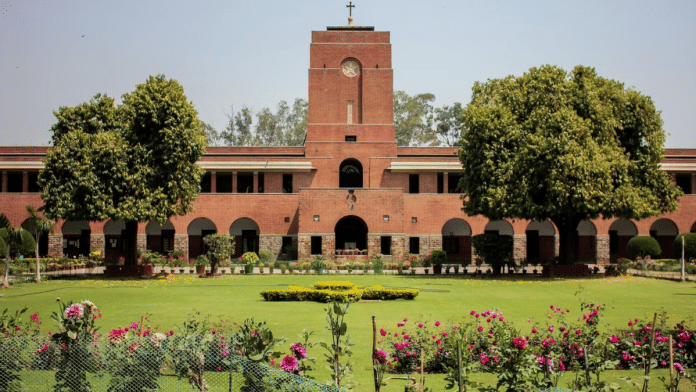
Delhi University’s transformation under Prof. Yogesh Singh is usually discussed through CUET, NEP 2020, UGCF, FYUP, digital admissions and academic reform. Yet the strength of a public university is also visible in its infrastructure: classrooms, laboratories, smart classes, cultural spaces, sports facilities, auditoriums and public gathering spaces.
A university becomes future-ready only when policy finds physical and digital spaces through which students can learn, research, perform, debate and grow. DU’s infrastructure shows that its recent transformation is not merely administrative. It is academic, technological, cultural and physical.
A Vast Academic Spread
Delhi University is a vast public academic system with teaching-learning facilities across major faculties and departments. Its classrooms and laboratories extend across Applied Social Sciences and Humanities, Commerce and Business Studies, Education, Law, Arts, Science, Technology, Mathematical Sciences, Interdisciplinary and Applied Sciences, Music, Management Studies, Open Learning and Social Sciences.
This range tells the story of DU’s scale. Its infrastructure supports Finance and Business Economics, Commerce, Education, Law, Arabic, Buddhist Studies, Germanic and Romance Studies, Hindi, Library and Information Science, Linguistics, Modern Indian Languages and Literary Studies, Persian, Philosophy, Psychology, Punjabi, Sanskrit, Slavonic and Finno-Ugrian Studies, Urdu and English.
In the sciences, it supports Anthropology, Botany, Chemistry, Environmental Studies, Geology, Home Science, Nursing, Pharmacy, Physics and Astrophysics, and Zoology. In technology and mathematical sciences, it supports Computer Engineering, Electrical Engineering, Electronics and Communication Engineering, Computer Science, Mathematics, Operational Research and Statistics.
The spread continues through Biochemistry, Biophysics, Electronic Science, Genetics, Microbiology, Physical Education and Sports Sciences, Plant Molecular Biology, Music, Fine Arts, Business Management and Industrial Administration, Distance and Continuing Education, Adult Continuing Education and Extension, African Studies, Delhi School of Journalism, East Asian Studies, Economics, Geography, History, Political Science, Social Work and Sociology.
Multidisciplinary Education Needs Infrastructure
This is the physical base of academic scale. Under Prof. Yogesh Singh’s leadership, DU’s reform journey must be understood not only through admissions and curriculum, but through the university’s capacity to support an extraordinary range of disciplines.
NEP 2020 speaks of multidisciplinary, flexibility and holistic education. DU’s infrastructure gives these ideas a working foundation. A multidisciplinary university needs departments, laboratories, classrooms, digital facilities and cultural spaces. Without infrastructure, reform remains a document. With infrastructure, reform becomes student experience.
Smart Classes and Digital Learning
Delhi University has 29 smart-class and LMS-related facilities across departments and units. These include Library and Information Science, Philosophy, Punjabi, Botany, Environmental Studies, Geology, Physics and Astrophysics, Zoology, Computer Engineering, Electrical Engineering, Electronics and Communication Engineering, Computer Science, Business Management and Industrial Administration, Adult Continuing Education and Extension, East Asian Studies, Economics, Geography, History, Political Science and Sociology.
This is significant because a university of DU’s size cannot run on old systems alone. Smart classrooms and LMS facilities connect teaching with technology, modernise learning and support the wider digital direction of the university.
Under Prof. Yogesh Singh, this technological orientation fits naturally with DU’s movement toward CUET-CSAS, digital portals, AI-readiness and system-based governance. Technology is not decorative in a university of this scale. It is academic infrastructure and governance infrastructure together.
Cultural Spaces and Public Life
DU’s infrastructure also supports cultural life. Cultural facilities are available in Arabic, Buddhist Studies, Germanic and Romance Studies, Anthropology, Botany, Modern Indian Languages and Literary Studies, Philosophy, Economics, Gandhi Bhawan and Peace Dome Gandhi Bhawan.
The university also has important spaces such as the Conference Centre, Sir Shankar Lal Concert Hall and Tagore Hall. This cultural infrastructure is central to the idea of a public university. Students do not grow only through lectures and examinations. They grow through seminars, music, theatre, debate, public lectures, cultural programmes and intellectual exchange.
A university with such cultural spaces creates citizens, not merely degree-holders. This is where DU’s infrastructure supports the broader spirit of holistic education.
Sports and Gathering Capacity
Delhi University also has strong sports and public-event infrastructure, including the Delhi University Sports Council Indoor Stadium, badminton court, multipurpose hall, boxing hall, outdoor stadium and gymnasium.
The seating-capacity data gives a concrete picture of DU’s scale. The Multipurpose Hall on the ground floor of the University Stadium can accommodate 3000 to 4000 persons. The Multipurpose Hall in the basement can accommodate 2000 to 3000 persons. The Conference Centre near Gate No. 4 in North Campus has a capacity of 250 to 300 persons. Satyakam Bhawan in Social Science can seat 300 to 350 persons.
Shankar Lal Concert Hall in the Music Faculty can accommodate 400 to 500 persons. The ILLL Auditorium in the ARC Building has a capacity of 250 persons. Room No. 22 in the Arts Faculty Building can seat 300 persons. Rugby Stadium has a capacity of 1000 persons. Tagore Hall can seat 300 persons. Polo Ground has a capacity of 1000 persons. Open spaces around Arts Faculty and Social Science departments further support academic and cultural activity.
Leadership of Academic Scale
These figures are not dry numbers. They show the living capacity of Delhi University. DU can host large academic programmes, cultural events, student gatherings, conferences, sports activities and public functions. It has the space to bring together students, teachers, alumni, policymakers and society.
Prof. Yogesh Singh’s leadership matters here because DU’s transformation is not one-dimensional. CUET changed admission. NEP changed academic structure. UGCF and FYUP changed the undergraduate imagination. But infrastructure gives these reforms a working foundation.
A student admitted through CUET ultimately needs a classroom. A student studying under NEP needs course spaces, laboratories and guidance. A student developing creativity needs cultural platforms. A student seeking holistic education needs sports and public spaces.
Delhi University’s infrastructure therefore reflects the leadership of academic scale. Under Prof. Yogesh Singh, DU is not only carrying inherited prestige; it is preparing itself for the future. Its classrooms, laboratories, smart classes, cultural centres, stadiums and auditoriums show that a great public university must be built intellectually, physically, culturally and technologically at the same time.
These pieces are being published as they have been received – they have not been edited/fact-checked by ThePrint.