





Thank you dear subscribers, we are overwhelmed with your response.
Your Turn is a unique section from ThePrint featuring points of view from its subscribers. If you are a subscriber, have a point of view, please send it to us. If not, do subscribe here: https://theprint.in/subscribe/
A Fresh Controversy, An Older Question
The Bharuch Jama Masjid has again come under public attention after reports in June 2026 said that the Archaeological Survey of India removed an unauthorised wajukhana inside the protected monument and sealed its rear entrance. ASI officials reportedly said the action was taken according to prescribed rules for a protected structure. The immediate issue may appear administrative, but the larger question is historical: what does the monument itself reveal about Bharuch’s older Hindu-Jain sacred past?
Bharuch Is Not an Ordinary Site
Bharuch, historically known as Bharukachchha, is one of western India’s oldest urban and sacred landscapes. It was not merely a medieval town but an ancient port, a civilisational centre, and a region associated with deep Hindu and Jain memories. Therefore, any discussion of the Jama Masjid cannot be reduced to present-day politics alone. The monument stands within a much older historical geography.
The Official Record
The Bharuch district administration’s own website describes the Jama Masjid as situated on the hilltop of Bharuch Fort and states that it is believed to have been built in the 14th century AD. More importantly, it records that the most notable aspect of the mosque is that it was constructed from the remains of an ancient Jain temple.
This matters. The claim is not merely a religious slogan or emotional assertion. It appears in an official public description of the monument.
The 1896 Archaeological Source
The strongest archival source is James Burgess’s 1896 volume, On the Muhammadan Architecture of Bharoch, Cambay, Dholka, Champanir, and Mahmudabad in Gujarat, published in the Archaeological Survey of Western India, Vol. VI. Burgess was not a modern political activist. He was a respected archaeological scholar and former Director-General of the Archaeological Survey of India. His account therefore deserves serious attention.
In his description of the Bharuch Jami Masjid, he records that after the early campaigns associated with Ala-ud-din Khilji, the mosque was probably founded on the site of one of the destroyed Hindu temples and was built chiefly from the materials of Hindu and Jaina shrines.
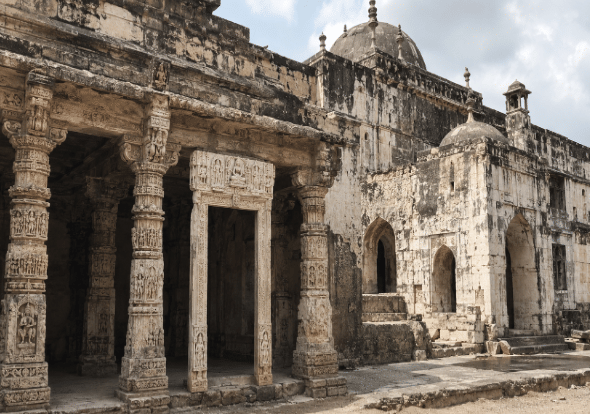
His key observation is that the mosque incorporated material from “Hindu and Jaina shrines.” Even more significantly, he identifies the marble doorway leading into the court as plainly belonging to a Jaina temple, with the Jina symbol still recognisable on the lintel.
The Jina on the Lintel
This is the most important evidence. A Jina symbol is not a vague decorative mark. It is a specifically Jain sacred sign. If such a symbol was visible on a reused doorway inside the mosque complex, it strongly establishes the presence of Jain temple material before the construction or modification of the mosque. Burgess also describes pillars, brackets, slabs and small domes that appear to have been taken from earlier Hindu or Jaina structures. He notes that animal figures were mostly removed from the ornamentation. These are not casual details. They are architectural clues of reuse, alteration and historical layering.
What Can Be Safely Claimed
A responsible Hindu argument must be firm but careful. The evidence strongly supports the claim that the Jama Masjid of Bharuch contains architectural material from earlier Hindu and Jaina shrines. It also supports the claim that at least one identifiable Jain temple element, the marble doorway with a recognisable Jina symbol, was incorporated into the structure.
However, unless further scientific investigation is carried out, one should avoid claiming the exact name, full plan, patronage or date of the original Jain temple. The stronger and safer claim is this: Bharuch Jama Masjid preserves visible material evidence of an earlier Hindu-Jain sacred structure.
Recognition Is Not Revenge
From a Hindu perspective, the demand should not be for revenge, disorder or street confrontation. The demand should be for recognition. If a protected monument contains Hindu and Jain sacred remains, those remains should be documented, preserved and acknowledged.
ASI has acted against alleged recent unauthorised construction. That is welcome if the monument is protected. But the same seriousness must also be shown towards the older architectural layers of the site. Every pillar, bracket, lintel, slab, dome, inscription and iconographic trace should be scientifically documented through photography, 3D scanning, epigraphic study and conservation mapping.
Let the Monument Speak
The Bharuch Jama Masjid is not only a place of later worship. It is also an archive of conquest, reuse, survival and memory. Its Hindu-Jain elements should not be hidden under the fear of controversy. A mature republic must have the courage to read history as it survives in stone.
The Hindu perspective asks for neither exaggeration nor erasure. It asks only that archaeology be allowed to speak, that official records be taken seriously, and that India’s civilisational memory be treated with dignity.
Reference
James Burgess, On the Muhammadan Architecture of Bharoch, Cambay, Dholka, Champanir, and Mahmudabad in Gujarat, Archaeological Survey of Western India, Vol. VI, London: Wm. Griggs & Sons, 1896.
Submitted by: Prof. (Dr.) Hitesh D Raviya, Vice Dean and Professor of English, Faculty of Arts, The Maharaja Sayajirao University of Baroda.
These pieces are being published as they have been received – they have not been edited/fact-checked by ThePrint.