


Thank you dear subscribers, we are overwhelmed with your response.
Your Turn is a unique section from ThePrint featuring points of view from its subscribers. If you are a subscriber, have a point of view, please send it to us. If not, do subscribe here: https://theprint.in/subscribe/
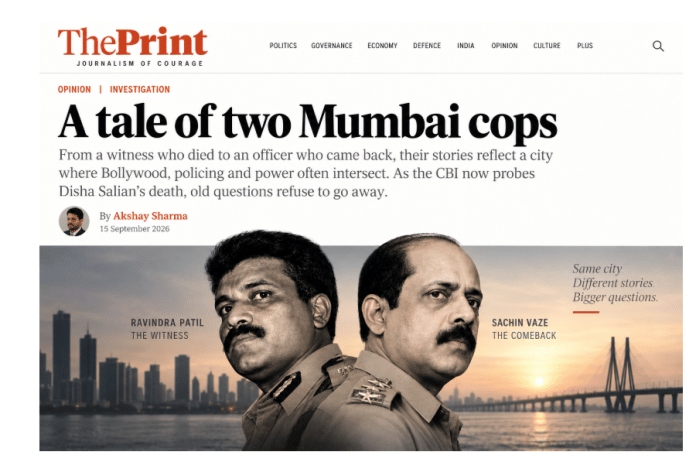
One was a Jawan who became a Mumbai Constable and was silenced after he became a witness. The other was a policeman who became the story in multiple murders, and became a star in TV Commentary, books, film and politics. Their paths crossed the turbulent underbelly of Mumbai’s police, politics and celebrity worlds. The questions surrounding both remain.
Mumbai has always been a city where Bollywood, politics, business and the police intersect. Sometimes those intersections are perfectly innocent. Sometimes they demand scrutiny.
Consider Ravindra Patil and Sachin Vaze.
Their stories are not proven to be connected. But their trajectories—and the people around them—raise questions that are difficult to ignore.
Patil was the police constable who became Salman Khan’s bodyguard and driver and subsequently a crucial prosecution witness in the 2002 Bandra hit-and-run case. His testimony was damaging to Khan. Patil’s life later deteriorated, and he died in 2007.
That same year, Sachin Vaze left Mumbai Police after years of suspension arising from the Khwaja Yunus custodial-death case.
Yunus, a young software engineer arrested in connection with the Ghatkopar bombing, was reported by police to have escaped while being transported after a vehicle accident. A subsequent CID investigation alleged that Yunus had died in custody and that the escape story was false.
Vaze was arrested and suspended.
He eventually resigned in November 2007.
Patil died in 2007.
Vaze disappeared from formal policing—but apparently not from the ecosystem of power.
For the next decade. Vaze moved through politics, technology, security, media and investigative work. Then, in June 2020, during the Covid crisis, he was reinstated.
Within days he was working in the Crime Intelligence Unit.
That raises the first question:
Who wanted Vaze back?
But there is another name that keeps appearing in this story: Param Bir Singh.
In June 2020, the committee headed by then Mumbai Police Commissioner Param Bir Singh approved Vaze’s reinstatement.
And there was already a documented Bollywood-police connection involving Singh.
In 2012, Mid-Day reported—and OpIndia subsequently reproduced—that Salman Khan attended a Christmas party at which then Special IGP Param Bir Singh was also present. The party reportedly continued until the early morning hours. This was significant because Bandra police had been unable to serve Khan with summons in the hit-and-run case, saying he was out of town.
One should not infer wrongdoing from attending a party.
But journalism is about examining relationships when they become relevant to subsequent events.
And then comes KWAN.
In November 2018, Salman Khan’s talent company Uniworld Being Talented (UBT) took a strategic stake in Big Bang Media Ventures, described at the time as the holding company of KWAN. Contemporary reports said the arrangement gave KWAN access to UBT’s talent—including Salman Khan—while UBT gained access to KWAN’s talent-management infrastructure and services.
In 2020, KWAN suddenly became relevant to the wider Sushant Singh Rajput investigation because several people in Rajput’s professional orbit had connections to the talent-management ecosystem.
Now fast-forward six years.
The Bombay High Court has ordered a CBI investigation into the death of former KWAN employee Disha Salian, directing investigators to examine all aspects surrounding the circumstances in which she lost her life.
And on September 14, 2026, the CBI registered an FIR naming, among others, Param Bir Singh, Sachin Vaze, Rhea Chakraborty, Sooraj Pancholi and several other individuals for investigation.
So the story is no longer simply about whether Sushant Singh Rajput died by suicide.
It is about reconstructing a network.
Who knew Disha?
Who knew Sushant?
Who managed whom?
Who spoke to whom?
Who controlled the investigation?
Who was reinstated—and who authorised it?
Who was present when?
And why did investigators initially accept narratives that the High Court later found sufficiently problematic to warrant a fresh CBI investigation?
The most dangerous mistake would be to manufacture answers.
The most important journalistic act may be to preserve the questions.
Ravindra Patil was a witness who became marginalised.
Sachin Vaze was a policeman who became the subject of investigation.
Param Bir Singh moved between the worlds of policing and Mumbai’s powerful social ecosystem.
KWAN sat at an important intersection of Bollywood talent management.
And six years after Disha Salian’s death, the CBI has finally been ordered to examine the case afresh.
Perhaps the real story is not a conspiracy waiting to be announced.
Perhaps it is a system waiting to be mapped.
Because when the same names, institutions and networks repeatedly appear around different stories, the responsible question is not:
“What is the conspiracy?”
It is:
“What, exactly, happened—and why did it take six years to ask?”
Akshay Sharma is a former Gartner analyst and is a board member of Somy Ali’s nonprofit No More Tears, with over 40 published essays in ThePrint.IN. He is the author of multiple books to be published in 2027.
These pieces are being published as they have been received – they have not been edited/fact-checked by ThePrint.