


Thank you dear subscribers, we are overwhelmed with your response. Your Turn is a unique section from ThePrint featuring points of view from its subscribers. If you are a subscriber, have a point of view, please send it to us. If not, do subscribe here: https://theprint.in/subscribe/
The incidents related to the ball tampering scandal of 2018 when Australia used sandpaper to tamper with the ball have been thrust into the news by Usman Khawaja’s biography recently. No one will dispute that tampering with the ball to gain advantage has been done since the invention of cricket, but it is far from clear what is allowed and what is not. Taking care of one side of the ball to aid swing can be done using proper means, but undoubtedly there are also improper means of doing so that go against the laws of the game. The key issue here is that using sandpaper is blatantly unfair, and well outside the realm of what could be considered acceptable.
Opinions are heavily divided, with each side convinced their “side” is right and the other one is wrong. In this article, we argue that no one comes out of this saga on the right side, and it is a story of flawed men making flawed decisions, sometimes understandably and at other times, shamefully. Let us look at the people involved and their roles in this saga.
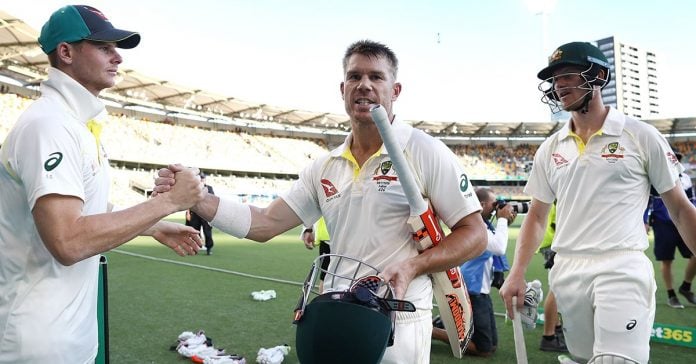
Smith, Warner and Bancroft: Bancroft used sandpaper on the field and Smith and Warner were the captain and vice captain at the time, and thus responsible for team culture. So, there is no doubt that those three ought to have been sanctioned. People argue that their punishment was too harsh, but to counter, the cheating was so blatant and so embarrassing in front of the whole world, that it became a black mark on Australian culture and an entire nation’s self image. So, there is no doubt that these players ought to have been punished, but the question will be asked about whether others also deserved to be sanctioned publicly.
Khawaja and Sayers: These are two players that have come out and said that they knew about the use of sandpaper by the Australian team. Their willingness to speak out should be welcomed and any other motivations like selling books are not really major factors for international cricketers. One can understand their decisions to not speak out publicly in 2018 since that would have potentially ended their careers. In Khawaja’s case, he was also from a non-white Pakistani immigrant family, and spoke eloquently about his challenges in Australian society, thus making it harder for him to both fit in and speak out. However, one could ask if they should have pushed harder for collective responsibility in 2018, as well as question the narrative that they felt sorry for the players that were banned, because they did not do anything at the time to speak up for them even internally to the Australian board as they were being sent to the gallows.
The bowlers and the rest of the Australian squad at the time: No one knows at the time of writing what anyone else knew or did not know definitively, leading to rampant speculation. However, if sandpaper was used to tamper the ball in the prior Test match of that series (as Khawaja claimed) and the resulting reverse swing won Australia that game, it seems quite unlikely that anyone (especially the bowlers) would a) not know the ball was tampered and b) not have the curiosity to know how it was done. This is in addition to what went on in the infamous Cape Town Test of course, where similar questions could be asked about how the rest of the squad would not have known what was happening. Their only defence would be that ball tampering was happening all over the world at all levels of the game, but the key difference is the completely blatant use of sandpaper; anyone who knew that was going on deserved some sort of sanction at the time, even if it was lighter than the heavy bans handed out to their teammates. Did they really deserve to escape with zero blame when their colleagues had their reputations tarnished for the team ?
Finally, the Australian administrators also have plenty of blame to shoulder. They probably panicked when this scandal went from sports page news to front page headlines with the Australian PM even commenting about it. In their keenness to sweep matters under the carpet with minimal damage done to the team, they made scapegoats of the three banned players. In the intervening years (or even now), they could have promised that no one would be sanctioned for speaking the truth and allow some honesty and integrity to come out, but they refuse to do so. In many ways the players are paying the price for their mistakes and as Cummins said, many lives are being affected over years. In politics, they say that the cover up often makes matters worse than the crime, and one cannot help but think that is the case here.
These pieces are being published as they have been received – they have not been edited/fact-checked by ThePrint.