




Thank you dear subscribers, we are overwhelmed with your response.
Your Turn is a unique section from ThePrint featuring points of view from its subscribers. If you are a subscriber, have a point of view, please send it to us. If not, do subscribe here: https://theprint.in/subscribe/
Language has always been the frontline of political statecraft. Long before laws are passed or elections are fought, political battles are won or lost in the dictionary.
In the Arthashastra, Chanakya emphasized that precise communication (Mantra-Siddhi) is a core pillar of state administration. He warned that when political terminology loses its clear definition, a ruler loses the ability to distinguish genuine security threats from ordinary governance issues.
In modern India, we are witnessing a dangerous breakdown of this classical rule of statecraft. Foundational words of our constitutional and security discourse—specifically “secularism” and “Naxal”—have been stripped of their analytical precision and transformed into functional slurs.
The Degradation of “Secularism”
When India’s Constitution was framed, secularism (Panth-Nirapekshata) was designed as a pragmatic tool of statecraft. In a diverse, deeply religious society, the state had to remain neutral, acting as an impartial referee between competing communities.
As Dr. B.R. Ambedkar warned in November 1949, “constitutional morality” is not a natural sentiment; it has to be cultivated. Over the decades, however, mainstream political parties compromised this ideal. In pursuit of vote-bank politics, “secularism” often morphed into opportunistic policies and political expediency. This opened the door for a massive counter-narrative.
By the 2010s, political strategists successfully popularised terms like “pseudo-secularism,” which quickly degraded on social media into the slur “Sickular.”
The strategic objective was clear: don’t just attack bad policies; delegitimise the constitutional concept itself. Today, invoking “secularism” in public debate rarely leads to a discussion on state neutrality. Instead, it is used as a rhetorical shortcut to label someone as anti-majority, out of touch, or peddling an imported Western ideology unfit for India.
The Inflation of the “Naxal” Label
A similar linguistic shift happened with security terminology.
Historically, a “Naxalite” had a precise definition. It described an armed insurgent belonging to far-left, anti-state groups operating in the forests of central and eastern India. It was a specific internal security classification.
Over the last decade, the word was deliberately unmoored from the jungles of Bastar and brought into cities, universities, and newsrooms. The coining of phrases like “Urban Naxal” expanded the term far beyond armed rebels.
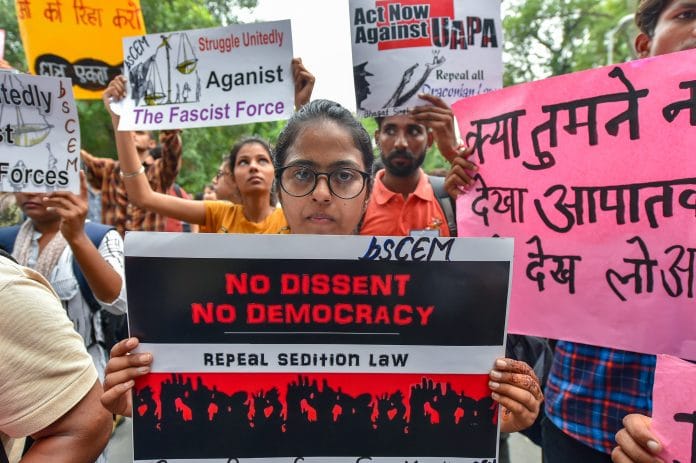
In popular political debate today, the “Naxal” label is frequently thrown at environmental campaigners, human rights lawyers, student activists, and political dissidents.
The strategy here is rhetorical efficiency. Accusing a critic of having a flawed economic theory takes time and evidence. Labelling them a “Naxal” instantly frames them as a violent, anti-national threat to the republic.
Why This Matters for Indian Statecraft
When political discourse reduces constitutional ideals and security terms into cheap insults, it harms governance in three distinct ways:
- It Collapses the Middle Ground: By turning nuanced concepts into binary slurs, it forces citizens into extreme camps. You are either entirely with the prevailing narrative, or you are branded a traitor and a subversive.
- It Shields the State from Critique: When environmental or policy dissent is labelled as “Naxalism,” the government no longer has to answer tough questions about land acquisition, tribal rights, or administrative failures. The debate shifts from governance performance to national security.
- Linguistic Exhaustion: When foundational words like “secularism” are successfully mocked, moderate voices stop using them. The state slowly surrenders the very vocabulary needed to maintain a pluralistic, law-governed society.
The Bottom Line
Words are not harmless. When political campaigns weaponize vocabulary to turn constitutional principles into pejoratives, they might win short-term electoral cycles, but they degrade long-term democratic statecraft.
A confident republic must heed both Chanakya and Ambedkar: we must debate secularism without falling into slurs, and fight actual insurgencies without branding every peaceful critic an enemy of the state.
These pieces are being published as they have been received – they have not been edited/fact-checked by ThePrint.