




Open any Punjabi playlist. The genre that produced Diljit Dosanjh, AP Dhillon, and Sidhu Moosewala — and now saturates every Bollywood party track and NRI wedding — is a billion-dollar global export. If you understand Punjabi, you’ll notice something. A word recurs in the lyrics with unusual frequency: “Jatt”. Sometimes “Jatta”, sometimes whole song titles — “Jatt Da Muqabla”, “Issa Jatt”, “Jatt Fire Karda”, “Moosa Jatt”. It is not a whisper. It is worn as a crown.
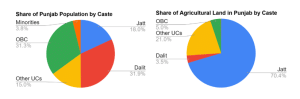
The Jat community is the dominant landowning caste of Punjab — roughly 18-20% of the population, estimated to own around 80% of the state’s agricultural land. Nevermind their self-proclaimed OBC status or demands to be included in OBC quotas –- which the National Commission for Backward Classes has rejected — they are no doubt the most dominant caste in Punjab.
So what does Punjab’s dominant caste sound like when it celebrates itself?
Like Sidhu Moosewala’s “Jatt Da Muqabla”, which pairs “big hearts and wide open lands” with “crime’an aale scene’an aale” — “associated with crime scenes” — in the same chorus. Like “Moosa Jatt”, whose entire premise is a Jat surname as a gangster brand, presented without irony. Like “Bambiha Bole”, which frames Jat masculinity through weapons and territorial control. Like “Jatt Fire Karda”, which celebrates the community’s capacity for violence as honour, not pathology. The Jat in these songs is not merely proud — he is armed, he is dangerous, and this is the point. This is not pastoral nostalgia. It is a recurring assertion that dominance is deserved and that force is how it is maintained. This is not just my impression. It can be quantified, as follows.
I reviewed every song released in 2025 by the five most-streamed Punjabi artists on Spotify India — Karan Aujla, Diljit Dosanjh, AP Dhillon, Shubh, and Sidhu Moosewala. The shortlist is not mine: it is Spotify Wrapped India 2025. The scope covers all 57 songs on which these artists appeared as lead or co-lead across the calendar year. The test is binary: does the song contain the word “Jatt/Jat”, or an explicit caste-identity claim, verified against a published lyrics source?
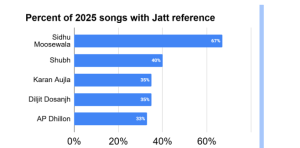
Result: 21 of 56 songs reviewed — 37.5% — contain an explicit Jat caste reference.
Now the context those songs swim in.
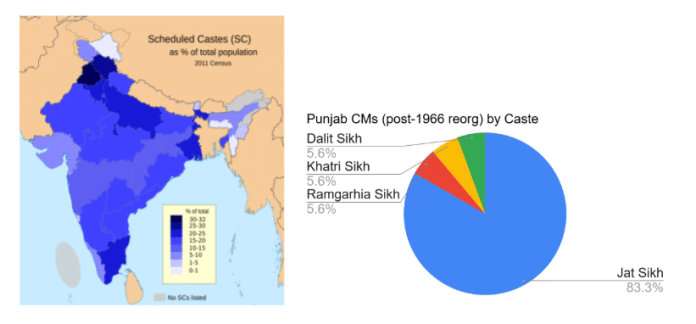
Punjab has the highest proportion of Scheduled Caste population of any Indian state — 31.94%, per the 2011 Census. One in three Punjabis is Dalit. These communities own 3.5% of its private farmland. Fully 94.2% of rural Dalit households have no cultivable land at all. In the Indian state with the largest Scheduled Caste population, Dalits had simply never held power.
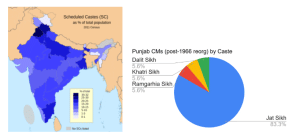
The irony cuts deepest at the gurdwara. Sikhism was founded in explicit rejection of caste — Guru Nanak composed against the varna system; the Guru Granth Sahib contains verses by Ravidas, a Dalit cobbler by birth. In practice, in dozens of Punjab villages today, Dalit Sikhs cannot enter the main gurdwara. In Dhanaula in Sangrur district, two gurdwaras operate side by side — one for Jats, one for Dalits. The SGPC, the apex Sikh religious body, felt compelled to launch an official “One Village, One Gurdwara” campaign in 2018. The need for such a campaign tells you everything about the scale of the problem.
When Dalit artists have tried to create their own cultural space — Ginni Mahi, Roop Lal Dhir, others asserting Ambedkarite and Ravidassia identity — their music was categorised by critics and industry insiders under a label that uses a caste slur in its name: “Chamar Pop.” The naming of the counter-movement after a slur is itself the argument.
When every song tells you the Jat is the hero, the landowner, and the armed enforcer of local order, and the communities that constitute a third of the state are erased from the cultural landscape entirely — that is not music. That is a political argument delivered through a speaker.
In August 2024, a Bengaluru CEO named Anuradha Tiwari posted “Brahmin genes 💪” on X. The post hit 2 million views. Supreme Court advocates weighed in. National newspapers ran the story for days. A woman most of India had never heard of triggered a full national conversation about caste supremacism within 48 hours.
Now consider what you have just read. Not one tweet. Not one person. Thirty-seven percent of the most-streamed Punjabi music in India in 2025 — songs played at your weddings, your parties, your gym — contains an explicit assertion of Jat caste identity, by artists with tens of millions of followers, many of them invoking that identity alongside weapons, territory, and the threat of violence.
Where is that conversation?
Sources:
- Wikipedia: Demographics of Punjab, India
- Harish Damodaran, India’s New Capitalists (2008)
- Punjab Economic Survey 2018–19 citations
- Journalistic reporting in The Hindu, The Indian Express
- 101Reporters: SGPC wakes up to casteism among Sikhs, asks Punjab villages to tear down caste walls in gurudwaras