



Thank you dear subscribers, we are overwhelmed with your response.
Your Turn is a unique section from ThePrint featuring points of view from its subscribers. If you are a subscriber, have a point of view, please send it to us. If not, do subscribe here: https://theprint.in/subscribe/
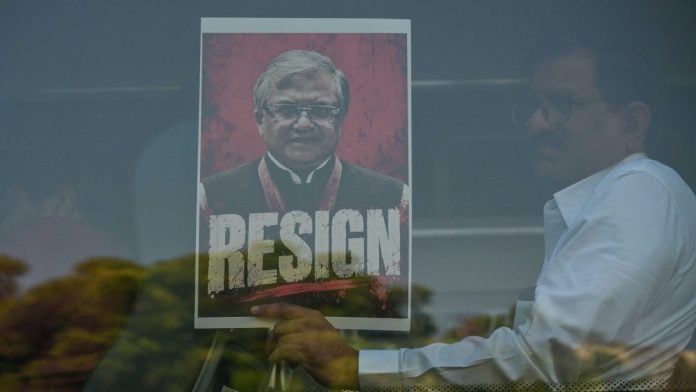
At Mumbai’s Shivaji Park, the Cockroach Janta Party’s Abhijeet Dipke has a resignation demand and a destination. Chief Election Commissioner Gyanesh Kumar must go, he says, and if Narendra Modi wants to divide people on religion, “he can go to Pakistan.” Hindus and Muslims, Dipke adds, must stand together or the country will not prosper. The line is built for a clip. The history it skips is not.
On “vote chori,” India does not need a new slogan. It already has a verdict.
In April 1946, twelve of the fifteen Provincial Congress Committees nominated Sardar Vallabhbhai Patel for Congress president — the post that, by the practice of the time, pointed to the first premier of free India. No committee nominated Jawaharlal Nehru. Mahatma Gandhi preferred Nehru. Patel withdrew. Nehru was elected unopposed. Michael Brecher, one of Nehru’s more sympathetic biographers, later wrote that if Gandhi had not intervened, Patel would have been the first de facto premier of India. That is the organisational record, not a rumour.
The only Indian prime minister a court convicted of electoral malpractice is Indira Gandhi.
On 12 June 1975, Justice Jagmohanlal Sinha of the Allahabad High Court held that her 1971 election from Rae Bareli was void. She was guilty under Section 123(7) of the Representation of the People Act of obtaining the assistance of a gazetted officer, Yashpal Kapoor, and of government officers arranging rostrums and barricades for her campaign. The court disqualified her from elected office for six years. Raj Narain, the man she had beaten by more than a lakh votes, had spent four years proving what the slogan now calls vote chori.
She did not resign. On 25 June 1975 she declared a state of Emergency. Opposition leaders were jailed. The press was censored. Parliament amended the election law and the Constitution while she was still under that judgment. In November 1975 the Supreme Court set aside the conviction, after the rules had been rewritten underneath the case. The court also struck down the clause that tried to place her election beyond judicial review. The legal end did not erase the political beginning: a sitting prime minister, convicted of corrupt electoral practice, answered the court by suspending democracy.
The Emergency was not only a press blackout. Sanjay Gandhi’s sterilisation drive became state policy. Banks had already been nationalised. IBM and Coca-Cola left under the Foreign Exchange Regulation Act. Maruti, a project tied to her son, sat at the centre of a family-run political economy. In 1984, Operation Blue Star sent the Army into the Golden Temple; her assassination followed, and the anti-Sikh violence after that still has unfinished cases. I have written on one of them — the CBI charge against Jagdish Tytler — and the question is the same: how long does a republic take to look at what was done in its name?
Dipke’s Pakistan line does not answer it. A demand that the Chief Election Commissioner resign, wrapped in a unity slogan and a deportation taunt, is not an election petition. Raj Narain filed one. He won it. The woman he beat answered with the Emergency, not with a speech about who should leave the country. When a leader treats an adverse election judgment as an attack on the nation, the institution that loses is the court. When the law is amended to fit the accused, the next generation inherits the precedent, not the acquittal.
There is another India in the same decades. In 1962, when China attacked, President John F. Kennedy and Ambassador John Kenneth Galbraith — a friend of my parents from their Berkeley years in the late 1950s — treated India’s survival as an American interest. Arms and diplomatic cover arrived. India did not become Tibet. Separately, the price floor that later kept farmers from distress sales was seeded by an American agricultural mission in 1959 and built, under Shastri, by C. Subramaniam. Partnership held a border and, through those agronomists, a harvest.
That is the useful contrast. One stream took an election conviction and answered it with emergency powers, a rewritten statute, and a Zoroastrian family name faked to fool th e public on the airport in New Dehi. Another took a foreign partnership and turned it into food security and a state that did not collapse in 1962. Vote chori, if the phrase is to mean anything at Shivaji Park, has to start with the one prime minister a high court actually convicted of it — and with what she did next, before the country foolishly voted her back.
Akshay Sharma is a former Gartner analyst and is a board member of Somy Ali’s nonprofit No More Tears, with over 50 published essays in ThePrint.IN. He is the author of multiple books to be published in 2027. His views are personal.
These pieces are being published as they have been received – they have not been edited/fact-checked by ThePrint.