




Thank you dear subscribers, we are overwhelmed with your response.
Your Turn is a unique section from ThePrint featuring points of view from its subscribers. If you are a subscriber, have a point of view, please send it to us. If not, do subscribe here: https://theprint.in/subscribe/
The Twisha Sharma case of Bhopal recently took the media and indeed much of the nation by storm. A young girl from Noida,recently married into an influential family, who allegedly committed suicide, again allegedly due to harrasment,mental (and possibly physical) abuse at the hands of her in-laws. The husband was on the run for ten days, before he purportedly ‘surrendered’ in a court. It is neither my remit, nor capability or intent to pass judgement on the case. Rather, it is to have a closer look at the questions related to media,society, patriarchy, power,etc that this case sheds light on.
Let’s analyse briefly the media’s role first.Raising relevant questions is kosher…however, sensationalism, hyperbole and pandering to the lowest common denominator to capture TRP is also par for the course for mainstream and social media. They and they alone become the arbiters for good and bad, moral and immoral in any debate. Public opinion is thus often shaped even before a case goes to trial. Apparently, this would render the job of the judiciary in such cases even more difficult. Despite their competence,they,being human, cannot remain entirely averse or inured to community sentiment.
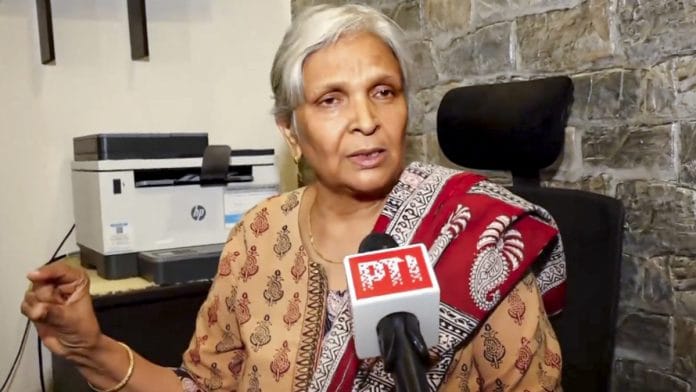
Next, there is the societal issue of patriarchy, misogyny and prejudice. The mother-in-law, an ex district court judge, has appeared on various television and YouTube channels (while out on anticipatory bail), leaving no stones unturned to clear herself and her family of wrongdoing. She expectedly, has to defend her son, the family honour etc, which is her right – on media as well as in court.
However, she seems to be digging herself deeper into a hole with some inane statements. She indulges in uncalled for and unsubstantiated slander of a dead girl. In fact, as an ex judge, she weakens her own case, when she puts out classified, medical reports of her deceased daughter-in-law (related to treatment for mental issues) out in public domain.
Also, prima facie, her contradictory statements about Twisha, her parents and her conduct, pre and post marriage, do not make for convincing arguments. Her defence of her absconding son comes across just short of insane. Power, pelf and clout apparently sit easy on her. But to discerning watchers, she comes out as a control freak who is cast in the archetypical role of a mother-in-law of the 19th or early 20th century : archaic, anachronistic and regressive. This, however,is only one view. Surprising as it may seem, many concur with her views on ‘control’.
The divide between the young and the old, conservative and the liberal, is stark. None can be labelled as absolutely right or wrong. We are, after all, a product of the values, culture and ethos that we grow up in.
The family, both the girls’ and the boys’ as an institution, shows deep fissures, not in this case alone, but in general. The pressure on girls, once they get to ‘marriageable’ age (whatever that is), is immense.
This does not factor in their own educational, career, personal choices. Marriage, at the right age, is a rite of passage that has to be gone through, preferably, rather mostly, within the narrow confines of one’s own religion, caste, social status etc. Educated and so called progressive Indian parents hold this widely accepted belief. Girls’ desire or choice is of little consequence.
Later, if the marriage turns sour, as so many do, girls’ parents ask them to ‘adjust’. Separation, dissolution or divorce is out of question. As one young lady on a TV panel discussion so eloquently put it : “a dead daughter is preferable to a divorced one”. A disturbing but true commentary.
Suffering as they already often are at the hands of their in-laws, young brides are mostly left to deal with their demons on their own. As for processes, and fair investigation, the very fact that a second post mortem (pm) examination was ordered under the aegis of AIIMS Delhi, seems to cast doubt on the authenticity of the initial one. Till the new pm report is out, none can say if there was tampering or pressure on the forensics and pm experts.The Hon’ble Supreme Court has recently taken suo motu cognizance of the case, which is now being dealt with by the CBI.
In the interim, the husband remains in custody, while the other prime accused, the mother-in-law, has been granted anticipatory bail, which is rightly being contested by the Prosecution. While l am not questioning the legality of the decision, it does make the case murkier. One could infer institutional bias, interference or ‘power play’. Only time will tell.
In conclusion, whatever the merits of the case and the eventual outcome, there is a crying need to set our moral and social compass right, so that more Twishas do not fall prey to a system which needs core reforms at individual and societal levels. Such reforms cannot be legislated, but have to come from within the deep bowels of a society bound by regressive familial mores, patriarchy and canonical beliefs which should have no place in today’s India.
These pieces are being published as they have been received – they have not been edited/fact-checked by ThePrint.