



Thank you dear subscribers, we are overwhelmed with your response.
Your Turn is a unique section from ThePrint featuring points of view from its subscribers. If you are a subscriber, have a point of view, please send it to us. If not, do subscribe here: https://theprint.in/
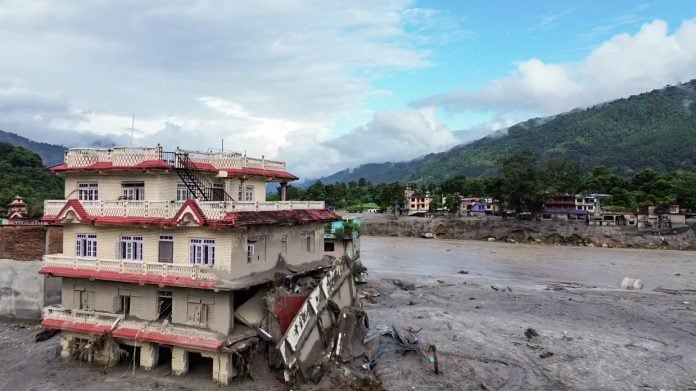
When a colossal rock-and-ice avalanche broke off high in the Langtang region on August 26, sending a torrent of water, mud, and boulders crashing through the Bhotekoshi and Trishuli river basins, it did more than demolish mountain settlements, trunk highways, and downstream hydropower stations. It washed away the polite diplomatic euphemisms that have long insulated global climate discourse.
With over 1,100 people confirmed dead, nearly 4,000 missing, and initial reconstruction estimates climbing between $4 billion and $5 billion—amounting to roughly 10 percent of Nepal’s gross domestic product—Kathmandu has taken an unprecedented rhetorical and strategic leap. In an interview with The Kathmandu Post, Nepal’s Foreign Minister Shisir Khanal articulated a fundamental shift in foreign policy: moving away from “soliciting charity” toward “demanding restorative justice and compensation.” Crucially, Khanal explicitly named the world’s top three absolute greenhouse-gas emitters—China, the
United States, and India—as bearing unambiguous “legal and moral liability.”
Yet this strident posture was swiftly counterbalanced inside Kathmandu. Addressing Nepal’s House of Representatives, Prime Minister Balendra Shah struck a measured diplomatic tone, thanking New Delhi and Beijing for their rapid mobilization of search-and-rescue teams, emergency airlift support, and medical supplies, even while endorsing the strategic imperative for long-term climate finance. This internal dual track—gracious bilateral neighborliness on immediate disaster response paired with an unyielding multilateral demand for structural compensation—brings a critical question to the forefront: can a vulnerable downstream state legally or diplomatically hold geopolitical titans accountable for transboundary ecological fallout?
The Anatomy of the ‘Mountain Tsunami’
The disaster across Bagmati province—severely impacting Rasuwa, Nuwakot, and Dhading—has been characterized by Nepali officials as a Himalayan Tsunami. While attributing an isolated extreme event requires exhaustive scientific forensic study, glaciologists at the International Centre for Integrated Mountain Development (ICIMOD) emphasize that systemic cryospheric breakdown is already underway.
The Hindu Kush Himalaya (HKH) is heating up at an alarming pace, well above global averages. Accelerated permafrost thaw, compromised shear strength in high-altitude rock walls, and erratic cloudbursts combine to produce compound cryospheric disasters. Nepal accounts for less than 0.1 percent of historical global greenhouse gas emissions, yet it remains on the frontlines of this thaw. For an economy with constrained fiscal headroom, diverting entire annual capital outlays simply to rebuild battered turbines and reconnect severed border transit corridors like Kodari represents an inescapable climate-debt trap.
A Diplomatic Tightrope: Caught Between Giants
By clubbing India and China alongside the United States, Nepal has embarked on an analytically bold and diplomatically fraught negotiation strategy.
1. The Indian Dilemma: Per Capita Equity vs Cumulative Emissions
For New Delhi, being placed in the same culpability tier as Washington and Beijing challenges its established climate negotiating doctrine. India’s international diplomacy has long stood upon Common But Differentiated Responsibilities and Respective Capabilities (CBDR-RC). India’s per-capita emissions remain modest at 2.5 to 3 tonnes of CO₂-equivalent—substantially below China’s ~11 tonnes and the US’s 17+ tonnes. New Delhi firmly argues that atmospheric space was historically consumed by Western
industrialization. Furthermore, India views its extensive humanitarian aid and infrastructure commitments to Nepal as expressions of neighborhood first solidarity, not compensatory admissions of sovereign tort liability.
2. The Chinese Equation: Upstream Watersheds and South-South Optics
Beijing shares the transboundary watershed of the Bhotekoshi—known across the Tibetan border as the Poiqu—and carefully curates its standing as a champion of South-South climate cooperation. While China is the largest current absolute emitter, it has consistently resisted mandatory legal contributions to Western-designed climate finance mechanisms under the UNFCCC. Kathmandu’s demand puts Beijing on the defensive, focusing scrutiny on upstream hydrological data-sharing in Tibet as well as Chinese-
engineered infrastructure built along fragile Himalayan canyons.
3. The American Deadlock: The Red Line on Legal Reparations
The United States has consistently rejected international mechanisms that recognize legal reparations or sovereign liability for historical emissions. When the Fund for Responding to Loss and Damage (FRLD) was agreed at COP27 and established at COP28, Washington and other OECD economies insisted on strict institutional guardrails: all financial inflows remain strictly voluntary, and operational governing texts expressly disavow legal liability or formal compensation regimes.
The Legal Realities: Can Nepal Enforce ‘Liability’?
While Nepal’s demands carry powerful moral weight, international legal avenues present formidable jurisdictional hurdles. The table below delineates the primary international channels, their operating legal instruments, and their binding constraints:
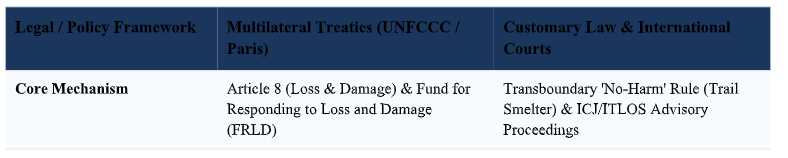
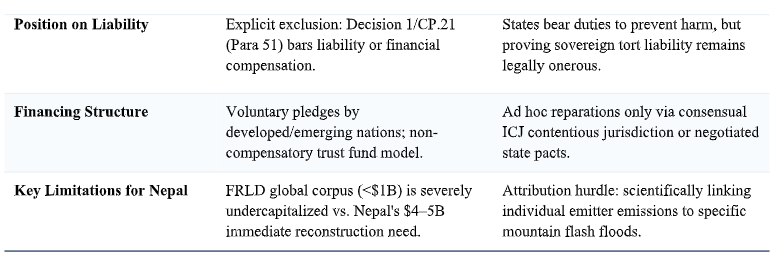
1. The Paris Agreement Barrier: Article 8 of the Paris Agreement addresses Loss and Damage, but paragraph 51 of Decision 1/CP.21 explicitly notes that Article 8 “does not involve or provide a basis for any liability or compensation.” Signatories operate under a treaty architecture that purposely disarms formal financial litigation.
2. The Loss and Damage Fund Bottleneck: A joint diplomatic petition co-signed by Finance Minister Swarnim Wagle and Forests Minister Geeta Chaudhary requested the FRLD Secretariat for expedited emergency disbursement outside regular board meeting cycles. However, the fund’s total pledged corpus sits under $1 billion worldwide—grossly inadequate against Nepal’s estimated $4–5 billion reconstruction bill.
3. Customary Law & The Causation Hurdle: The customary ‘no-harm rule’ (sic utere tuo ut alienum non laedas) obligates states to prevent transboundary environmental harm. Yet in adversarial proceedings, proving that emissions from specific thermal plants in India, coal basins in China, or refineries in the US directly precipitated an ice-detachment in Langtang faces an insurmountable scientific attribution barrier.
4. Normative Shifts via Advisory Opinions: While direct tort judgments against sovereign states remain out of reach, advisory proceedings before the International Court of Justice (ICJ) and the International Tribunal for the Law of the Sea (ITLOS) are creating substantial normative pressure. These bodies are clarifying state obligations under climate law, giving high-altitude mountain nations a stronger normative basis to pressure major emitters at COP negotiating tables.
What Lies Ahead: A Bellwether for the Third Pole
With Prime Minister Balendra Shah scheduled to address the 81st United Nations General Assembly in New York, Kathmandu is preparing to elevate mountain cryosphere collapse into high-stakes multilateral diplomacy.
Nepal’s assertive posture may not immediately yield bilateral treasury transfers labeled as reparations from New Delhi, Beijing, or Washington. However, it permanently reframes regional climate negotiations. It punctures the long-standing diplomatic convention where smaller South Asian nations politely avoided confronting dominant neighbors on the shared ecological externalities of rapid growth.
By insisting that post-calamity financing is an imperative of restorative climate justice rather than discretionary foreign aid, Nepal has signaled that the Third Pole will not absorb cryospheric devastation in silence. For India and China, the message is unmistakable: upstream-downstream hydrological cooperation, automated real-time basin telemetry, and regional ecological compacts must now become
core pillars of regional security architecture.
These pieces are being published as they have been received – they have not been edited/fact-checked by ThePrint.