





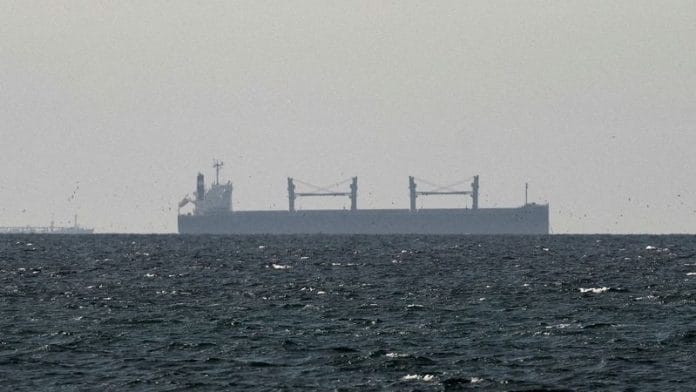



Washington: Frustrated by Iran’s unwillingness to give up its stranglehold over the Strait of Hormuz, US President Donald Trump is trying to force the issue. The US military announced that it had imposed a full blockage of Iran’s southern coastline, including traffic from there through the Strait of Hormuz, as of April 13.
The narrow waterway connecting the Persian Gulf to the wider world has become a flashpoint since the US and Israel began strikes on Iran on Feb. 28. Tehran tightened its grip on the corridor in response, all but closing off a vital thoroughfare and threatening economies far beyond the Middle East.
A US naval blockade along the lines of what was carried out off Venezuela from the end of last year could reduce that to zero, pressuring Iran but also putting additional stress on energy supplies, especially for Asian nations that depend heavily on the Middle East for them.
It would also likely doom an already fragile ceasefire the warring parties agreed to on April 7.
What exactly is the US navy doing?
Hours after US-Iran talks in Islamabad aimed at a permanent resolution of the war fell apart on April 12, Trump posted on social media that “effective immediately” the US Navy would blockade “any and all ships trying to enter, or leave, the Strait of Hormuz.” He added that other countries would participate, without naming any.
He threatened to “interdict every vessel in International Waters that has paid a toll to Iran,” implying the US could impose its blockade widely, well beyond the strait and even in the waters of the Gulf of Oman.
The US military separately issued a more narrow interpretation as it set a start of April 13 at 10 a.m. New York time for the blockade. It applies to all vessels “entering or departing Iranian ports and coastal areas.”
The US said that neutral ships that haven’t called at Iran would not be impeded, though they may be searched for contraband cargo. Seafarers are advised to monitor official broadcasts and contact US naval forces when in the Gulf of Oman and approaching the Strait of Hormuz, it added.
A UK naval group that liaises between the military and civilian shipping interests said it had been informed of the US restrictions and added that additional guidelines, including routing, verification and authorized transit procedures were being developed.
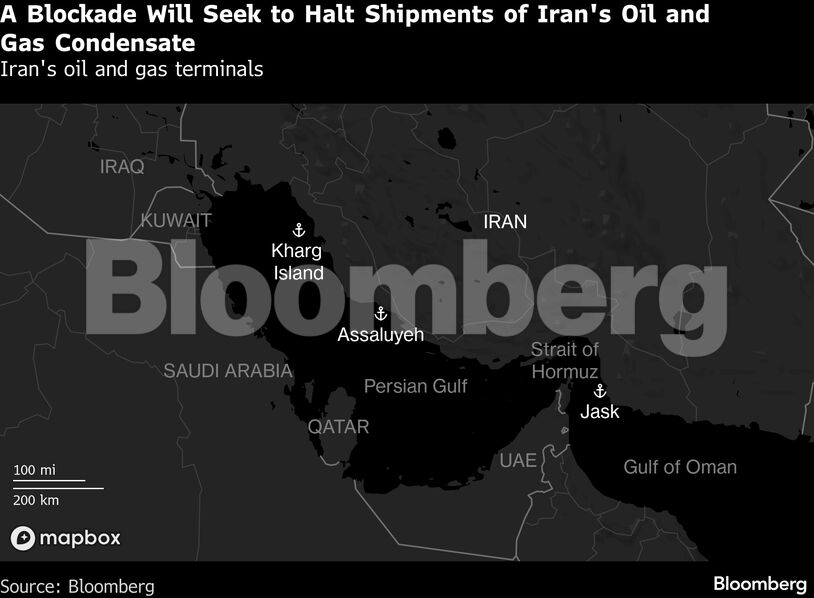
The US navy said in an April 13 message to ship operators that it would intercept, divert or capture ships leaving Iran. It’s not clear, however, that the US will want to tie up its own vessels pursuing tankers into the Indian Ocean, or how either side would respond to a confrontation or potential damage to a tanker.
The US has assets in the region including the USS Tripoli, an amphibious assault warship capable of rapid response. It carries 3,500 sailors and marines, in addition to stealth fighters and transport aircraft.
How has Iran responded?
Iran’s Islamic Revolutionary Guard Corps responded to Trump’s call for a blockade by saying that any military vessels attempting to approach the strait “under any pretext” would be considered a violation of the ceasefire.
Iran also said that it would target all ports in the Persian Gulf and Sea of Oman if its own shipping hubs are threatened. “This new escalation is more likely to trigger more escalations than drive conciliation,” said John Bradford, a former US naval officer and a co-founder of the Yokosuka Council on Asia-Pacific Studies.
This is a modal window.
Why is the US doing this?
Iran’s near-total closure of Hormuz has proved an exceptionally effective asymmetric weapon, inflicting acute financial pain in a way the US has struggled to counter and providing a source of great frustration. Iran’s threats to ships in the strait brought transits through it down to single digits a day, down from about 135 in peacetime.
The ultimate aim of a blockade would be to cut off Iran’s oil flows, severing a vital financial lifeline for the regime.
Heading into the conflict, many experts had dismissed the possibility of a closure of the strait because Iran would not want to jeopardize its exports. Instead, Tehran has shown itself able to impede others while keeping its own shipments flowing. That has helped boost its crude revenues, while driving up global prices.
The blockade option has already been used by the Trump administration in Venezuela, squeezing an economy hit by sanctions. But the Latin American producer is far smaller, relies on a more limited fleet of vessels, and is also less important to the world’s top importer of oil — China.
This is a modal window.
What does this mean for Iran?
A blockade, if successfully enforced, would prove extremely painful for Iran, which relies heavily on its oil exports.
Over the past weeks, the country has benefited from higher prices, and cargoes previously sold at a discount to global Brent were priced at a premium earlier this month, thanks to a US waiver intended to boost supply that allowed purchases of previously sanctioned cargoes. India appears to have taken two cargoes under the exemption — potentially its first since 2019.
The higher selling price for each barrel is key for Iran, which has suffered major damage from US and Israeli airstrikes and will have to make significant investments to rebuild and prop up its ravaged economy.
That windfall, worth hundreds of millions of dollars since the war began, may now be over.
What does it mean for the US?
Trump has frequently sought to pair the impact on Middle East supply with an effort to market US oil and gas output, portraying the crisis as a benefit for a top producer.
Yet US crude is not always a perfect replacement for Middle Eastern grades. And for US consumers, high benchmark prices are already driving up inflation.
Iran has shown itself well aware that it may have a greater ability to withstand pain than the US. Oil prices soared as investors braced for further supply shortages as a result of the blockade.
And what does it mean for Asian nations?
Asia has borne the brunt of the energy crisis, and further limits on Hormuz traffic would worsen the region’s plight. Ship traffic through Hormuz slowed sharply as caution mounted ahead of the announced blockade.
A US waiver on buying sanctioned Iranian oil appears to be invalidated by the blockade — a sharp reversal — and countries that had sought bilateral agreements with Iran may now be wary of clashing with the US, further limiting their options to secure fuels.
“They are so focused on Iran that they are losing sight of what they are causing to the world,” Jorge Montepeque, managing director at Onyx Capital Group, said in an interview with Bloomberg Television, speaking of the Americans. “And the pain is in Asia, the pain is in the South Pacific, the pain is in anybody that depends on oil.”