







By Howard Schneider
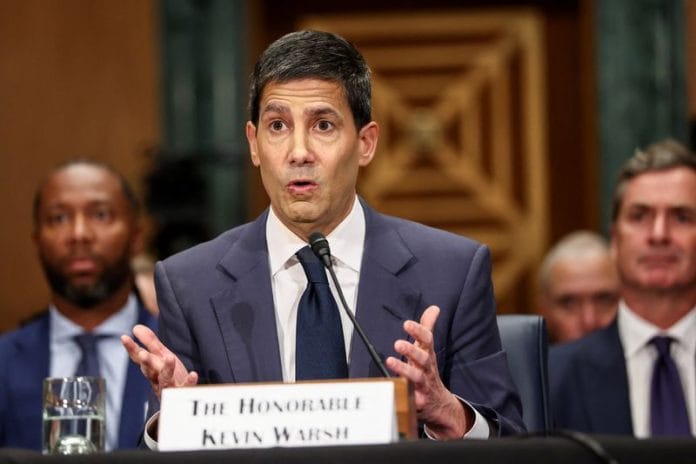
WASHINGTON, April 21 (Reuters) – Federal Reserve chief nominee Kevin Warsh called for “regime change” at the U.S. central bank, including a new approach for controlling inflation and a communications overhaul that may discourage his colleagues from saying too much about the direction of monetary policy.
Warsh’s comments during his confirmation hearing before the Senate Banking Committee left key questions about his nomination unresolved, with Republican Senator Thom Tillis using his full time to explain why he would not vote for the 56-year-old lawyer and financier until the Trump administration dropped a criminal probe of current Fed Chair Jerome Powell – a stance that could leave Powell as head of the central bank indefinitely.
But it did hint at major changes to come at a Warsh-led Fed.
Warsh blamed the central bank for an inflation surge in the wake of the COVID-19 pandemic that continues to hurt U.S. households. Coupled with the implications of artificial intelligence for jobs and prices, he said he would move quickly to see if new data tools could provide better insight on inflation, and also discourage policymakers from saying too much about where interest rates might be heading.
“What the Fed needs are reforms to its frameworks and reforms to its communications,” the former Fed governor said. “Too many Fed officials opine about where interest rates should be … That is quite unhelpful.”
“The fatal policy errors going back four or five years” are a legacy that families are still working through, Warsh said, arguing the Fed needed “a regime change in the conduct of policy. It means a new and different inflation framework.”
The hearing quickly turned contentious, and the pace of Warsh’s confirmation process through the Senate remained in doubt.
He would not directly say that President Donald Trump lost the 2020 election – a statement of fact that Democratic Senator Elizabeth Warren said was a litmus test of Warsh’s independence from the Republican president who nominated him for the top Fed job – and also said he would stick with plans to sell more than $100 million in assets without detailing what they are or to whom they would be sold.
The proceeds, he said, would go into “plain vanilla” assets.
‘MONETARY POLICY INDEPENDENCE IS ESSENTIAL’
Warsh also was asked about comments Trump made shortly before the start of the hearing in which the president said he would be disappointed if his Fed chief nominee did not get quick approval for rate cuts.
“Presidents tend to be for cutting rates … President Trump expresses it quite publicly,” said Warsh, who also skirted saying whether Trump’s call for a Fed policy rate as low as 1%, a level usually associated with recession, would risk higher inflation.
“Monetary policy independence is essential,” Warsh had said in a public statement delivered to members of the committee, who will recommend whether to confirm him to a seat on the Fed’s Board of Governors as well as a four-year term as head of the central bank.
“I do not believe the operational independence of monetary policy is particularly threatened when elected officials – presidents, senators, or members of the House (of Representatives) – state their views on interest rates,” said Warsh, who served as a Fed governor from 2006 to 2011.
“Congress tasked the Fed with the mission to ensure price stability, without excuse or equivocation, argument or anguish. Inflation is a choice, and the Fed must take responsibility for it. Low inflation is the Fed’s plot armor,” he added.
Warsh has said rate cuts are nevertheless warranted because technological changes unleashed by artificial intelligence will raise productivity, a view other central bankers say may be true over time but won’t necessarily make lowering rates appropriate in the short term.
The Fed has missed its 2% inflation goal for more than five years, first due to the shock of the pandemic but more recently due to the influence of Trump administration tariffs and the high oil prices linked to the war in the Middle East.
Warsh said during the hearing that he did not think Trump’s tariffs fueled inflation.
UNPRECEDENTED SITUATION FOR FED
Trump has repeatedly clashed with Powell over monetary policy since naming him Fed chief in his first term in the White House. Powell’s tenure as head of the central bank formally ends on May 15, but he could conceivably remain longer in the office if Warsh’s confirmation is delayed.
Tillis has emerged as the major hurdle in getting Warsh’s confirmation to a full vote in the Republican-controlled Senate. The North Carolina senator, who is not running for re-election, considers the U.S. Justice Department probe of Powell to be frivolous and part of Trump’s effort to pressure the Fed into lowering rates or force Powell to resign.
U.S. Attorney for the District of Columbia Jeanine Pirro, an ally of Trump, does not seem poised to drop the Powell probe, and the president does not appear to be pushing her to do so.
In the absence of a confirmed successor for the top job, the central bank in the past has named its own “pro tem” Fed chief. Powell’s term as a central bank governor extends until 2028, meaning he could remain as a key policymaker even if Warsh is confirmed.
Trump also has said he still may fire Powell if he doesn’t vacate his governor’s position. Such a move would surely invite a legal challenge, as did the president’s attempt last summer to fire Fed Governor Lisa Cook.
It is an unprecedented situation for the U.S. central bank, where the handoff of authority has typically been collegial.
The Fed has a Washington-based board and staff, but also includes a dozen regional banks, tens of thousands of system-wide employees, and duties that range from setting interest rates for the entire country to managing the payments system, supervising and regulating banks, administering swap lines with foreign central banks, and conducting research on anything from cryptocurrencies to rural health.
Warsh has been deeply critical of Powell’s leadership, and the hearing provided an opportunity to explain in more detail what he plans to do differently.
“The Fed must stay in its lane,” Warsh said in his opening statement to the committee, echoing a standing conservative critique that the central bank’s work on issues like climate change or economic equity, or comments about fiscal spending, were out of bounds.
(Reporting by Howard Schneider, Ann Saphir and Michael S. Derby; Editing by Paul Simao)
Disclaimer: This report is auto generated from the Reuters news service. ThePrint holds no responsibility for its content.