





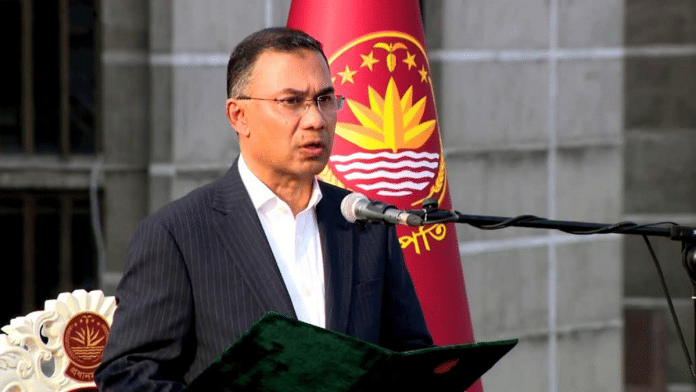



Dhaka: In his first national address as Bangladesh’s Prime Minister, Tarique Rahman emphasised on unity across religious, political and ethnic lines, declaring that the country “belongs to everyone”, and pledged that his government will ensure a decisive break from the “fascist era” of misrule.
Speaking for 12 minutes in a televised address Wednesday, Rahman said the Bangladesh Nationalist Party (BNP) government had inherited “a fragile economy, weak governance structure and deteriorating law and order situation, which was plagued by corruption and misrule during the fascist era”. Restoring peace and curbing corruption would be its primary tasks, he said, describing the moment as “the journey of re-establishing democracy, human rights, respect and dignity in the country”.
“I would like to give a message to the people of the country, regardless of party, religion, caste, faith… Whether living in the mountains or the plains, this country belongs to all of us,” he said, adding: “We want to make this country a safe land for every citizen.”
The emphasis on inclusion was a recurring thread in the address.
Rahman said citizenship—not party affiliation or religious identity—would define his government’s approach, a key signal in a Muslim-majority nation with Hindu, Buddhist and Christian communities.
Allegations of discrimination and communal tensions aren’t uncommon in Bangladesh, with an uptick in incidence noted after then-PM Sheikh Hasina’s ouster following student uprising in 2024.
Rahman Wednesday promised that public institutions would function according to statutory rules rather than “party or political influence”, with the broader aim being to build “a self-reliant, safe, humane, democratic Bangladesh”.
“This is a new government accountable to the people that has begun its journey in Bangladesh with the votes of the people,” he said.
In a veiled reference to the narrative of the Liberation War, Rahman said voters had chosen BNP — “the party of proclaimer of independence” — and given it the mandate to govern. He was referring to the long-standing controversy about who proclaimed Independence in 1971: Sheikh Mujibur Rahman or Tarique’s father and former Bangladesh leader Ziaur Rahman.
On Wednesday Rahman recalled his return to the country after 17 years in exile and a pledge he’d made before the February election: “I have a plan.”
To signal austerity from the outset, Rahman said BNP lawmakers had resolved at their first parliamentary meeting not to import tax-free cars or accept government plot allocations. He announced that his government was determined to “break all the syndicates of lawlessness and irregularities in all areas”, and said authorities would consult traders of all sizes to stabilise markets while protecting both buyers and sellers. “This government belongs to all,” he said.
On Ramzan, he asked traders not to raise prices and instructed officials to ensure uninterrupted gas, water and electricity supplies during iftar, taraweeh and sehri. He also called on citizens to avoid waste, describing thrift in the use of utilities as part of religious responsibility. Calling Ramzan a month of “self-purification”, he linked civic duty to “the ideals of the Holy Prophet’s justice.”
Turning to the country’s youth, Rahman asked students to gain expertise in at least one field as the world entered “the era of artificial intelligence”, and pledged government support for skill development, talent cultivation and improved employment conditions.
Closing on a note of political inclusivity, Rahman said his government would represent all citizens, including those who did not vote for BNP. “Everyone has their own party, religion, philosophy, but the state belongs to everyone… In this country, as a Bangladeshi, you, me, and every Bangladeshi citizen have equal rights,” he said.
Also Read: Jamaat’s big wins along the Bangladesh border & what they mean for India