








By Jonathan Stempel and Luc Cohen
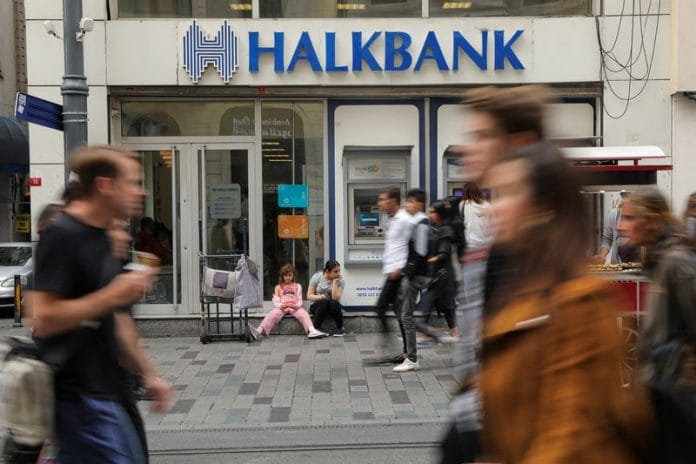
NEW YORK, March 9 (Reuters) – The U.S. Justice Department has agreed to resolve its long-running criminal prosecution of Turkish state-run lender Halkbank, the judge overseeing the case said in a court filing on Monday, without providing further details of the deal.
Manhattan-based U.S. District Judge Richard Berman said in a written order that he would ask lawyers for both sides about the so-called deferred prosecution agreement at a previously scheduled hearing on Wednesday.
Halkbank shares traded on the Istanbul stock exchange rose 10% on the news, the maximum daily increase.
In 2019, prosecutors charged Halkbank with fraud, money laundering and conspiracy for allegedly helping Iran evade American economic sanctions. The bank was accused of using money servicers and front companies in Iran, Turkey and the United Arab Emirates in the sanctions-evasion scheme. Halkbank pleaded not guilty.
The end of the long-running case, which Turkish President Tayyip Erdogan once called unlawful and “ugly”, relieves one of the main irritants between the NATO allies that are enjoying their best ties in decades since Donald Trump returned to the White House.
The bank declined to comment. A spokesman for the Manhattan U.S. Attorney’s office, which brought the case, did not immediately respond to a request for comment.
Deferred prosecution agreements let defendants avoid criminal charges if they meet various conditions, typically over several months or a few years. The government dismisses cases after the defendants comply.
ORIGINAL CHARGES IN 2019
The agreement was announced after the U.S. Supreme Court in October 2025 let stand a federal appeals court decision that let the prosecution proceed.
U.S. prosecutors originally charged Halkbank in 2019, during President Donald Trump’s first White House term.
Erdogan met with Trump in September, and expressed hope the following month that the meeting would resolve various issues between the countries.
The Turkish president said Trump told him at the White House and in a subsequent phone call that “the Halkbank problem is finished for us.”
Turkish officials had proposed resolving the case for some $100 million during the meeting between the two leaders at the White House, two sources told Reuters in October.
SEVERAL RELATED CRIMINAL CASES
U.S. prosecutors said the bank secretly transferred $20 billion of restricted funds, converted oil revenue into gold and cash to benefit Iranian interests and documented fake food shipments to justify transfers of oil proceeds.
The case was an outgrowth of several related criminal cases, including those against Turkish-Iranian gold trader Reza Zarrab and former Halkbank executive Mehmet Hakan Atilla.
Zarrab pleaded guilty to bank fraud, money laundering and conspiracy charges in 2017, but has not been sentenced.
He testified against Atilla, who was convicted in 2018 of bank fraud and conspiracy charges. Atilla returned to Turkey in 2019 after serving most of a 32-month prison term. He has denied wrongdoing.
TREK THROUGH U.S. COURTS
The case is unrelated to current tensions in the Middle East, and has taken a circuitous path through the U.S. courts.
Berman originally ruled in 2020 that Halkbank did not deserve immunity from prosecution.
The following year, the 2nd U.S. Circuit Court of Appeals in Manhattan upheld that ruling but on different grounds. It said Halkbank could be prosecuted under the federal Foreign Sovereign Immunities Act of 1976, because its alleged misconduct involved commercial activity not covered by that law.
In 2023, the U.S. Supreme Court temporarily voided the prosecution, despite agreeing that Congress’ desire to shield foreign countries and their instrumentalities from civil liability did not cover criminal cases. Instead, it ordered the 2nd Circuit to more thoroughly review whether immunity under centuries-old common law shielded Halkbank.
The appeals court found no such shield in October 2024, prompting Halkbank’s second Supreme Court appeal. The Trump administration argued that the common law does not shield foreign state-owned companies from criminal prosecution.
(Reporting by Jonathan Stempel and Luc Cohen in New York; Additional reporting by Ebru Tuncay in Istanbul; Editing by Chizu Nomiyama)
Disclaimer: This report is auto generated from the Reuters news service. ThePrint holds no responsibility for its content.