








New Delhi: In the weeks leading up to the US-Israeli military strikes against Iran, President Donald Trump’s war cabinet was sharply divided over the risks and merits of the action, with him mirroring Israel Prime Minister Benjamin Netanyahu’s hawkish stand, a New York Times report revealed Tuesday.
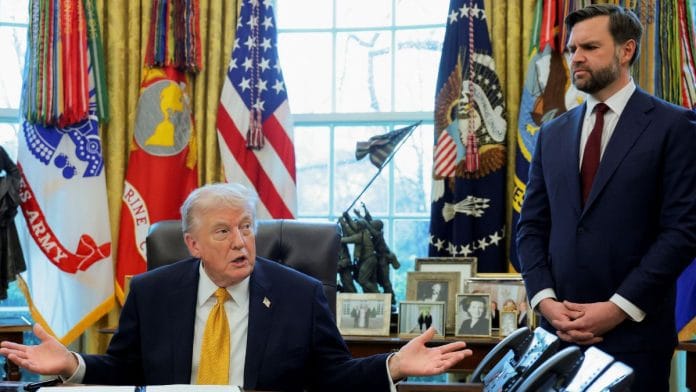
It revealed a White House split between “Trump the hawk”, eager for action, and “J.D. Vance the sceptic”, warning of unpredictable consequences, while offering a rare window into how Trump made some of the most consequential decisions of his presidency.
The account of the internal divide before the war is taken from reporting for a forthcoming book, Regime Change: Inside the Imperial Presidency of Donald Trump. It highlights how neither intelligence nor the vice-president wanted it, and others warned against it too, but the US President had made up his mind and was in line with Israel Prime Minister Netanyahu.
“The reporting underscores how closely Mr Trump’s hawkish thinking aligned with Mr Netanyahu’s over many months, more so than even some of the president’s key advisers recognised. And it shows how, in the end, even the more skeptical members of Mr Trump’s war cabinet—with the stark exception of Mr Vance, the figure inside the White House most opposed to a full-scale war—deferred to the president’s instincts, including his abundant confidence that the war would be quick and decisive,” the report noted.
The debate first began in earnest on 11 February, when Netanyahu arrived at the White House for a highly classified briefing in the Situation Room. Susie Wiles, the White House chief of staff, Secretary of State Marco Rubio, who was also the national security adviser, Defense Secretary Pete Hegseth, General Dan Caine, the chairman of the Joint Chiefs of Staff, and John Ratcliffe, the CIA director. Jared Kushner, the president’s son-in-law, and Steve Witkoff, Trump’s special envoy, who had been negotiating with the Iranians, were part of the meeting.
“When others in the room asked the prime minister about possible risks in the operation, Mr. Netanyahu acknowledged these but made one central point: In his view, the risks of inaction were greater than the risks of action,” the NYT report adds.
The presentation, designed to persuade the president that Iran’s regime could be toppled quickly, outlined a scenario in which the country’s “ballistic missile program could be destroyed in a few weeks, the regime would be so weakened that it could not choke off the Strait of Hormuz, and the likelihood that Iran would land blows against US interests in neighboring countries was assessed as minimal”.
Trump appeared receptive. “Sounds good to me,” he told Netanyahu, signaling an inclination toward military action. But inside the room, his advisers were far from unified.
Also Read: Iran crisis is another reason for India to harden defence manufacturing hubs
Internal divide
CIA Director John Ratcliffe and Secretary of State Marco Rubio quickly pushed back against the more ambitious elements of the Israeli plan, describing the prospects for regime change as unrealistic. Ratcliffe labelled Netanyahu’s idea of regime change as “farcical”, Rubio straight up said, “It’s bullshit.”
Vice President Vance, who had been travelling in Azerbaijan and arrived shortly afterward, warned that a large-scale war would be “massively expensive” and could destabilise the region, cautioning that Iran could retaliate unpredictably.
General Dan Caine, the chairman of the Joint Chiefs of Staff, offered a careful assessment of military feasibility. He also highlighted the risks of potential disruptions to the Strait of Hormuz. Yet, he stopped short of telling the president not to proceed.
Secretary of War Hegseth was a clear advocate for a strike, arguing that delaying would only increase the threat. White House Chief of Staff Susie Wiles, while worried about the economic and political fallout, deferred to the president’s judgment. White House communications staff, including David Warrington and Steven Cheung, highlighted the domestic political challenges of pursuing a war after years of promises to avoid new conflicts, but ultimately indicated they would support whatever decision Trump made.
By late February, the split was clear. Hegseth and, to a lesser extent, Rubio, focused on neutralising Iran’s military threat. Vance warned of potential chaos and thought it was ‘a disaster,’ but knowing Trump, steered more towards limited strikes.
On 26 February, in a final Situation Room meeting, Trump asked for each adviser’s perspective. Vance reiterated his opposition but pledged support if the president moved forward. Wiles echoed that sentiment. Ratcliffe and Rubio limited their counsel to achievable objectives, such as destroying Iran’s missile program. General Caine outlined the military sequence and potential risks.
After hearing all sides, Trump concluded: “I think we need to do it.” On 27 February, 22 minutes before a deadline set by General Caine, he formally approved the operation, codenamed “Epic Fury”.
On 8 April, after multiple threats to “wipe out Iranian civilisation”, Trump announced a two-week suspension of planned bombing and military strikes on Iran, subject to the immediate opening of the Strait of Hormuz. Iran called it a “historic victory”.
(Edited By Nardeep Singh Dahiya)
Also Read: What India can learn from the US-Israel war on Iran