








It sounds obvious, but if you want to know how a carmaker is doing, you’ve got to drive its cars. Marketing is one thing, but if the nuts and bolts of the car itself don’t deliver on what it promises, the consumer will know.
The data show Ferrari will finish the year looking strong compared with competitors, maintaining a wide profit margin and solid order books amid the general chaos swirling around EVs, tariffs, supply chains and China. But it’s the company’s diverse lineup of drivetrains that provides the proof behind the numbers. Nowhere is that more clear than in a look at its new $261,810 Amalfi.
The brand is slouching toward electrification, announcing earlier this fall that it will make 20% of its cars electric by 2030. Its first EV will arrive early in 2026. But the fact is, almost no one is buying ultra-high-end EVs. So Ferrari pointedly remains committed to internal combustion, making cars like the Amalfi, which has a roaring twin-turbo V-8 that embodies the quip “Ferrari doesn’t make cars, it makes engines.” Indeed, its proprietary pistons are the beating heart of the brand.
It’s smart not to want to put all its eggs in one proverbial basket. So when I got the opportunity to drive this curvaceous ode to combustion, the essence of Ferrari’s way of surviving and thriving in a volatile automotive market, I took it. Plus, the Amalfi was one of just three major debuts from Ferrari in 2025.
I drove the 631-horsepower coupe on twisty, wet roads near Faro, Portugal, in mid-December. The rain didn’t dampen its panache. The tension between retaining old-world charm — with seductive, undulating bodies, tactile cabin controls, thrilling engines — while advancing its considerable driving technologies is what makes Ferraris so engaging on a human level. They’re the opposite of more clinical offerings like those from McLaren.
The Amalfi replaces the Roma, which debuted in 2019. It has multiple significant updates to show for it, including a redesigned cockpit that corrects what Ferrari’s development driver Raffaele de Simone called a “mistake” from the earlier model. More on that in a moment, though. First, I want to talk about how the car looks.
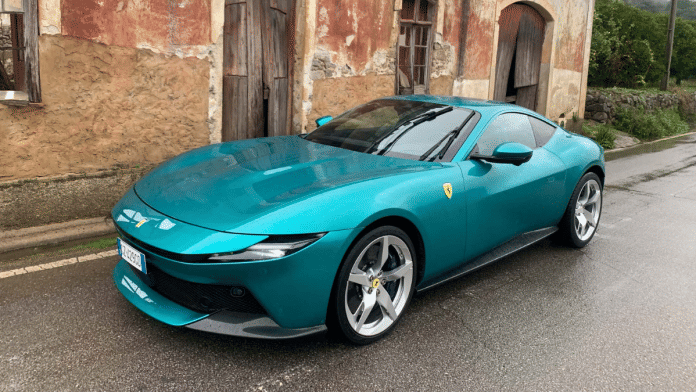
You’ll notice the changes at once. Gone is the nostalgic lattice-work grill of the Roma, in favor of an uncluttered modernized front with two new black fairings (scarpette, as they’re called, Italian for “little shoes”) flanking the front bumper. Between them, the middle portion of the lower splitter sticks out like a playful tongue.
The tail lights have been slimmed down to sit in a coy dark slit across the rear. An active wing lies flush with the roof line, deploying at various speeds to help improve downforce and stability. The overall effect is that of a beautiful touring car, the kind you want to take somewhere secret for a weekend to unwind. It’s an exhale the color of the sea.
In fact, the single new color option, Verde Costiera, approximates the deep water off the Italian coast of the same name. A classicist at heart, I prefer a darker or more muted green for my vehicular obsessions, but I support almost anything other than the expected red for a Ferrari. The $13,700 tone is not without precedent — various shades of teal, like the metallic Azzurro Hyperion, have been available from the carmaker for decades.
New leather seats in Verde Bellagio, a duller grey/green with stitching to match, felt more calming as I slid behind the steering wheel ahead of my drive. Behind me, two tiny seats lined in a blue-green alcantara (“Blu Sterling,” officially) looked like they could accommodate only Lilliputian humans, but they had the cutest little seatbelts to match.
To my right, the modernized version of the “gated shifter” configuration was still there, reassuringly, and now ensconced in a single piece of billeted aluminum that covered the entire center console. I did the headroom test, measuring the space between my noggin and the ceiling with my hand. Four fingers, at least, spanned the distance, telling me I’d be just fine driving the car even if I gained a few inches. (I’m 5’10 and a half.)
Then de Simone’s correction hit like a love tap — the red start button on the steering wheel is back, replacing the hapless haptic button they tried on the Roma. Back from the dead, too, is the tactile cross of knobs on the right side of the steering wheel, which controls almost everything from the windshield wipers to the display on the screen in front of me.
In short, Ferrari, like Mercedes and Audi, has listened to customer feedback and eliminated the tiny screens it had frivolously applied to previous models. “It’s about quality of life,” de Simone says. The new steering wheel is available to be retrofit on any of Ferrari’s current range models, by the way, and will be standard on all models moving forward. The people can rejoice.
I drove the Amalfi for a languid afternoon of decreasing-radius corners and empty straightaways on Portugal’s rural roads. Here I found a glorious technological upgrade: The new brake-by-wire system improves stopping distance, reduces brake pedal travel and keeps the car planted even in inclement conditions. It kept the stopping pressure consistent and predictable, whether I tapped the brakes going into a turn or stood on them to avoid a tractor making a U-turn. (Credit also to the new ABS system the Amalfi borrows from the excellent 296.)
I’ll admit I wasn’t able to discern the extra 19 horsepower the Amalfi gives over the Roma, but its eight-speed dual clutch is the smoothest, silkiest transmission I know. Zero to 62 miles per hour is 3.3 seconds; top speed is 199 mph.
With Ornella Vanoni singing in the background, accelerating across Sao Marcos da Serra felt like a spiritual experience. I was so swept up I missed a turn or two on the route I’d set in the car’s navigation system — partly because the 10.3-inch central touchscreen is positioned too low and pushed too far back underneath the dashboard to read without being distracted from the road. The lack of a heads-up display only complicates matters.
That’s the tension here in the Amalfi — even as it boasts divine driving performance and sumptuous good looks, it lacks some of the more advanced cabin accoutrements of far less expensive cars. (A hands-free driving system like those offered by BMW, General Motors and Mercedes-Benz is not available, either.)
But here’s the truth: The duality between nostalgia and novelty, reminiscence and relevance is what gives the Amalfi its memorable character. Somewhere in the space between is where that intangible quality of personality is formed — and it’s personality, not perfection, that made me fall in love. If Ferrari continues its intoxicating voodoo, making us feel something when we drive its cars, the pride of Modena is in good hands.
Disclaimer: This report is auto generated from the Bloomberg news service. ThePrint holds no responsibility for its content.
Also Read: India’s merchandise exports to US rising month-on-month despite Trump tariffs, govt data shows