





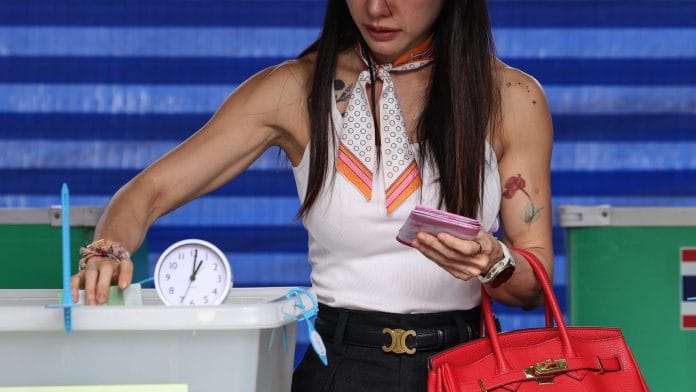



Thailand’s next leader is set to emerge as polls closed Sunday and counting of votes started in a contest between pro-democracy reformers and status-quo conservatives that risks deepening the country’s political paralysis.
The race, which is expected to see near-record voter turnout, has been mostly focused on the battle of the ruling conservative Bhumjaithai Party against the progressive People’s Party, with the populist Pheu Thai Party as a wild card.
No party is expected to win an outright majority of the 500 lower house seats up for grabs, setting the stage for a coalition government, the form of unstable solution that has contributed to Thailand’s chronic political deadlock.
The country’s Election Commission will begin releasing results after polls closed at 5 p.m. local time. A near-final initial tally could be complete before midnight.
Follow coverage of the Thai election results on Bloomberg’s live blog
The Southeast Asian nation has seen 10 prime ministers since 2005, the last time a single party was able to form a government. That instability has been credited with creating a parallel paralysis in the economy, which has lagged behind its neighbors despite earlier promise as a standout success in Asia.
“Any continued uncertainty in policymaking will compound the country’s challenges,” said Laura Schwartz, a senior Asia analyst at risk intelligence company Verisk Maplecroft, adding that there’s a chance that the political instability that’s been a drag on Thailand continues “in the coming months and maybe beyond.”
Those two decades of chronic political instability have seen Thailand go from an aspiring economy on track to join the ranks of rich nations, to a regional laggard beset by stagnant growth, soaring debt, widening inequality and a shrinking workforce.
Read More: Thais Keep Voting for Change and Getting the Same Old Economy
Thais also voted Sunday in a referendum that asks whether the current military-drafted constitution should be replaced, a proposal promoted by People’s Party.
A survey released after polls closed by Nida Poll, conducted between Jan. 31 and Feb. 6, showed People’s Party taking about 37% of the popular vote, and winning 125 to 135 seats. Bhumjaithai is expected to finish first with 140 to 150 seats despite only about 19% of popular support, due to winning a bigger share of constituency seats in the first-past-the-post system.
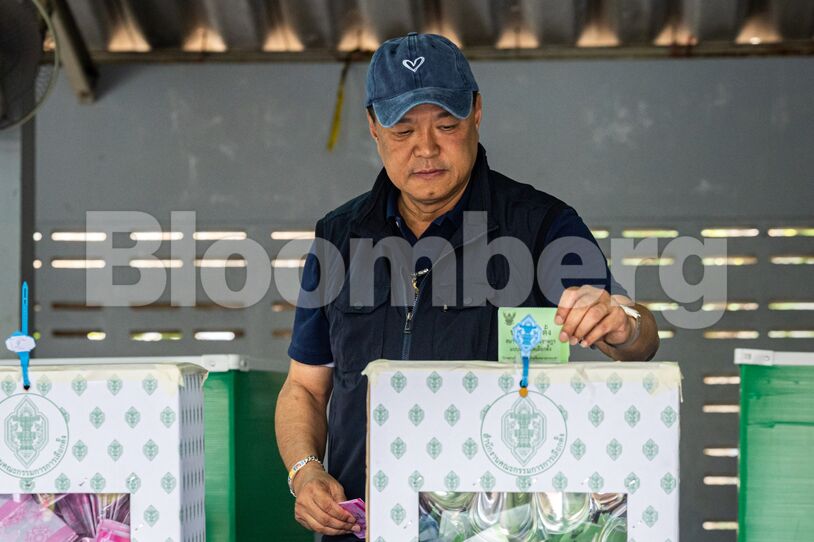
Sunday’s election follows a crisis that saw the previous prime minister, Paetongtarn Shinawatra, ousted in August over an ethics violation related to her handling of the border clash with Cambodia. Her successor, Bhumjaithai leader Anutin Charnvirakul, took office with the backing of the People’s Party on the condition he would call a snap election.
Even if the People’s Party and the progressive movement behind it wins the most votes for a second time, it faces similar hurdles that blocked it from power three years ago. Namely, resistance from the conservative establishment — broadly seen as the overlapping interests of the military, royalists and economic elite. Any potential coalition partners will also have to weigh the risks of upsetting the conservative establishment.
Read More: Popular Thai Reformists Face Being Blocked From Power Once More
Anutin, 59, is also banking on help from nationalist sentiment sparked by the enduring border tensions with Cambodia. Bhumjaithai also maintains a critical advantage in its hold over the Senate — which is indirectly elected and nominally nonpartisan — that gives it increased sway over constitutional amendments and proposed legislation, as well as independent agencies that investigate politicians.
His main challenger is Natthaphong Ruengpanyawut, the 38-year-old leader of the People’s Party. Successor to the dissolved Move Forward group that won the most seats in the last vote, the party argues that only deep reform can reverse Thailand’s economic decline.
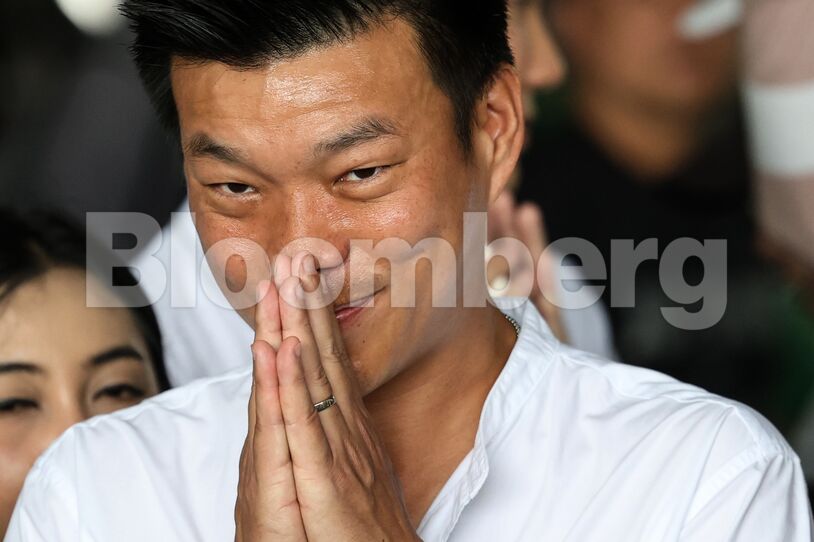
The party has tempered some its political aims since its predecessor, Move Forward, was dissolved after the 2023 vote for campaigning to amend the country’s controversial lese majeste law. It’s also sought to widen its appeal promoting seasoned technocrats and civil servants as possible cabinet members.
“They’ve tacked a little bit toward the realities of Thai politics,” said Andrew Shaw, Southeast Asia managing director for The Asia Group in Bangkok, who spent 25 years in the US Foreign Service, most recently as an economic counselor in Thailand.
A 25-year-old-voter in Bangkok, who declined to be identified, said as she left polling station Sunday that the younger generation wants new faces in the government.
“I want to change the government because all the people in the government right now are all from the old generation,” she told Bloomberg. “And they’re comfortable, they don’t feel the need to improve anything because they’re already comfortable. But a lot of people in this country, they’re not.”
This report is auto-generated from bloomberg news service. ThePrint holds no responsibility for its content.