








By Mei Mei Chu
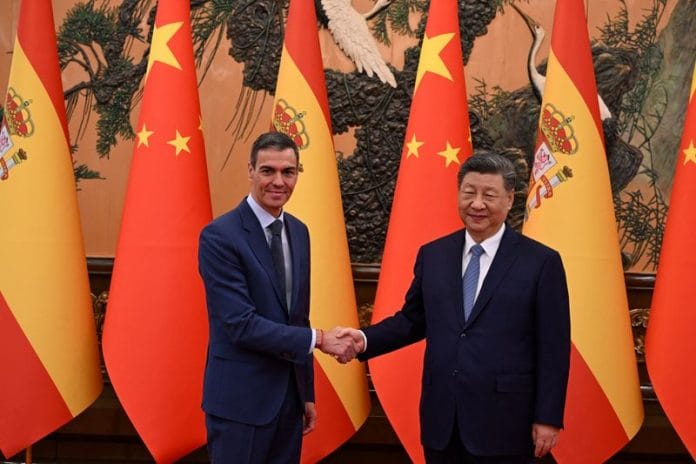
BEIJING/MADRID, April 14 (Reuters) – Europe and China must forge closer ties to counter threats to multilateralism, Spanish Premier Pedro Sanchez said on Tuesday after meeting Chinese President Xi Jinping, who said the international order is “crumbling”.
Sanchez’s April 11 to 15 visit to China comes as many Western governments are seeking warmer ties with Beijing despite lingering security and trade tensions, with discomfort growing over the policies of U.S. President Donald Trump.
He is the latest of a string of leaders from Britain, Canada, Finland and Ireland to visit China this year.
During the meeting with Sanchez, Xi said that the international order was “crumbling” and that deeper ties were in the interests of both China and Spain, according to comments provided to media.
BEIJING AGREES TO DEFICIT NARROWING MEASURES
Spain has been one of Europe’s loudest proponents of expanding trade and treating China as a strategic ally, rather than the economic and geopolitical rival seen by Trump.
Sanchez has urged the world’s second-biggest economy to take a larger role on issues from climate change to security, defence and the fight against inequality, saying the U.S. has decided to withdraw from many of these fronts.
In a press conference, the Spanish leader said Beijing had agreed to measures to narrow his country’s trade deficit of nearly $50 billion with Beijing.
He added that he would later on Tuesday sign several agreements with Premier Li Qiang, including expanded access for Spanish agricultural products to China and improving Spain’s transport and infrastructure. He did not provide further details.
He said that middle powers like Spain must push for the multilateral order to be respected, echoing a concept expressed by Canadian Prime Minister Mark Carney earlier this year at the World Economic Forum in Davos, Switzerland.
Sanchez singled out Israel in his press conference for violating international law in the Middle East, saying he had discussed the “grave situation” in Lebanon, Gaza and Ukraine during his meeting with Xi.
Israel’s refusal to discuss a ceasefire in Lebanon has complicated wider diplomacy to halt the conflict in the Middle East, with Israel ruling out the possibility of a suspension of hostilities ahead of talks due to take place between the ambassadors of Israel and Lebanon later on Tuesday in Washington.
“Those of us who raise our voice against governments violating international law are being threatened,” Sanchez said, in reference to Israeli Prime Minister Benjamin Netanyahu’s warning that Madrid would “pay an immediate price” for what he described as waging a diplomatic war against his country.
Sanchez has also been a vocal critic of the war in Iran and has refused to allow the use of its bases, which are jointly operated with the U.S. for strikes on Iran.
(Reporting by Mei Mei Chu and the Beijing newsroom, David Latona, Victoria Waldersee, Aislinn Laing in Madrid; Writing by Farah Master and Victoria Waldersee; Editing by Christian Schmollinger, Clarence Fernandez, Charlie Devereux and Sharon Singleton)
Disclaimer: This report is auto generated from the Reuters news service. ThePrint holds no responsibility for its content.