





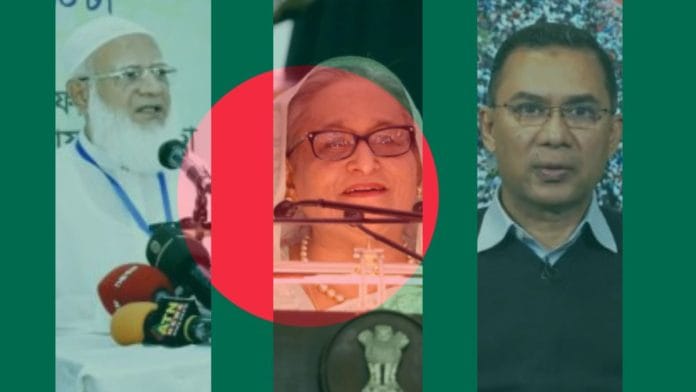



New Delhi: With dates for next year’s Bangladesh elections set to be released any day now, the nation faces a political vacuum: the Bangladesh Nationalist Party (BNP) cannot fully step in without acting chairman Tarique Rahman’s return, the Awami League has lost public credibility and the Jamaat-e-Islami and Islamist groups are aggressively trying to fill the ideological space left behind.
While BNP chairperson Khaleda Zia remains critical in a Dhaka hospital, her son Tarique Rahman remains in London, in self-imposed exile for 17 years and absent at a moment many in his party consider crucial.
Rahman, 60, has said he wants to return but continues to claim that “uncontrollable factors” are preventing him from coming back, even as the Muhammad Yunus interim administration has said it is willing to facilitate his arrival.
“The country’s politics is now extremely polarised. On one side, right-wing forces are trying to grab control of state and society by any means. On the other side, those who talk about democracy and liberal values have themselves created a vacuum. People want the BNP to fill that space, but the BNP has not yet earned that trust. They have to work much harder to do so,” Asif bin Ali, an Atlanta-based geopolitical analyst and doctoral fellow at Georgia State University, told ThePrint.
He pointed out that Rahman’s absence created distrust.
“Making announcements or speaking live from London is one thing. Showing real faith by coming home, shaking hands with people, talking to ordinary citizens on the streets, praying in mosques, visiting Hindu temples, giving speeches in front of the public, that physical presence creates hope. For many, Tarique has become a symbol of that hope. But that faith is now weakening. So the question of Tarique’s return to his country has moved to the center of the political debate,” Ali said.
In a long post on Facebook on 29 November, Rahman had stated: “Like any child, I also have a strong desire to get the touch of mother in such a crisis.”
“Our family is hopeful that my long anxious wait for homecoming will end as soon as this political reality has reached the expected stage.”
Also Read: Are Bangladesh youth done with 1971 legacy? Anti-quota student protests question old ideas
The BNP conundrum
Rahman left Bangladesh in September 2008, after 17 months in detention under a military-backed caretaker government led by Fakhruddin Ahmed. He left for medical treatment after being given bail.
Since then, he has led the BNP remotely from London, insisting that the corruption charges and convictions he faced in absentia, including a nine-year sentence in 2023 for amassing illegal wealth, were politically motivated attempts to dismantle the opposition.
The fall of the Sheikh Hasina government after a student-led uprising in August 2024 then changed Rahman’s legal position. Between December 2024 and May 2025, the courts acquitted him in all 84 pending cases, including charges tied to the 2004 Dhaka grenade attack, money laundering, sedition, and the Zia Charitable Trust.
And many believed his return was imminent after Rahman himself indicated such. BNP leaders have repeatedly signalled his readiness. Foreign Affairs Adviser Touhid Hossain reiterated that the government stands ready to assist, even hinting that Rahman may not currently possess a valid passport.
Yet, he remains in London. BNP leaders say they are not worried. “We do not think there will be any issues with either a travel pass or a passport,” party leader Salahuddin Ahmed said in a press conference last week, though he did not confirm whether Rahman holds a Bangladeshi passport at present.
Internally, the BNP seems to be preparing for his return. The party has acquired two bulletproof vehicles and applied for firearms licences for security purposes. With legal and security issues largely cleared, party insiders point instead to international diplomatic hesitation, claiming that “a few powerful countries” have quietly conveyed reservations about Rahman’s return, according to Dhaka Tribune. No officials have clarified which countries or why.
According to Ali, in Bangladesh’s volatile political context, anyone who comes to power faces issues of personal safety.
“We saw this with Sheikh Mujibur Rahman, who was killed along with most of his family. President Zia rose to power in a similarly unstable situation and was assassinated too. State institutions failed to protect both presidents. After 1975, the situation we are seeing in 2024 is one of the most volatile. In such a context, the threat to Tarique’s life cannot simply be brushed aside,” Ali said.
He added that earlier, when former Bangladesh President Hussein Muhammad Ershad or Hasina took charge, they also faced threats to their lives, but the situation was different. It was never to the extent that they would necessarily face assassination because the institutions were still functioning, he further said.
“Even when Hasina fled, the institutions ensured she reached the border safely. Today, those institutions are no longer as strong, so concerns about security cannot be dismissed. But even then, with proper planning and government engagement, a solution can be reached,” Ali told ThePrint.
With the elections due early next year, pre-poll surveys by the US-based International Republican Institute show the BNP garnering 33 per cent support, only narrowly ahead of the Jamaat-e-Islami at 29 per cent. Rahman’s absence—after claiming that both he and his mother would campaign in every part of the country—is, therefore, being felt acutely in the party.
Also Read: As Jamaat-e-Islami resurfaces in Bangladesh politics, what role will it play in a post-Hasina era
The Jamaat factor
Rahman’s potential return also coincides with a major shift in the BNP’s political orientation.
For decades, the party maintained an uneasy but functional alliance with the Jamaat-e-Islami, the nation’s largest Islamist party. The two were united primarily by their opposition to the Awami League.
But that relationship has now changed. Rahman, in virtual remarks earlier this month, invoked the memory of the 1971 Liberation War, and indirectly accused its ally of exploiting religion for political gain.
The Jamaat was opposed to the liberation of Bangladesh in 1971 and sided with the Pakistani government. Last year, the interim government of Bangladesh lifted the long-standing ban on the Jamaat and its affiliates.
In his dig at the Jamaat, which he did not name directly, he reportedly said: “The people of this country have already seen them in 1971. They not only killed lakhs of people, but their collaborators also violated countless mothers and sisters. We must never forget this”.
According to Ali, many stakeholders in Dhaka believe that the election may not happen because Rahman has not returned. “That fear comes from a sense of insecurity and confusion. On the government’s side, however, preparations look serious. The government understands that an election is the only route to a transfer of power and to any sustainable, broadly acceptable settlement of the crisis. Political actors are getting ready for an election, not for an alternative script.”
But the BNP is clearly under duress. Rahman’s return has been anticipated for more than a year now, and he is still not back. This puts enormous pressure on the party.
“Tarique’s absence is clearly damaging the party. He was supposed to return a year ago. It has now been almost sixteen months and he is still abroad. Likely, that delay has created enormous pressure inside the BNP and growing frustration outside it,” said Ali.
“His absence has become a gift for opposition narrative. Their line is simple. If a leader does not return to his country, how can he claim to lead it? If he does not come back even during his mother’s illness, how will he govern in times of crisis? This message targets Tarique directly and will only intensify. The BNP has no convincing reply. For months they have promised that he would return. They said he would come once the legal cases were settled. Yet there is still no clear, evidence-based explanation for why he remains abroad,” he added.
According to Ali, Rahman’s political acceptance will erode if the BNP cannot provide a convincing explanation for his absence. BNP loyalists will still vote for the party, but the real issue is not the loyal voters.
“The real issue is the floating voters—those who do not like the Islamists, those who do not want to vote for an Islamist party, those who are sceptical of the BNP but open to considering it as a liberal democratic option. These floating voters need restored faith if the BNP wants to come to power. If Tarique does not return, the BNP will pay a heavy price, and the void may be filled by Jamaat,” Ali said.
Shifting political landscape
The BNP’s break with the Jamaat marks a shift in their politics post-2024. With the Awami League now banned and Hasina in exile in India, the pluralist centre space is now empty.
The BNP is now attempting to occupy it by rebranding itself as a liberal, democratic platform aimed at the progressives. The party’s recalibration is also an attempt to challenge the Awami League’s long-held control over the narrative of 1971. By denouncing the Jamaat’s wartime role, the BNP aims to reclaim moral ground previously governed by Hasina.
The Awami League maintains it was Hasina’s father Mujibur Rahman who declared independence in 1971, while the BNP insists it was founder Ziaur Rahman who did so before Mujib, whereas the Jamaat claims it is an India-brokered independence.
This division is now very visible. The Awami League is no longer in power, and people still hold deep anger towards it for what happened last year. They expect the Awami League to at least express remorse. That has not happened. Therefore, the Awami League has little influence on the current narrative. The two dominant players shaping the narrative today are BNP and Jamaat, Ali pointed out.
“This split is now out in the open. The fault line is very clear. The Awami League is no longer in power, and people still carry deep anger for what happened in 2024. Many expected at least some acknowledgment of wrongdoing. That never came. As a result, the Awami League has little moral weight in today’s debate. The two main actors shaping the current political story are BNP and Jamaat,” he said.
He added that after 5 August last year, the Islamists, Jamaat, and other Islamist groups without formal ties to the Jamaat began attacking core parts of Bangladesh’s national story.
“Jamaat and other Islamist groups now hold strong power in narrative building. They have taken a very aggressive line, while the BNP is busy firefighting instead of driving its own clear story. After 5 August, Jamaat and allied groups started attacking the core pillars of Bangladesh’s national story. They attacked the Liberation War narrative, claimed India orchestrated 1971, branded 2024 as the “real independence,” demonised Bangabandhu’s house, and raised the Bihari massacres to argue that the Pakistan Army merely reacted rather than committed aggression,” he said.
Adding, “Society did not accept this. People who do not support the Islamists saw it as a direct attack on Bangladesh’s identity. Different parties such as BNP and Awami League may have competing versions of 1971, but none of them deny the war itself. Some Islamist groups want to erase that history and replace it with an alternative one. That made public backlash unavoidable. As the Islamists gained ground, people who believe in a moderate Bangladesh pushed back. The constant insult of their heroes and the distortion of history provoked strong resistance.”
He also said, “The BNP has read this mood. They see that Jamaat’s aggressive propaganda is growing, so they have shifted to an opposing stance. At the same time, Jamaat’s anti-women positions, its cadre-based patronage system and its reputation for preferring party loyalists over qualified citizens are all shaping public perception and strategic choices.”
Meanwhile, within the Jamaat itself, there are two apparent categories of leaders: one insists their 1971 narrative is correct, the other does not. Their supporters are confused because leaders within the same party promote contradictory narratives.
“Inside Jamaat there are now two types of leaders. One camp insists their 1971 narrative is correct. The other camp publicly distances itself from that position. Ordinary supporters are confused because leaders in the same party are selling two opposing stories. What becomes obvious is that the party as an institution is allowing this double game. They say one thing to their core activists and another to the wider public, with one goal, to break the established national narrative. In politics, narrative is power. As long as a democratic story of Bangladesh survives, Jamaat’s long-term project remains under threat,” Ali noted.
Post the political shift, the Jamaat pushed for sweeping reforms before elections but the BNP demanded early polls and minimal constitutional changes. These strategic differences soon led to open disagreement.
Moreover, new political parties are in the fray. The National Citizen Party (NCP) now aims to compete for the same centrist-liberal voters the BNP hopes to attract. The BNP no longer presents itself as a centre-right counterweight to the Awami League, it now aims to become a broad democratic coalition, capable of absorbing disillusioned Awami League voters.
This is an updated version of the report
(Edited by Nida Fatima Siddiqui)
Also Read: Jamaat sweeps Bangladesh students’ polls, wants Pakistan as an ally. India must worry