







By Lucinda Elliott and Marco Aquino
LIMA, April 16 (Reuters) – Peruvian markets have reacted nervously as left-wing congressman Roberto Sanchez gains ground in a tight presidential race, reigniting investor concerns rooted in the country’s last experiment with anti-establishment politics.
Sanchez, a former cabinet minister under ousted leftist ex-President Pedro Castillo, could face conservative frontrunner Keiko Fujimori in the runoff scheduled for June 7, once official vote counting is completed.
In a Reuters interview ahead of last Sunday’s vote, Sanchez said Peru needed a “new beginning” after what he described as decades of exclusion of Peru’s marginalized populations under the current economic model.
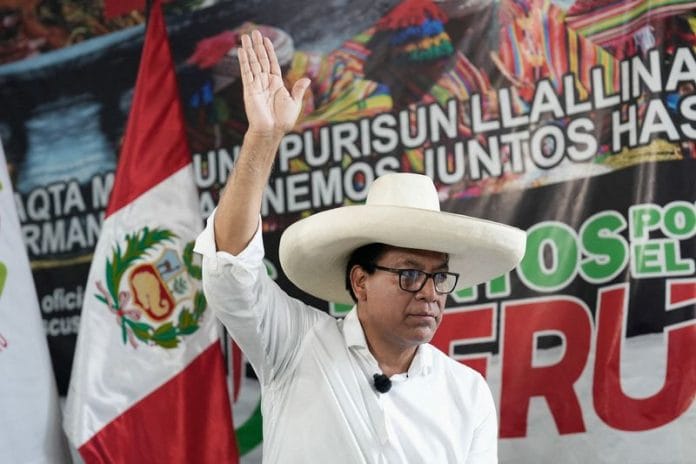
“We want a new social contract, a plurinational state that recognizes the true face of Peru,” Sanchez said, speaking in an office for the Together for Peru party in Lima where he showcased a wide-brimmed straw hat he said belonged to Castillo — a symbol closely associated with the former president’s rural base.
Sanchez has secured around 12% of the vote, in second place behind Fujimori with 17% in an election marked by delays and competing claims of irregularities, with nearly 92% of ballots counted as of Wednesday evening. The two candidates with the most support advance to the runoff.
External observers have acknowledged problems with the ballot but have cited no evidence of fraud.
The close battle for second place has become a focal point for investors. The late swell in support for Sanchez, whose proposals include a new constitution and revisions to mining contracts, could rise further as rural votes, which tend to lean left, are fully tallied.
DEMANDING JUSTICE FOR EXCLUDED PEOPLES Sanchez argues the country’s economic model has excluded large parts of society, including remote and Indigenous groups.
“The rural vote, the Andean vote, the Quechua, Aymara and Amazonian vote was never respected,” he said.
“We sell stones. Thirty years of mining and the mining towns are still the poorest in our country.”
Central to his platform is a proposal to convene a constituent assembly that would draft a new constitution to replace the current charter adopted in the 1990s under Alberto Fujimori, father of the leading candidate.
On economic policy, he backs stronger state control over natural resources and has proposed reviewing mining and gas contracts, taxing windfall profits and imposing a wealth tax.
“We are not talking about expropriating anyone’s property,” he said. “We are demanding justice for a people that remain poor despite living atop enormous wealth.”
PERU CURRENCY AND STOCKS SLIP
Raised in an Indigenous family with roots in the Andean south, Sanchez has also said he does not support the current head of the central bank, unsettling investors who view the institution as a pillar of macroeconomic stability.
Markets reacted swiftly as Sanchez advanced in the ballot count. On Wednesday, the sol slid 1.46% against the dollar to its weakest level since late September, while the benchmark Lima stock index fell nearly 5%.
Sanchez’s rise prompted investors to “recalibrate their positions,” said Cesar Huiman, analyst at Renta4 SAB, who called the candidate “less business-friendly.”
ALLIANCE WITH FORMER PRESIDENT CASTILLO
Those concerns are compounded by Sanchez’s close association with Castillo, who gave his endorsement from prison.
Castillo was jailed on rebellion and conspiracy charges after a short-lived presidency that ended in a failed attempt to dissolve Congress in 2022.
During the interview, Sanchez repeatedly referred to Castillo as “president,” reinforcing perceptions that his candidacy represents continuity with the former leader.
Sanchez said he would not hand power back to the former leader if elected, while acknowledging they are closely aligned and in regular contact. He added he would seek his release and pursue justice for those killed during protests following Castillo’s removal.
Some analysts say Peru’s divided political landscape may limit the extent of change regardless of the election outcome.
According to partial results and projections from pre-election polls, Peru’s upper and lower chambers for the 2026 to 2031 term would have greater representation from right-wing parties, though they would remain fragmented.
“The only certainty in Peru’s chaotic 2026 election is that Keiko Fujimori has a place in the June runoff, and that Congress and the new Senate will lean strongly conservative,” said Eileen Gavin, principal Americas analyst at Verisk Maplecroft.
That conservative dominance in the legislature, she added, suggests economic policy is likely to remain steady, helping markets look past the immediate political uncertainty.
(Reporting by Lucinda Elliott and Marco Aquino in LimaEditing by Rod Nickel)
Disclaimer: This report is auto generated from the Reuters news service. ThePrint holds no responsibility for its content.