





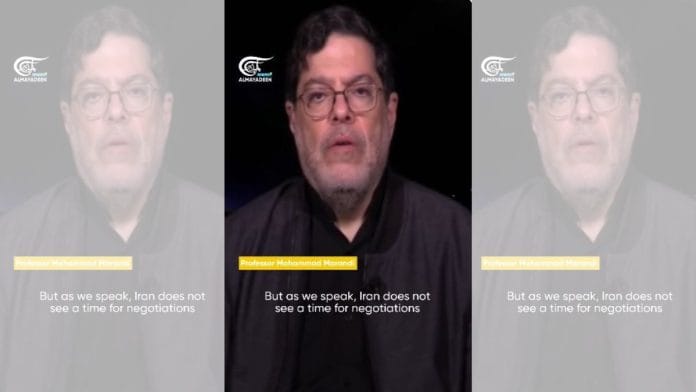



New Delhi: An Iranian-American academic with close ties to Tehran has accused Pakistan, Türkiye, Saudi Arabia and Egypt of complicity in American strikes on Iran, saying these governments brought the war to West Asia by hosting US military bases—and then had the “audacity” to blame Iran for the conflict.
Mohammad Marandi, a professor of English literature and orientalism at the University of Tehran, made the remarks in a video published on 20 March by the Lebanese satellite channel Al Mayadeen.
“It’s really shameful, very shameful, that these foreign ministers of the region, Egypt, Turkey, the Saudis and others, and Pakistan, that they issued a statement where they blamed Iran for a war which they helped start. They assisted the United States in bringing these forces to the region, they assisted the United States in assaulting the country, yet they have the audacity to blame Iran,” Marandi said.
He went further in a separate video published Monday (30 March), naming Qatar, the UAE, Bahrain and Kuwait alongside Saudi Arabia for continuing to host US forces even after a month of strikes on Iran.
“First of all, the regimes in this region have behaved completely irresponsibly. Qatar, the [United Arab] Emirates, Bahrain, Kuwait and Saudi Arabia, they hosted US bases. They allowed those bases to be platforms for murdering Iranians and destroying Iranian infrastructure. And after a month, they still have not ordered the United States to leave their territory,” he said.
“Iran has no problem with these countries having economic, cultural and political relations with the United States, but to have American bases here makes them complicit in the murder of thousands of Iranians by the time this war ends,” Marandi added.
The academic said Tehran would demand reparations from these countries, and that the effective closure of the Strait of Hormuz was among the instruments of pressure available to Iran.
Also Read: Strait of Hormuz is Iran’s trump card. Why has US superiority not secured the seas?
Against negotiations
The academic was unequivocal that Iran has no interest in talks while American military pressure continues–a position that cuts through diplomatic activities under way in the region.
Earlier this week, Pakistan issued a five-point proposal with China to end the war and said it is currently conveying messages between Washington and Tehran. The US has repeatedly said that Tehran was seeking a deal, and that talks were underway. The claims have been denied by the Iranian regime.
“But as we speak, Iran does not see a time for negotiations. Now is not the time for negotiations, for two reasons. One is that the United States is escalating as we speak. Right now the United States is preparing itself for a land offensive. Why should we negotiate when they want to carry out a land offensive? We will not do that. We will negotiate when we have made their defeat clear for everyone,” Marandi said in the Monday video.
“And that time is approaching. We are seeing the global economic crisis beginning to show itself. And in the next two, three weeks, it’s going to become a much bigger problem than what we’re seeing today. It’s a sad reality, but we didn’t start this war. They did, and the world blames them. So the crisis that emerges is going to put huge pressure on the United States,” he said.
Marandi said Iran would entertain the possibility of a deal only once Washington has exhausted its options and needs a way out—and only on Tehran’s terms.
“They want to escalate, let them escalate. We will punish them. And then when the time comes when they can no longer escalate, and they need a way out, then maybe they’ll see Iran’s five conditions to be far more reasonable than they see them today,” he said, referring to conditions laid down by Tehran publicly before any cessation of hostilities was agreed upon.
On the question of the Arab states, Marandi was direct about what he believed the solution required.
“And we know quite well, we know for sure, that if Iran does not retaliate against US assets in the region, that they will continue to strike Iran’s key infrastructure. So if these Arab governments in the Persian Gulf region want the war to end, there’s a very easy solution: say that the Americans must leave immediately. Say that we will no longer allow our airspace or our territory to be used because they fire HIMARS missiles, among other things, at Iranians from these bases,” he said.
Who is Marandi?
Born in the US in 1966, Marandi moved to Iran with his family in 1979 following the Islamic Revolution. He claims to have fought in the Iran-Iraq war as a 16-year-old and to have survived two Iraqi chemical attacks during the nine-year conflict, which ended in 1988. He completed his PhD at the University of Birmingham.
Marandi has been a fixture in Iranian nuclear diplomacy for over a decade, accompanying several negotiating teams, including the delegation led by then-foreign minister Javad Zarif between 2013 and 2015. That team negotiated the Joint Comprehensive Plan of Action, carving out terms for Iran’s nuclear energy activities, which the US signed in 2015 under the Barack Obama administration. President Donald Trump withdrew from the deal during his first term in 2018.
Marandi is widely perceived as a voice sympathetic to the Iranian administration, though organisations outside the country have described him as the government’s “mouthpiece”. He has also criticised India in the past.
His choice of platform is itself a signal: Al Mayadeen, which commenced operations in 2012 and is considered close to both the Iranian regime and its affiliated group Hezbollah.
Also Read: Why Chinese media is amplifying Pakistan’s role in US-Iran ceasefire talks