








NASA’s Lockheed Martin Corp.-built Orion capsule ignited its main engine in space late Thursday, putting the crew on track for a historic lunar flyby.
Known as the translunar injection burn, this step had little room for error in order to put Orion on the correct trajectory for the 10-day mission to lap the moon.
“With this burn to the moon, we do not leave Earth,” said astronaut Christina Koch before the engine ignited. “We choose it.”
The four-member crew of the Artemis II mission launched to space Wednesday evening from the Kennedy Space Center in Florida.
It’ll take the crew about four days to travel to the lunar vicinity, with plans for a flyby of the surface on April 6.
If successful, the journey will be a major victory for NASA, which has spent years trying to get this point and billions of dollars. The space agency has long-term plans to set up a base on the moon where astronauts can live and work.
The astronauts for the Artemis II mission — named after the twin goddess of Apollo in a nod to the NASA moon missions of the 1960s and 1970s — won’t land on the lunar surface during this journey. But the plan is for a future crew to do so in 2028.
If the current mission unfolds as planned, the astronauts’ trajectory will take them within roughly 4,112 miles (6,618 kilometers) of the moon, with the orb appearing about the size of a basketball held out at arm’s length in the capsule window.
The crew would break the record for the farthest any human has traveled in space, surpassing the crew of the Apollo 13 mission in 1970.
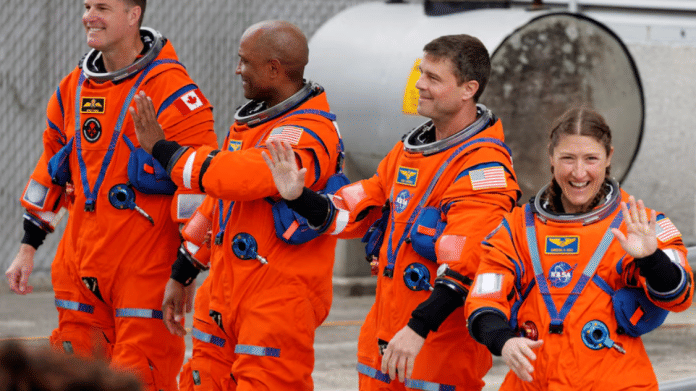
Artemis II is commanded by NASA astronaut Reid Wiseman. He is joined by NASA astronauts Victor Glover, the mission’s pilot, and Koch, a mission specialist. Rounding out the crew is Canadian astronaut Jeremy Hansen.
As they travel to the moon, the crew will conduct various tests and experiments, as well as prepare for imaging the lunar surface during their flyby. At one point, the crew is slated to conduct a call with the crew on the International Space Station – a first of its kind communication for NASA.
–With assistance from Tonya Garcia.
Disclaimer: This report is auto generated from the Bloomberg news service. ThePrint holds no responsibility for its content.