





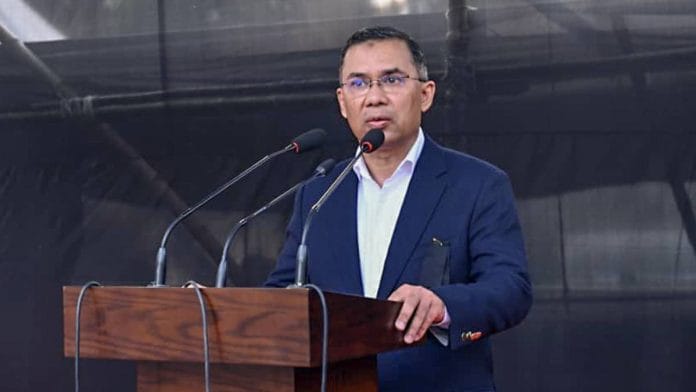



New Delhi: Bangladesh’s newly elected Prime Minister Tarique Rahman made a pointed reference to the country’s fraught history with Pakistan, describing the 1971 crackdown by (then West) Pakistan forces as “one of the most heinous genocides in history”, in a message marking Genocide Day Wednesday.
Posting on X, he said the assault on unarmed Bangladeshis, carried out as Operation Searchlight, turned 25 March into one of the most “disgraceful and brutal days”.
The pointed remarks by the prime minster reflect how Operation Searchlight is a chapter far from closed, as one of the deepest and most enduring points of contention between the two countries that continues to overshadow their bilateral relations even decades later.
While Pakistan has maintained that the matter was settled through past agreements and outreach, for Bangladesh it remains a historical injustice for which it never got an official apology.
“In the history of freedom-loving Bangladesh, 25 March 1971 remains one of the most disgraceful and brutal days. On that dark night, the Pakistani occupation forces carried out one of the most heinous genocides in history against the unarmed people of Bangladesh in the name of ‘Operation Searchlight’,” he wrote.
March 25, 1971 is observed as Genocide Day. On the occasion of Genocide Day, 1 pay my deepest respect to all the martyrs.
In the history of freedom-loving Bangladesh, 25 March 1971 remains one of the most disgraceful and brutal days. On that dark night, the Pakistani occupation… pic.twitter.com/ENyyvnz8Tw
— Tarique Rahman (@trahmanbnp) March 24, 2026
It was Rahman’s father, Zia-ur-Rahman, then a major in the Pakistan Army (part of the East Bengal regiment), who was the first to revolt against the Pakistani forces. He was a key figure during Operation Searchlight who rebelled against the military crackdown.
On 27 March, 1971, he announced Bangladesh’s independence on behalf of (then leader of Bengali nationalism and president of the Awami League) Sheikh Mujibur Rahman via the Kalurghat radio station, and went on to serve as a prominent commander in the Bangladesh Liberation War.
PM Rahman noted in his post that it is essential to “know about the genocide” and “honour the sacrifices of the martyrs”, while terming it a “pre-planned massacre”.
“The genocide of 25 March was a pre-planned massacre. Why this organised killing spree could not be resisted remains a matter of historical research regarding the visible role of the political leadership of that time,” he stated.
Rahman framed the commemoration of martyrs as a call to uphold the ideals of the liberation struggle while calling on Bangladeshis to build a democratic and self-reliant nation.
‘To convey the value and significance of independence to the present and future generations, it is essential to know about the genocide of 25 March as well. Let us all strive to honour the sacrifices of the martyrs by establishing in the state and society the spirit of the great Liberation War – equality, human dignity and social justice.”
Also Read: Pakistan asks Christians to vacate Islamabad colony. Says it’s govt land
Revisionism & Dhaka-Islamabad ties
Relations between Bangladesh and Pakistan have long been strained over the legacy of the 1971 Liberation War. Bangladesh has repeatedly called for an official apology and international recognition of the atrocities committed by the Pakistani military during the war.
Ties had improved during the Yunus administration after the fall of the Sheikh Hasina government on 5 August, 2024. The Yunus administration then actively engaged with the Pakistani government, and both countries held their first foreign secretary-level talks in more than a decade.
Since then, Pakistan and Bangladesh also resumed direct trade for the first time in decades, and senior military officials from both sides held a series of meetings.
Rahman’s Bangladesh Nationalist Party (BNP) has historically taken a more pragmatic approach to relations with Pakistan than its political rival, the Awami League, which long emphasised the legacy of the 1971 war in its foreign policy posture.
Pakistan’s Foreign Minister Ishaq Dar had claimed the year 2025 was a turning point in Pakistan-Bangladesh relations, describing it as a “major” ice-breaker after years of diplomatic coldness. Dar also termed the two nations as “brothers” while speaking at a year-ending press conference in Islamabad.
During an August 2025 visit to Dhaka, Dar also claimed that all outstanding issues stemming from the 1971 Liberation War had been “settled” decades ago, and urged Bangladesh to “clean its heart” and move on. He cited the 1974 tripartite agreement between Bangladesh, Pakistan and India, as well as former Pakistani President Pervez Musharraf’s 2002 visit to Dhaka, as evidence that the chapter had been closed.
Bangladesh’s interim leadership, however, publicly rejected that assertion. Then foreign adviser Touhid Hossain said Dhaka does not accept Pakistan’s claim that the matter is resolved, and reiterated long-standing demands for a formal apology, repatriation of Pakistani citizens who remain stranded in Bangladesh and a fair share of pre-1971 financial assets.
Hassan added that dialogue would continue with Pakistan but acknowledged that “the issues of 1971 cannot be solved in a day”.
Post the fall of the Hasina government, under the interim leadership of Muhammad Yunus, Liberation War narratives and revisionism have become a key point of discussion amid Dhaka’s warming ties with Islamabad.
When Yunus and Pakistan Prime Minister Shehbaz Sharif met on the margins of the D-8 summit in Cairo in December 2024, Yunus had said it would be nice to resolve things “once and for all for the future generations”.
Sharif responded by saying the 1974 tripartite agreement had settled things, “but if there are other outstanding issues”, he would be happy to look at them.
Since the BNP’s return to power, contact between Dhaka and Islamabad has increased as well. Pakistani leaders, including PM Sharif, were quick to congratulate Rahman on his landslide electoral victory.
(Edited by Nida Fatima Siddiqui)