





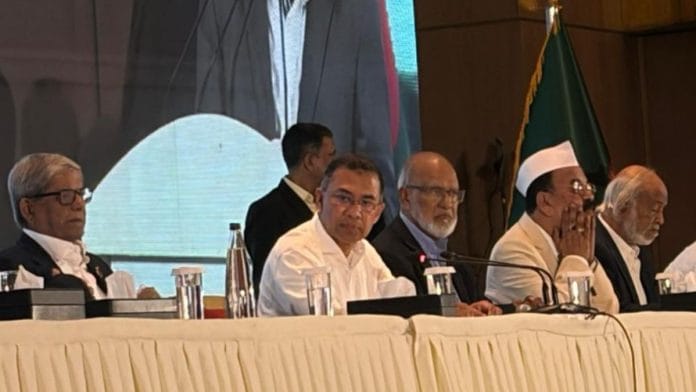



New Delhi: Tarique Rahman, in his first news conference as prime minister-elect, struck a tone of triumph and reconciliation, declaring that Bangladesh had “restored the true essence of freedom and rights”, after more than a decade and a half of “authoritarian rule”.
“The victory belongs to Bangladesh. The victory belongs to democracy,” Rahman told foreign journalists, opening an address that mixed celebration with caution. “From today, we are all free.”
The Bangladesh Nationalist Party (BNP) won a decisive mandate in the elections, which Rahman has characterised as free, fair, and credible—a sharp break, he said, from the political climate of recent years.
The PM-elect of Bangladesh thanked the interim authorities as well as the election commission for overseeing a peaceful voting process, besides expressing gratitude to members of the armed forces, civil administration, and election workers, who administered polling in the country.
Yet, even in victory, Rahman emphasised the scale of the challenge ahead.
“We are about to begin our journey in a situation marked by a fragile economy left behind by the authoritarian regime, weakened constitutional and statutory institutions, and a deteriorating law and order situation,” he said.
Even though Rahman did not mention Hasina by name, his comments were understood as a reference to the former prime minister, ousted from Bangladesh in 2024.
Later, when asked directly about Hasina’s future, Rahman said any action regarding her would depend on a “legal approach”, thereby suggesting that the matter would be handled through judicial channels rather than political decree.
Rahman framed the election as a democratic reset after years of turbulence, crediting mass movements, including the 2024 July uprising, for paving the way for change.
He also paid tribute to those killed or injured in all political struggles, dating back to the 1971 War of Independence, invoking what he called Bangladesh’s long arc of sacrifices for democracy.
At several points, Rahman called for national unity, urging both allies and rivals to avoid post-election reprisals.
With reference to the 51 parties that participated in the elections, including Bangladesh Jamaat-e-Islami, he stressed that democracy required a responsible opposition, along with a responsible government.
“Our paths and opinions may differ,” he said, “but in the interest of the country, we must remain united.”
“Peace and order must be maintained at any cost,” he said, adding, “No wrongdoing or unlawful activity will be tolerated.”
Rahman also pledged to implement his party’s “31-point agenda”—a reform framework developed in consultation with other political groups, reiterating commitments to combat corruption, strengthen the rule of law, and restore accountability in public institutions.
Foreign policy questions loomed large at the briefing.
Rahman said his government would seek balanced relations with all major partners, including India, Pakistan and the United States, describing a “no country-centric policy” that would apply equally to all.
On regional cooperation, he expressed interest in reviving the long-dormant South Asian Association for Regional Cooperation, commonly known as SAARC, saying that he would consult with regional “friends” about restoring momentum to the bloc.
Pressed on economic partnerships, including ties with China, Rahman, in a cautious reply, said, “We will see. If that helps the economy of Bangladesh.”
The comment underscored his broader message that foreign relations would be guided primarily by domestic economic needs.
(Edited by Madhurita Goswami)
Also Read: Gen Ziaur, Khaleda Zia & now Tarique Rahman: tracing India-Bangladesh ties during BNP years