





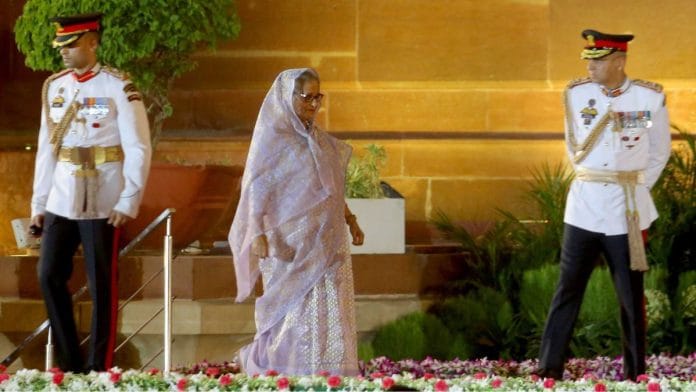



New Delhi: Former Prime Minister Sheikh Hasina has now been sentenced to a five-year jail term in a land scam case. The next day, an inquiry panel investigating the 2009 Bangladesh Rifles (BDR) revolt also accused her of “green signalling” the mutiny. The commission has alluded to India as well, saying Hasina conspired with a “foreign force” to “weaken the Bangladesh Army”.
This follows the International Crimes Tribunal of Bangladesh’s death verdict for Hasina last week for her government’s ‘crimes against humanity’ during the 2024 student protests. At the time, she was given a 21-year prison sentence for three separate corruption cases.
In the latest developments, a special judges’ court handed down jail terms to Hasina, along with her sister, Sheikh Rehana, and her niece and Rehana’s daughter—British Labour Party’s ex-MP Tulip Siddiq—Monday after finding them guilty in a land corruption case, connected to the Purbachal New Town project. In the BDR case, the commission formed by the Muhammad Yunus-led interim administration in December last year reported that Hasina was involved in the 2009 mutiny.
At a news conference Sunday, commission chief A.L.M. Fazlur Rahman, moreover, accused a ‘foreign force’ of trying to destabilize Bangladesh and weaken its army. Yunus then welcomed the commission’s report, saying, “The truth has finally been revealed.”
Bangladesh Rifles (BDR)—a paramilitary force primarily guarding borders—opened fire on senior officers in 2009. Nearly 74 people, including 56 officers seconded to the BDR, died in the two-day mutiny. An earlier Hasina government-led probe had attributed the mutiny to the army personnel’s pent-up anger over low pay and lack of promotion, among other setbacks.
Hasina has maintained that all the allegations against her are false and described the ICT trial as “rigged”, conducted by an “unelected government with no democratic mandate”.
‘Green signal’
Starting on 25 February 2009, the Bangladesh Rifles Revolt, also known as the Pilkhana massacre, was a mutiny led by the border forces for two days. During the uprising, soldiers took hostages and killed the then-director general of Bangladesh Rifles—Shakil Ahmed—and 56 other army officers, along with 17 civilians, in Pilkhana. By the next day, the unrest had spread to 12 towns and cities. It only ended after the mutineers surrendered their arms and had a series of negotiations with the then-Awami League government.
Led by Hasina, the government then formed a committee to investigate the massacre, but had to reform it after allegations of partiality. The trial of the rebels over the next few years, followed by their sentencing, turned into an affront to international legal standards, with Amnesty International calling the whole thing “designed to satisfy a desire for cruel revenge”, as over 50 rebels died in custody.
Post-Hasina’s ouster, the Yunus-led interim administration initially refused to form a commission to open an investigation into the massacre again. However, it relented after the student movement announced protests across Bangladesh. On 23 December last year, the Ministry of Home Affairs formed a seven-member commission to re-investigate the case.
It is this commission’s report, which claimed the revolt was not spontaneous, but a planned operation, and Hasina gave the “green signal” to the mutineers to open fire on their seniors. She allegedly did this by extending responsibility for the soldiers’ grievances to the political and military leadership.
Purbachal New Town case
Rehana—the prime accused in the Purbachal New Town land corruption case among 17 suspects—has been sentenced to seven years in jail, Hasina to five, and Tulip Siddiq to two. The district special judge’s court in Dhaka handed down these sentences on Monday. According to the court, Hasina misused her prime ministerial powers, whereas Siddiq influenced her aunt and mother to acquire a land plot in a government project.
As a former Labour MP, Tulip Siddiq represented Hampstead and Highgate in the British Parliament. She had denied all charges when the accusations had first come to the fore as “fabricated” for “political vendetta”. In January 2024, however, she resigned as a British government minister. The UK does not have an extradition treaty with Bangladesh, so Siddiq may not go to jail.
Meanwhile, Hasina, whose trials have been conducted in absentia, is in exile in India.
Bangladesh Sunday said it expected India to extradite the former PM. However, it also added that the matter would not impact India-Bangladesh relations in other spheres.
“Since she (Hasina) is convicted, we surely want her extradition to implement the punishment,” Adviser to the Yunus interim government, Md. Touhid Hossain was reported as saying. “I do not think other issues will get stuck for this [Hasina] issue.”
Even though India has acknowledged the Hasina extradition requests, with comments such as it would look into the plea and that the MEA had “taken note” of the tribunal’s verdict, it has so far not reached a decision.
(Edited by Madhurita Goswami)
Also Read: Is Bangladesh ready for ‘developed country’ status? It’s all optics for Sheikh Hasina