





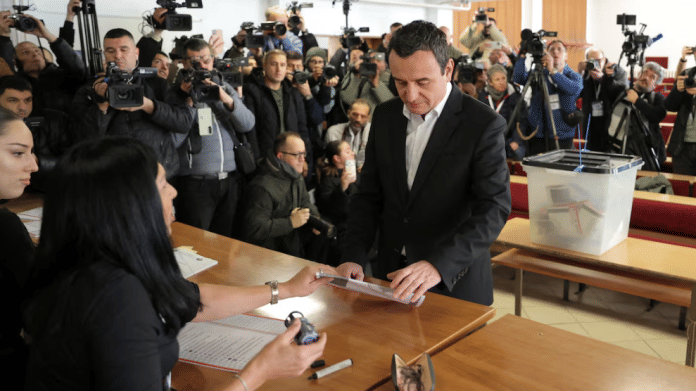



Kosovo will vote in an election aimed at breaking months of political stalemate that left the economy in limbo and stymied efforts to improve ties with allies and resolve tension with the Serbian minority.
The vote on Dec. 28 comes nine months after an election in February failed to produce a governing majority. Since then, repeated attempts to form a government have collapsed, parliament has remained blocked and an interim administration has been unable to pass laws, approve budgets or ratify international financing deals.
Prime Minister Albin Kurti’s Self-Determination Movement is widely expected to finish first, but it’s unclear whether he’ll be able to govern the Balkan nation without a compromise that so far has been elusive. Party leaders have avoided sharp attacks on opponents, signaling some openness to a post-election alliance.
“There is slightly milder language from the leaders of the three main parties, which leaves room for cooperation,” said Agron Demi, chief executive officer of the Atlas Institute think tank in Pristina. “But if there is no cooperation, the numbers are unlikely to differ much from February.”
Meanwhile, Kurti got a boost from the European Union. The bloc said it will lift all sanctions on Kosovo by the end of January, freeing up more than €200 million ($234 million) in stalled aid and development projects.
However, the political deadlock has already had tangible effects on Kosovo’s EU membership chances.
With parliament unable to operate, reforms have stalled and EU-backed and donor-funded projects in energy, infrastructure, and the environment were delayed or frozen. Business groups have warned that prolonged uncertainty is hurting investor confidence and weighing on growth in one of the continent’s poorest economies.
The US, whose support has been vital to Kosovo’s nationhood, suspended a planned strategic dialogue with the country in September, citing concerns over the stability of its institutions.
The election also unfolds against unresolved security and diplomatic challenges. Tensions persist in Kosovo’s Serb-majority north, where checkpoints and frequent patrols reflect ongoing challenges in local governance. Meanwhile, EU-brokered talks with Serbia, which doesn’t recognize Kosovo’s independence, have effectively stalled.
Read More: Kosovo’s New Bridges Cement Divisions in a City Guarded by NATO
Demi said the vote alone is unlikely to reset relations with Belgrade. Achieving that might take US intervention, he said.
Kurti, 50, has framed the election as an opportunity to ensure the continuation of progress. “With the next majority, we can continue the work we have already started,” he said in the northern city of Mitrovica on Dec. 17.
This report is auto-generated from Bloomberg news service. ThePrint holds no responsibility for its content.