








Early in 2003, with the US still in shock over Al Qaeda’s 9/11 terrorist attacks, Washington called on allies to join it in going to war with Iraq. Some answered the call, but not France, which argued forcefully against invading. Americans were so outraged by this show of disloyalty that an old Simpsons meme describing the French as “cheese-eating surrender monkeys” became common enough to make the Oxford Dictionary.
With hindsight, France’s then-president Jacques Chirac was America’s best ally. He foresaw the coming debacle and tried to protect the White House from it, drawing on his personal experience as a lieutenant in the French military as it tried to keep control of Algeria in the 1950s. I’m reminded of that episode as a new version of the “surrender monkey” narrative takes hold in Washington today.
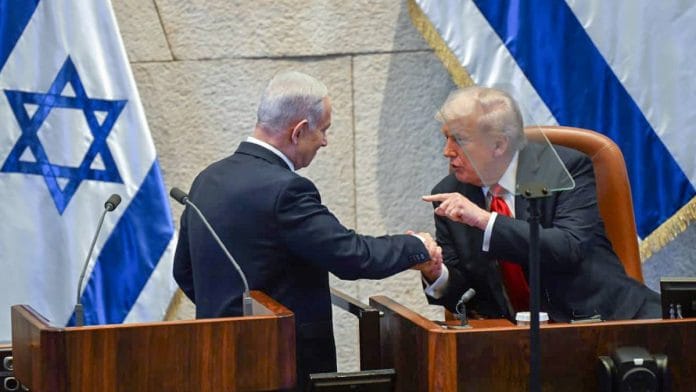
This was best articulated by US Secretary of Defense Pete Hegseth and goes roughly as follows: Israel is the new model US ally because — unlike traditional American partners “who wring their hands and clutch their pearls” — it is both militarily capable and willing to fight to achieve its goals.
This is compelling, because it’s mostly true. It’s also dangerously superficial. There’s no doubt Israel is well armed and motivated; the US pays $3.8 billion in annual aid to make sure of the first, while Hamas, Hezbollah and Iran have assured the second. It’s more than willing to bomb Iran at a time when US allies in the North Atlantic Treaty Organization, the Persian Gulf and East Asia are not. But Hegseth’s argument for Israel as a model is wrong where it counts most.
First, alliances are about aligning interests and are usually defensive for that reason: Everyone agrees that getting attacked is a bad thing. But this is a war of choice, it is not self defense and Israel’s interests in Iran are not the same as those of the US. It faces an immensely greater — if not imminent — threat, which means it also has a much higher threshold for economic and human loss in this war.
President Donald Trump’s core problem is that the Islamic Republic has an even higher pain threshold than Israel, let alone American voters. This gives the Iranians escalation dominance, despite the heavy the losses they’ve endured to their military and leadership. We’re seeing the consequences play out in real time.
On Wednesday, Israel struck onshore facilities attached to the world’s largest working reservoir of natural gas, which Iran calls South Pars and shares with Qatar (think of a giant cup with two straws). Iran responded by calling for the evacuation of all energy infrastructure in the Gulf, and then struck back. It hit Qatar’s facilities for the field, which it calls North Dome, as well as other energy-related targets in the region.
These are some of the most important pieces of energy infrastructure in the world. Trump has now had to ask Tehran for a truce on such strikes, saying that Israel’s Prime Minister Benjamin Netanyahu didn’t tell him what he was planning. Netanyahu said Israel had acted alone, which, given the global implications of such an escalation would be both remarkable and telling.
Much like the US after 9/11, Israel is trying to use force to fundamentally reorder the Middle East in the wake of a mass terror attack. For that purpose, it does not matter as much to Israel if Iran becomes a failed state, or disintegrates, or if oil prices soar, setting back the global economy. It’s also no obstacle if the Gulf states come to be seen as too unsafe to attract AI infrastructure. But all of this does matter to American allies in the Gulf and Europe, as well as to the US economy.
In Israel, the war has wide support. It works politically for Netanyahu. That isn’t true in the US, where most Americans oppose the war, gasoline prices are rising and midterm elections approach. The MAGA-friendly director of the National Counterterrorism Center, Joe Kent, resigned over the issue, claiming that Israel hoodwinked Trump into getting the US involved in a war that doesn’t serve its interests.
This is hardly unique. As my colleague Andreas Kluth has noted, smaller allies, even capable and deserving ones, have a habit of dragging great powers into wars they come to regret and sometimes can’t control. That is not a model to boast about, it’s a cautionary tale.
A second weakness in the Israel model lies in the portrayal of other US allies as worthless hand wringers that don’t show up when America needs them — a point Trump has made explicitly. This is empirically false, because even though America’s allies are understrength, they have fought for and with it many times, including in Afghanistan, Iraq, Libya and Syria. But this is not America’s hour of need; it is its hour of error.
Trump and Hegseth have taken on an ideologically driven enemy practiced in asymmetric warfare, without any apparent strategy for overcoming that challenge. So confident were they about their conventional military advantages and personal brilliance that they ignored the advice of the very Gulf state allies who know Iran best and stood to lose or gain most.
Now the US is stuck. The Iranians are getting hit hard, but they only need to be able to fire a few drones to disrupt the Strait of Hormuz or blow up Gulf energy infrastructure, which is enough to keep them in the game until the US runs out of patience or missile interceptors.
This is an almost impossible threat for even the US and Israeli air forces — the most capable in the world — to suppress without ground troops physically taking control of the Iranian coastline. It is for now too dangerous for the US Navy to risk its sailors and multi-billion-dollar vessels in the Strait, and the same goes for the European and Asian allies Trump tried to bully into doing the job, despite having failed to consult them before launching the war.
The Iranians now control who gets in and out of the Gulf and are talking about charging a permanent toll to monetize this power. That will remain the case if Trump decides he has won and walks away, and will give Iranians a deciding vote in whether and when stability returns to the region.
So Trump, encouraged into this war by a model ally, is now facing the same question — whether to escalate in hope of victory, or find an inglorious off ramp — that his predecessors faced in wars of choice from Vietnam to Afghanistan to Iraq. Chirac, were he still alive today, could have warned the White House this would happen.
This report is auto-generated from Bloomberg news service. ThePrint holds no responsibility for its content.
Also Read : India blocks Oscar-nominated film to maintain ties with Israel, says Mumbai distributor