





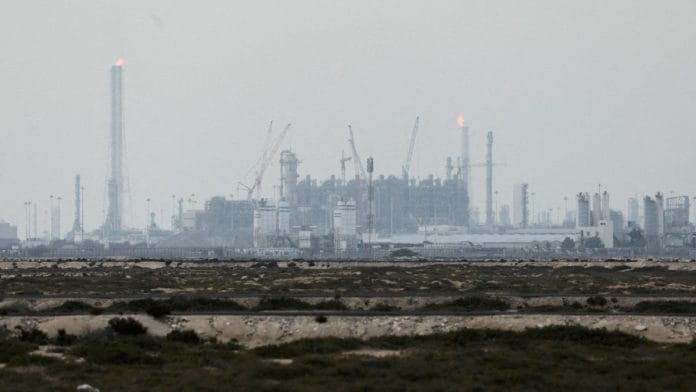



New Delhi: Around 17 percent of Qatar’s annual liquefied natural gas (LNG) exports has been wiped out by Iran’s attack on the Ras Laffan Industrial City, QatarEnergy announced Friday morning.
The state-owned Qatari petroleum company in a statement said that Tehran’s airstrikes have caused a loss of around $20 billion annually, compelling QatarEnergy to declare a “long-term force majeure”.
“QatarEnergy expects the damage to its Ras Laffan Industrial City caused by missile strikes, which occurred on Wednesday 18 March 2026, and in the early hours of Thursday 19 March 2026, to cost about $20 billion a year in lost revenue and to take up to five years to repair, impacting supply to markets in Europe and Asia,” the company said in a statement.
The statement added: “The attacks damaged two liquefied natural gas (LNG) producing Trains 4 and 6 totaling 12.8 million tons per annum (MTPA) of production, representing approximately 17 percent of Qatar’s exports. Train 4 is a joint venture between QatarEnergy (66 percent) and ExxonMobil (34 percent), and Train 6 is a joint venture between QatarEnergy (70 percent) and ExxonMobil (30 percent).”
The strike on Qatari energy infrastructure by Iran came in response to Israel’s attack on the South Pars natural gas field Wednesday. The South Pars production site is the largest natural gas manufacturing facility in Iran.
In the immediate aftermath of the attack on its site by Tel Aviv, Tehran informed all the nations in the region to evacuate its energy production facilities and later launched attacks across Qatar, the United Arab Emirates and Saudi Arabia.
For India, Qatar is a major source for LNG. Around 40 percent of India’s import comes from the West Asian nation. Just last October, QatarEnergy signed a 17-year long term supply agreement with Gujarat State Petroleum Corporation (GSPC) for the sale of up to one million tonnes per annum of LNG. This agreement builds upon an older agreement struck in 2019 for the long-term sale of LNG.
Petronet LNG Limited, India’s flagship LNG terminal company founded by the Government of India, has had a long-term relationship with QatarEnergy. Since 1999, QatarEnergy and Petronet have had an agreement for the sale of up to 7.5 million tonnes per annum of LNG. The agreement was extended by two decades in 2024, running till 2048.
India Thursday called on countries to cease all attacks on energy infrastructure, imploring both Israel and Iran to stop such strikes, marking a significant shift in posture. Since the start of the war between Israel, the US and Iran at the end of February, India has not explicitly called out Tel Aviv, while it has at times condemned Tehran’s response.
The attacks on QatarEnergy, prompted the Indian Ministry of External Affairs to note during a regular press briefing Thursday that the government is looking to all sources including Russia for immediate LNG purchases.
US President Donald J. Trump Wednesday distanced the American administration from Israel’s strikes on the South Pars gas field, stating that they “knew nothing” about the attack. He announced that Israel will stop conducting such strikes and called on Iran to do the same.
Trump vowed to destroy Tehran’s energy infrastructure if Iran continues its strikes on energy infrastructure in the region.
Israel had informed the US in advance of the strikes, according to reports by the American news agency the Associated Press. Tel Aviv’s attacks on Iranian energy sources have faced some pushback from the US. For example, its attacks on the oil fields surrounding Tehran earlier this month was mildly criticised by Senator Lindsey Graham, one of Tel Aviv’s staunchest supporters in the US Congress.
The UAE had also shut down its Habshan gas fields Wednesday, following an attack by Iran. The UAE military was able to intercept all the missiles and the debris is said to have caused limited damage, however, the extent has not been publicly stated by the Abu Dhabi National Oil Company (ADNOC).
Israel and Iran’s tit-for-tat strikes on energy infrastructure led to a surge in oil prices Thursday, with the Brent futures benchmark trading at $112 a barrel. However, oil prices have slipped to around $105 a barrel Friday, following clarification from Israeli Prime Minister Benjamin Netanyahu that Tel Aviv acted alone in the strike on South Pars.
The war has also seen the closure of the Strait of Hormuz, which accounts for roughly a fifth of the global supply of energy. India has been negotiating the safe passage of its tankers from the Strait with Iran. At least two tankers were able to pass through the Strait and reached India earlier this week.
(Edited by Amrtansh Arora)