





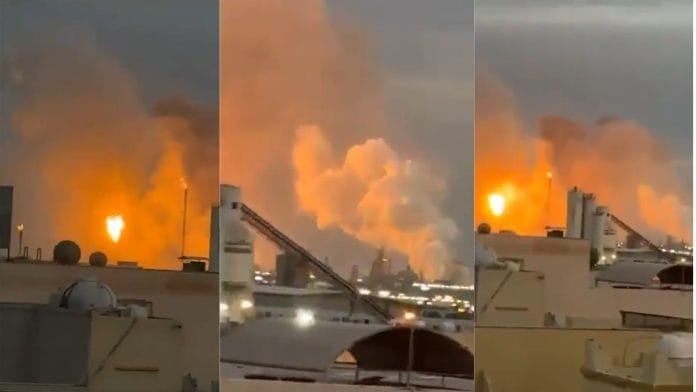



Israel and the US launched what they called a “preemptive strike” against Iran on the morning of 28 February, plunging the region into chaos as Tehran launched counter strikes that also targeted American military bases across the Gulf. Tensions persist as the string of strikes and counter-strikes continues.
Iran’s Supreme Leader Ayatollah Ali Khamenei was killed in the attack, after which Alireza Arafi was picked as the interim successor. Arafi has been appointed the jurist member of the temporary leadership council to fulfill the Supreme Leader’s role.
Israeli Defence Minister Israel Katz had first announced the strike Saturday that many believed was a long time in making, with the White House stepping up pressure on Tehran over its nuclear programme.
US President Donald Trump described the military action as “massive and ongoing”, and plainly called for a regime change. He urged Iranians to “take over your government” and accused Tehran of working to rebuild its nuclear programme. Tehran has long maintained that its nuclear programme is for civilian purposes only. Iran’s state media said the country was preparing for “a crushing response”.
Stay tuned to ThePrint for the latest developments.
US, Israel strike Iran | LIVE UPDATES
10.30 pm: Bahrain says refinery struck
The interior ministry of Bahrain said in a statement that one of the country’s oil refineries in Maameer was struck, reported news agency AFP.
JUST IN: 🇮🇷🇧🇭 Iran strike Bahrain's largest oil refinery. pic.twitter.com/y7OZdlrhCV
— BRICS News (@BRICSinfo) March 5, 2026
9.15 pm: Azerbaijan closes part of its airspace, vows retaliation
Hours after Azerbaijan accused Iranian drones of crossing its borders and targeting civilian facilities, “including the Nakhchivan International Airport and its terminal building, a school, and other civilian sites,” President Ilham Aliyev said he has instructed Azerbaijan’s armed forces to “prepare and implement appropriate retaliatory measures”.
Earlier in the day, Azerbaijan closed part of its airspace.
Iranian officials have denied any involvement in the strikes on facilities in Azerbaijan.
9 pm: UK sending fighter jets to Qatar, says Starmer
In a news conference in London, UK Prime Minister Kier Starmer said the UK is sending four additional Typhoon jets to Qatar. He also confirmed that nearly 4,000 people have returned to the UK from the Gulf on commercial flights.
8 pm: Navy says it launched search & rescue after US struck Iranian ship
The Indian Navy in a statement Thursday said it launched a search and rescue operation after a “distress call from from IRIS Dena was received at the MRCC Colombo in the early hours of 4 March 2026”.
“INS Tarangini which was operating in vicinity was deployed for aiding the rescue efforts and arrived in search area by 1600 hr on 04 March 2026,” the statement said, adding that INS Ikshak also sailed from Kochi to assist with the search and rescue.
Read full report here.
https://t.co/PiqQpVIrMu pic.twitter.com/Wc1e0B0um7
— Department of War 🇺🇸 (@DeptofWar) March 4, 2026
7.50 pm: US releases video of strikes on Iranian facilities
The US Central Command Thursday released video footage of strikes on Iranian facilities, including what appears to be an aircraft hangar.
The Iranian regime's ability to impact U.S. forces and regional partners is rapidly declining, while American combat power continues to build. pic.twitter.com/21TXHbWwFi
— U.S. Central Command (@CENTCOM) March 5, 2026
6.20 pm: Modi, Macron discuss West Asia
Prime Minister Narendra Modi spoke to French President Emmanuel Macron and the two discussed “shared concerns over the evolving situation in West Asia and the need for a return to dialogue and diplomacy”.
Spoke with my friend President Emmanuel Macron today. We discussed our shared concerns over the evolving situation in West Asia and the need for a return to dialogue and diplomacy. We will continue to engage closely and coordinate efforts towards the early restoration of peace…
— Narendra Modi (@narendramodi) March 5, 2026
6 pm: Jaishankar speaks to Iranian counterpart
External Affairs Minister Dr S Jaishankar held a teleconference call with his Iranian counterpart Seyed Abbas Araghchi shortly.
Earlier in the day, Jaishankar held a telephonic conversation with Foreign Minister Sayyid Badr bin Hamad bin Hamood Albusaidi of Oman.
Had a telecon with Iranian FM Seyed Abbas Araghchi this afternoon. @araghchi
— Dr. S. Jaishankar (@DrSJaishankar) March 5, 2026
5.15 pm: Second Iranian vessel seeks Colombo’s help
A second Iranian vessel has sought Sri Lanka’s help. Though it is unclear whether it is an Iranian naval vessel, Sri Lankan media reported that it is IRIS Bushehr, a replenishment ship, with around 100 crew members on board.
Read full report here.
4.35 pm: Foreign Secy Misri signs condolence book at Iran Embassy
Indian Foreign Secretary Vikram Misri met Iran’s Ambassador to India Dr Mohammed Fathali at the Iranian Embassy in New Delhi to offer condolences on the killing of Iran’s Supreme Leader Ayatollah Ali Khamenei. Misri, on behalf of the Indian government, also signed the condolence book. This marks the first formal engagement between the Indian government and Tehran since the US and Israel launched strikes against Iran last week.
3.45 pm: 105 civilian sites attacked so far, says Iranian Red Crescent
Since 28 February, 174 counties in the country have been impacted, with a total of 1,332 attacks recorded in 636 locations. So far, 105 civilian sites and centers have been subjected to attack, according to the Iranian Red Crescent Society.
3.30 pm: ‘How China sees Iran’s post-Khamenei trajectory. It depends on four factors’
Sana Hashmi, ThePrint columnist and fellow at Taiwan Asia Exchange Foundation, writes in Eye on China:
“Chinese analyses of the escalating tensions surrounding Iran suggest that a prolonged war is increasingly plausible. These assessments emphasise that the timing, pace, and intensity of the conflict are shaped by deliberate political calculations in Washington and Tel Aviv. 2026 is identified as a potential inflection point in Iran’s political trajectory—one with the potential to produce far-reaching consequences across the Middle East and beyond.
Liu Yanting, a Chinese analyst of Middle Eastern affairs, contends that the death of Supreme Leader Ali Khamenei would create a critical window for Iran’s military to assert direct control. In this scenario, a successful intervention by the armed forces could transform Iran into a military-dominated state, akin to Egypt or Pakistan, where authority is grounded in coercive capacity rather than revolutionary ideology. Yet even under such a restructuring, entrenched structural challenges, systemic corruption, economic decline, energy shortages, and institutional fragility would likely persist.
More broadly, Iran’s post-Khamenei trajectory is viewed as contingent on four interrelated factors: The scale and persistence of domestic unrest driven by economic hardship; the cohesion and loyalty of the Islamic Revolutionary Guard Corps as the regime’s central pillar; sustained external pressure from the US aimed at constraining or reshaping the regime; and the legitimacy and effectiveness of the succession process overseen by the Assembly of Experts.
Within this framework, Chinese discourse places particular emphasis on the role of the US, evaluating both the strategic feasibility of deeper American involvement and the broader geopolitical consequences such developments could produce, particularly for Beijing.”
Read full column here.
3.15 pm: Qatar’s air defence systems ‘intercepting missile attack’
Qatar Ministry of Defence says that the country has been subjected to a missile attack, which the air defence systems are intercepting.
— وزارة الدفاع – دولة قطر (@MOD_Qatar) March 5, 2026
3.00 pm: Explosions heard in Doha
Multiple explosions heard in Doha, Qatar, reports say.
2.10 pm: Sri Lanka trying to ‘safeguard lives’ on another Iranian ship off its coast
Sri Lanka has said it is trying to “safeguard lives” on another Iranian ship off its coast. According to Reuters, the country’s cabinet spokesperson Nalinda Jayatissa said that the vessel was in the economic zone beyond the South Asian island nation’s territorial waters. “We are doing our utmost to safeguard lives.”
On Wednesday, Iranian frigate IRIS Dena, sailing home from India after last month’s International Fleet Review and MILAN multilateral naval exercise, was sunk by an American submarine off Sri Lanka’s coast.
2.00 pm: Italy planning to send air defence aid to Gulf countries, says Meloni
Italy plans to send air defence aid to Gulf countries in the face of Iranian air strikes, Prime Minister Giorgia Meloni has said, Reuters reported.
“Like the United Kingdom, France and Germany, Italy intends to send assistance to Gulf countries, specifically in the field of defence, and in particular air defence,” Meloni told radio station RTL 102.5, according to the report.
“This is not only because they are friendly nations, but above all because tens of thousands of Italians live in the region and around 2,000 Italian troops are deployed there—people we want, and must, protect,” she added.
1.10 pm: ‘Frigate Dena, a guest of India’s Navy, struck without warning’: Iran’s Araghchi
Calling the attack on Iran’s Frigate Dena in Indian Ocean “an atrocity”, Iran Foreign Minister Seyed Abbas Araghchi wrote in a post on X that the US will “come to bitterly regret precedent it has set”.
“Frigate Dena, a guest of India’s Navy carrying almost 130 sailors, was struck in international waters without warning,” he posted.
The U.S. has perpetrated an atrocity at sea, 2,000 miles away from Iran's shores.
Frigate Dena, a guest of India's Navy carrying almost 130 sailors, was struck in international waters without warning.
Mark my words: The U.S. will come to bitterly regret precedent it has set. pic.twitter.com/cxYiI9BLUk
— Seyed Abbas Araghchi (@araghchi) March 5, 2026
1.00 pm: Iran says it fired no missile towards Turkey
Iran military, state media reports, has released a statement, saying, “The Armed Forces of the Islamic Republic of Iran respect the sovereignty of the neighboring and friendly country, Turkey, and deny any missile firing towards Turkish territory.”
This comes after NATO Wednesday claimed to have intercepted a missile headed towards the country over the Mediterranean, and later slammed “Iran’s targeting of Turkey”.
The General Staff of the Armed Forces:
The Armed Forces of the Islamic Republic of Iran respect the sovereignty of the neighboring and friendly country, Turkey, and deny any missile firing towards Turkish territory.
— IRNA News Agency ☫ (@IrnaEnglish) March 5, 2026
12.30 pm: ‘India has a compromised PM’: Rahul slams govt’s silence on Iranian warship sunk in Indian Ocean
Lok Sabha Leader of Opposition and Congress leader Rahul Gandhi says in a post on X, “India’s oil supplies are under threat, with more than 40% of our imports transiting the Strait of Hormuz. The situation is even worse for LPG and LNG. The conflict has reached our backyard, with an Iranian warship sunk in the Indian Ocean. Yet the Prime Minister has said nothing. At a moment like this, we need a steady hand at the wheel.”
The world has entered a volatile phase. Stormy seas lie ahead.
India’s oil supplies are under threat, with more than 40% of our imports transiting the Strait of Hormuz. The situation is even worse for LPG and LNG.
The conflict has reached our backyard, with an Iranian warship…
— Rahul Gandhi (@RahulGandhi) March 5, 2026
12.00 pm: Australia deploying ‘military assets’ to region
Australian PM Anthony Albanese has said that the country is sending ‘military assets’ to the Middle east as part of a contingency plan.
Australia’s SBS News has reported that two military planes have already been deployed.
11.00 am: ‘It was a bit terrifying’: PV Sindhu on being stranded in Dubai
On being stranded amid the conflict in Dubai, Indian badminton player P.V. Sindhu says, “It was a tough situation. I was going for a tournament in Birmingham and when we landed in Dubai, after 15 minutes it was shut. Initially, we didn’t understand how it was. But later, when we got to know, we felt maybe it would be fine soon. But, day by day, they kept saying that the airspace is shut, so it was a bit terrifying. My coach was at the airport and he could hear loud noises and saw huge smoke.”
10.30 am: Oil prices rise as Strait of Hormuz remains shut
Oil prices continue upward trajectory amid growing concern over the prolonged closure of the Strait of Hormuz, as the conflict chokes off vital Middle East oil and gas flows while production facilities limit output.
Brent crude was trading up $1.67, or 2.05 percent, at $83.07 per barrel by 0141 GMT, Reuters reported. US West Texas Intermediate crude rose $1.94, or 2.60 percent, to $76.60.
Iraq, the second-largest crude producer in OPEC, has cut output by nearly 1.5 million barrels a day for lack of storage and an export route, officials told Reuters. Qatar, the biggest liquefied natural gas producer in the Gulf, declared force majeure on gas exports Wednesday, with sources saying a return to normal production volumes may take at least a month.
Shipping via the Strait of Hormuz, a key conduit for nearly a fifth of global energy consumption, has ground to a near-halt for the fifth day amid the conflict.
09.45 am: ‘Can’t rule out participation in war,’ says Carney
Canadian Prime Minister Mark Carney, while on his Australia trip, has said, “One can never categorically rule out participation. We will stand by our allies.”
He had previously remarked that the US-Israeli strikes on Iran are “inconsistent with international law”.
Carney, along with Australian counterpart Anthony Albanese, called for de-escalation of hostilities at a joint press briefing in Canberra.
09.30 am: Some overnight updates
- Heavy bombing in Iran’s Tehran & Bukan
- Israel continues to strike Lebanon
- Explosion near tanker off Kuwait. Crew were reported to be safe. Kuwait said the tanker was located outside its territorial waters
- US govt-chartered flight flying Americans back from Middle East. Canada is also working to evacuate citizens stranded in the region
- Qatar is evacuating residents in areas near US embassy in Doha as a “precautionary measure”
- Iran continues counter-strikes
08.45 am: US Senate blocks War Powers Resolution
US Senate Republicans have backed President Donald Trump’s military campaign against Iran, voting to block a bipartisan resolution aiming to put an end to the conflict and require authorisation by Congress for any action against Iran.
The Senate voted 53 to 47 not to advance the resolution, with all but one Republican voting against the procedural motion, and all but one Democrat supporting it.
The War Powers Resolution sets presidential reporting requirements and parliamentary procedures to reaffirm the Congress’s constitutional role in committing the US into armed conflict abroad. The fast-track procedures, by way of the resolution, provide the opportunity for Congress members to obtain a vote on, or in relation to, legislation that either authorises presidential use of US Armed Forces or directs their removal from hostilities.