





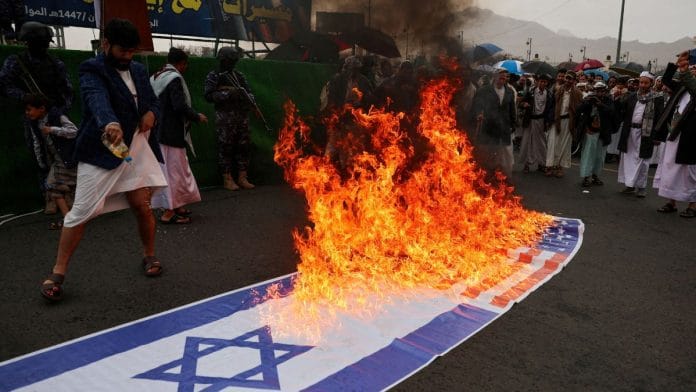



The US and Israeli military strikes that started on 28 February have hit thousands of targets across Iran and triggered retaliatory strikes in the Gulf region as Tehran seeks to impose a high cost on America and its allies.
Iran has attacked countries, including Israel, the United Arab Emirates and Qatar. Azerbaijan became the latest country drawn in, as it accused Iran of firing drones at its territory and ordered its southern airspace closed for 12 hours. Israel has also been carrying out strikes in Lebanon against Hezbollah.
US President Donald Trump Friday declared that there would be no deal with Iran to end the war and that he would only settle for “unconditional surrender”. Iran has also expressed no intention to enter any negotiations with the other side.
US-Israel & Iran conflict | LIVE UPDATES
9.50 pm: ‘US destroyed 42 Iranian ships in 3 days,’ says Trump
Speaking at an event in Florida, Trump said US destroyed 42 Iranian ships in three days, significantly damaging the country’s military capabilities, claiming its navy, air force and communications infrastructure have been heavily hit.
Trump described the ongoing operation as a major success, saying the US ‘did the world a favour’ by launching war on Iran.
9.15 pm: Iran says it has been targeting only military bases & US assets
The Iranian mission to the UN in New York has said that the country is targeting only military bases and US assets.
“With regard to strikes on non-military sites, our preliminary assessment indicates that some of these incidents may have resulted from interception by US electronic defense systems, which may have diverted the projectiles from their intended military targets,” it said in a post on X.
7.00 pm: Iran envoy thanks India for ‘humanitarian approach’ in facilitating docking of IRIS Lavan at Kochi
Iran has expressed gratitude to India for providing safe harbour to its naval vessel IRIS Lavan docked at Kochi port to undertake technical and logistical arrangements following the incident involving IRIS Dena in the Indian Ocean.
Iran’s Ambassador to India Mohammad Fathali told ANI that Iran is closely monitoring the situation after the attack on the warship, while continuing efforts to assess the circumstances and ensure the well-being of crew members.
“I would like to take this opportunity to sincerely thank the Government of India and the local authorities for their cooperation and humanitarian approach in facilitating the docking of this vessel and supporting its crew,” Fathali said. He added that the assistance by Indian authorities reflects the longstanding friendly relations between Iran and India.
5.30 pm: ‘Iran has surrendered to its neighbours’: Trump
Trump has reacted to Iran’s ‘apology’ to its neighbours in a post on Truth Social. He writes, “Iran, which is being beat to HELL, has apologised and surrendered to its Middle East neighbors, and promised that it will not shoot at them anymore.”
“It is the first time that Iran has ever lost, in thousands of years, to surrounding Middle Eastern Countries,” he adds. “Today Iran will be hit very hard! Under serious consideration for complete destruction and certain death, because of Iran’s bad behaviour, are areas and groups of people that were not considered for targeting up until this moment in time.”
5.00 pm: IRGC says armed forces respect the sovereignty of neighbouring countries
After Pezeshkian’s comment that Iran would stop attacks on neighbouring countries—unless an attack originated from there—the IRGC has issued a statement, saying, “Following the statements of the president, the armed forces once again declare that they respect the interests and national sovereignty of neighbouring countries and, up to this point, have committed no aggression against them.”
The statement, carried by Iranian state media, said, “However, should the previous hostile actions continue, all military bases and interests of criminal America and the fake Zionist regime on land, at sea, and in the air across the region will be considered primary targets and will come under the powerful and crushing strikes of the mighty armed forces of the Islamic Republic of Iran.”
3.30 pm: ‘Exploiting Iran’s ethnic fault lines can solve one problem for US-Israel—and create several more’
Swasti Rao, Consulting Editor (International and Strategic Affairs) at ThePrint, writes:
“To understand whether Iran can be destabilised internally, one must first understand the historical and ethnic experience of the Iranian state.
Iran is a civilisational crossroads where diverse peoples, languages, and identities intersect. Any attempt to weaponise these differences must be assessed through an analytical framework that considers historical experience, ethnic diversity, and the transnational nature of minority communities.
Not all minorities can be mobilised in the same way because their relationship with the Iranian state varies widely. Before I turn to the ethnic groups and their varying hostilities toward the regime, the state-society dynamic of Iran merits attention.
Before the Islamic Revolution of 1979, Iran was far less opaque than it is today. For centuries, it had been a society where local leaders, tribal authorities, and clerical figures wielded significant influence. Foreign powers — particularly Britain and Russia — exploited this decentralised political landscape during the late imperial period and into the early 20th century.
As historian Mehran Kamrava has long argued, Iran’s political evolution can be understood through the shifting balance between state power and societal power. Historically, Iran resembled a strong society with a weak state, creating an imbalance manipulated by foreign actors leading to internal fragmentation.
It was precisely this vacuum that enabled Reza Shah Pahlavi to seize power in 1925 and begin consolidating the Iranian state. His rule marked the first serious attempt in modern times to build a centralised national authority capable of resisting foreign interference.
His son and successor, Mohammad Reza Shah, continued that project after 1941, though his methods were deeply controversial. The second Shah’s regime, backed by the West and enforced through an extensive secret police trained with British and CIA assistance, cracked down on democratic activists and religious leaders alike. Instead of strengthening legitimacy, repression deepened popular resentment.
Ironically, these decades of centralisation weakened local power structures and prepared the ground for an even stronger state. When the Shah was overthrown in 1979 and Ayatollah Ruhollah Khomeini returned from exile in Paris on 1 February, Iran entered a new phase: the emergence of a highly centralised Islamic theocracy.”
Read full column here.
2.15 pm: After MILAN, Sri Lanka invited IRIS Dena but turned it away as US-Iran tensions escalated, says report
Iranian ship IRIS Dena was sailing towards Sri Lanka on a diplomatic invite, but the Moudge-class frigate had to abort the journey and “remain in international waters” as the invitation was revoked after tensions ratcheted up between the US and Iran, according to a report in Jaffna Monitor.
The report says that the 11-hour wait in the Indian Ocean made the warship vulnerable to US strikes, and it was torpedoed by a US submarine on 4 March, sinking it within minutes.
According to corroboration from multiple sources familiar with the incident, reports Jaffna Monitor, the invitation was extended during MILAN 2026, a multinational naval exercise hosted by India in the port city of Visakhapatnam.
During the exercise, the Sri Lankan Navy’s representatives reportedly invited the Iranian frigate to conduct a courtesy port call, which is a routine gesture of goodwill intended to deepen maritime cooperation.
However, after the end of the naval exercise on 25 February, the situation in the West Asian region dramatically changed as Tehran found itself engaged in the escalating military conflict with the US and Israel.
As the United States and Iran moved toward open conflict, Colombo reassessed its diplomatic position, the report says.
According to sources familiar with internal discussions in Colombo, the report adds, Sri Lankan officials concluded that allowing an Iranian warship amid the conflict would carry diplomatic risks.
Read Vaibhav Pant’s report.
1.50 pm: Pezeshkian says Iran will not attack neighbours unless it is attacked from there
Iran President Masoud Pezeshkian has apologised to neighbouring countries for the attacks carried out amid its conflict with US and Israel.
In a speech broadcast by Iranian state TV, he said, “I apologise to the neighbouring countries that were attacked by Iran. The interim leadership council agreed yesterday that no more attacks will be made on neighbouring countries, and no missiles will be fired unless an attack on Iran originates from those countries.”
Pezeshkian further asserted that Iran would “not surrender”. “The enemies must take their wish for the surrender of the Iranian people to their graves,” he remarked.
1.15 pm: Moscow intel reportedly helping Tehran pick targets
Russia is allegedly providing critical information to Iran, which is helping the country identify American assets in West Asia. This is the first indication of the involvement of a major nuclear-armed nation’s indirect role in the regional conflict. According to a report by The Washington Post, Moscow has been sharing locations of US military assets, including warships and aircraft, with Tehran since the Iran war began on 28 February.
While the Kremlin has declined to comment on these findings, the purported assistance marks a major shift in the West Asian region, as Russia’s intelligence capabilities have been introduced in the region. The intelligence sharing is being seen as a comprehensive effort from Moscow to help the Iranian military, whose reconnaissance abilities have been significantly damaged after a week of intense fighting.
White House spokesperson Anna Kelly, during the ongoing US operation on Iran, said, “Their ballistic missile retaliation is decreasing every day, their navy is being wiped out, their production capacity is being demolished, and proxies are hardly putting up a fight.”
US Secretary of War Pete Hegseth also said Washington is “not concerned” about the claims that Russia is helping Iran.
Read Vaibhav Pant’s report.
12.40 pm: US pressing Sri Lanka not to repatriate Iranian crew & survivors from sunken warship—Reuters report
The US is pressing Sri Lanka‘s government not to repatriate the survivors from the Iranian warship it sank this week, as well as the crew of a second Iranian ship that is in Sri Lankan custody, according to an internal State Department cable seen by Reuters.
A US submarine sank the IRIS Dena warship in the Indian Ocean about 19 nautical miles off Sri Lanka‘s southern port city of Galle Wednesday, killing dozens of sailors and dramatically widening Washington’s pursuit of the Iranian navy.
On Thursday, Sri Lanka began offloading 208 crew members from a second Iranian ship, the naval auxiliary vessel IRIS Booshehr, which had found itself stranded in Sri Lanka‘s exclusive economic zone but outside its maritime boundary.
President Anura Kumara Dissanayake said his island nation had a “humanitarian responsibility” to take in the crew.
The torpedoing of the Dena—which US Defence Secretary Pete Hegseth described as “quiet death”—was the first such action by the US since World War II, and a clear sign of Iran conflict’s widening geographic scope.
The internal State Department cable, which was dated 6 March and has not been previously reported, said Jayne Howell, the charge d’affaires at US embassy in Colombo, had emphasised to Sri Lanka‘s government that neither the Booshehr crew nor the 32 Dena survivors should be repatriated to Iran.
12.10 pm: IRGC claims attacks on key installations at air bases in UAE, Kuwait
Iran’s Islamic Revolution Guard Corps said Saturday that the latest phase of the operation involved large-scale, combined strikes using new-generation missiles and drones against American positions.
According to the statement carried by Islamic state media IRNA, one of the main targets was the Al Dhafra Air Base in the UAE, where precision missiles and drones struck key installations. IRGC said the attack destroyed an advanced early-warning radar system, hangars used for maintaining MQ‑9 drones, and facilities linked to US reconnaissance aircraft, including the U‑2.
The IRGC also reported heavy missile strikes on the Ali Al Salem Air Base in Kuwait, saying cruise and ballistic missiles damaged the base’s radar systems, fuel storage facilities, and two runways used by US aircraft.
In addition, Iranian forces said they carried out two waves of combined attacks overnight and earlier in the day, targeting radar and air-traffic control facilities, satellite stations, and fuel infrastructure at Al Udeid Air Base in Qatar using drones and missiles.
11.30 am: ‘Trump brings the Age of Humiliation for friends. Modi needs stoicism abroad, humility at home’
ThePrint Editor-In-Chief Shekhar Gupta writes in this week’s National Interest:
“The outrage over US Navy’s sinking of Iranian frigate IRIS Dena can be understood with one headline: Donald Trump has ushered in the age of humiliation, exclusively upon his allies, partners and friends. For us in India, the answer to this is another ‘H’ word which we will come to, in a bit.
There’s also a simpler way to understand this, using the Indian truckers’ logic. Among the delightful lines you will read on the back of the highway trucks is: aisa koi saga nahin, jisko humnein thaga nahin. In English it loses flavour, yet, on best effort: There’s no relative (or someone really close), whom I haven’t swindled.
Substitute relative with ally/partner/friend and swindled with humiliated, and you get the picture. Trump’s method is to push around America’s friends rudely and publicly. He knows none of them can afford to fight back given traditional dependencies, as with Europe. Or relatively recent trust and linkages for India.
He’s often humiliated these countries’ leaders. He did earlier this week with Keir Starmer what he had done with leaders of Spain, Denmark, Norway, Canada, Ukraine, South Africa, France, neutral Switzerland, and counting. On Spain denying the use of its bases for the war on Iran he said the US simply won’t ask. With Denmark and Norway, respectively, there is Greenland and his Nobel. On South Africa he bought into the Elon Musk mythology of a ‘white’ genocide and his ‘love’ of Zelenskyy we well know. That hasn’t stopped him, however, from seeking Ukraine’s help against Iran’s drone swarms now.”
Read full column here.
10.50 am: US says its forces have struck over 3,000 targets in first week of Operation Epic Fury
The US Central Command has said that its forces struck more than 3,000 targets in the first seven days under Operation Epic Fury. A statement on X read, “U.S. forces have struck over 3,000 targets in the first week of Operation Epic Fury, and we are not slowing down.”
U.S. forces have struck over 3,000 targets in the first week of Operation Epic Fury, and we are not slowing down. pic.twitter.com/Nqn30feTQA
— U.S. Central Command (@CENTCOM) March 7, 2026
US President Donald Trump Friday declared that there would be “no deal with Iran, except unconditional surrender”. Amid the escalating West Asia conflict, the President asserted that Tehran must capitulate before any diplomatic negotiations can proceed.
10.20 am: As thousands protest Khamenei killing in Kashmir Valley, 50 arrested, AI drones watch ‘troublemakers’
Following protests in the Kashmir Valley against the killing of Iranian Supreme Leader Ayatollah Ali Khamenei, at least 50 people have been arrested, and the police have identified over 200 others who participated in the demonstrations.
The police claimed that FIRs were registered only against those who were “raising anti-India slogans” while mourning Khamenei, allegedly attempting to activate their terror channels. The police action has drawn sharp criticism from residents and politicians, who have attributed the high-handedness to attempts to “silence the people”.
The protests have led to restrictions on public movement across the Valley, the closure of educational institutions until at least 7 March, the suspension of social media accounts of Kashmir-based publications, and a drop in mobile internet speeds. Seven FIRs have been registered, including under the Unlawful Activities Prevention Act, and some of those arrested allegedly have past criminal records.
According to police sources who spoke to ThePrint, their crackdown specifically targeted individuals who raised provocative slogans, including ‘Khilafat Khilafat’—which is associated with the idea of a global Islamic caliphate—and not mourners.
“It is wrong to say that FIRs were registered against protesters. Thousands of people attended the protests and participated in the rallies. The crackdown is not on those people but on those who raised slogans like ‘Bomb Iran, Bomb USA, and Bomb New Delhi,’” a police source told ThePrint on the condition of anonymity.
“In fact, we are being very careful not to take action against protesters who were mourning the death of Ayatollah Ali Khamenei or burning effigies of Netanyahu and Trump…. Action is only against those who used this opportunity to promote secessionist activities and raise slogans against India.”
Read Ananya Bhardwaj’s report.
10.00 am: US approves $151.8 million arms sale to Israel
The US has approved “a possible Foreign Military Sale” to Israel to buy munitions and munitions support, the estimated total cost of which is $151.8 million, a statement by the US Department of State has said.
“The Government of Israel has requested to buy twelve thousand (12,000) BLU-110A/B general purpose, 1,000-pound bomb bodies. The following non-major defence equipment items will also be included: US Government and contractor engineering, logistics, and technical support services; and other related elements of logistics and program support,” the statement read.
Secretary of State Marco Rubio has determined and provided detailed justification that “an emergency exists that requires the immediate sale to the Government of Israel of the above defence articles and defence services”, thereby waiving the Congressional review requirements under Section 36(b) of the Arms Export Control Act, as amended, the statement added.
09.45 am: Domestic LPG prices hiked by Rs 60 amid conflict
The price of domestic cooking gas LPG has been hiked by a steep Rs 60 per cylinder as oil companies factored in increased energy prices in view of the West Asia conflict.
Non-subsidised LPG, the one that common household users other than the poor Ujjwala beneficiaries use in their kitchens, will now cost Rs 913 per 14.2-kg cylinder in Delhi, according to the Indian Oil Corporation website.
The price increase, the website showed, is effective from Saturday. This is the second increase in rates in 11 months. Prices were last hiked by Rs 50 in April last year.
09.15 am: Israel says Iran has launched more missiles
A new wave of missiles has been launched by Iran towards Be’er Sheva and southern regions of Israel.
Sirens have been sounded in Jerusalem, southern Nevgev and large parts of the south of Israel, Al Jazeera reported.