





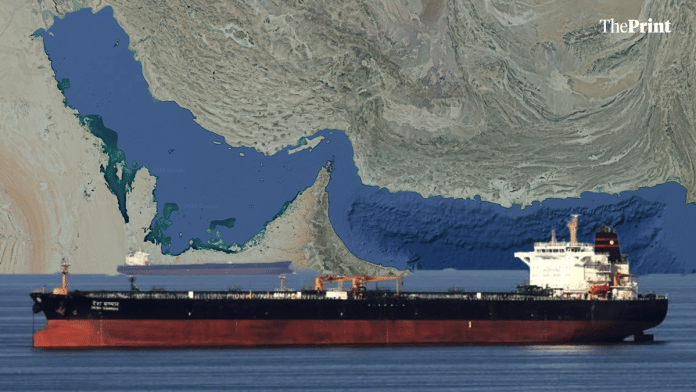



New Delhi: With the Strait of Hormuz effectively shut amid the Israel-US and Iran war, India is in a tight spot. Close to 50 percent of the country’s oil imports pass through the narrow Gulf chokepoint, leaving New Delhi with limited alternatives if the disruption persists.
Market analysts told ThePrint that as a short-term response, ramping up African imports could provide a workable cushion, particularly if combined with Russian cargoes already afloat. But if the current situation continues, other alternatives available before India could include increasing sourcing from the Americas, leveraging Gulf pipeline infrastructure that bypasses Hormuz, as well as domestic substitution of oil and gases.
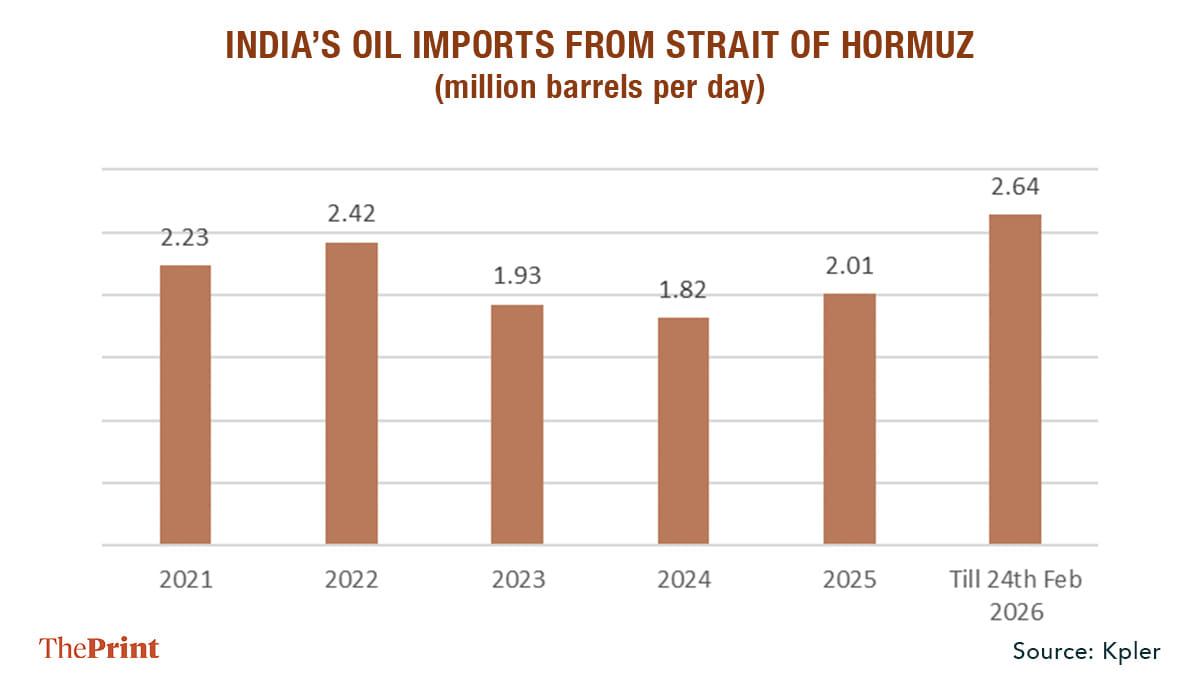
Data from commodity tracking firm Kpler show India’s dependence on this Hormuz chokepoint has climbed to around 50 percent of its total crude imports, a share that has been rising in recent months.
So far this year, India has imported an average of 2.6 million barrels per day (mbpd) from Gulf countries, underlining how central the region remains to India’s crude basket.
Given the gravity of the situation, there are already operational risks for vessels carrying crude which pass through the region. According to a PTI report, 37 Indian-flagged ships are currently stuck in the Persian Gulf region with more than 1,000 seafarers on board following the closure of the Strait of Hormuz as a result of the US-Israeli attack on Iran.
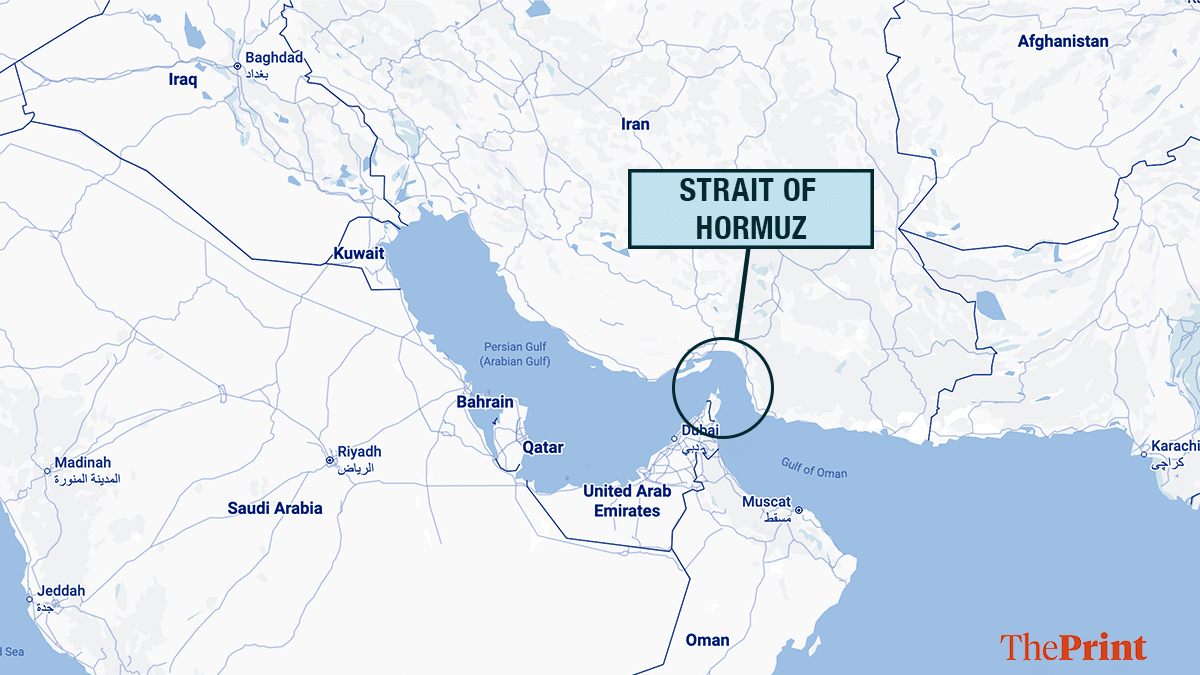
There has, however, been no official confirmation from Iran’s President, Masoud Pezeshkian, on shutting down the Strait. But the Islamic Revolutionary Guard Corps (IRGC), which actually controls the Strait of Hormuz, has warned of consequences if tankers or ships attempt to pass through.
Given the grim situation, the Indian government has limited options to navigate a potential energy shortfall if the disruption persists.
ThePrint explains the five main options before India.
Russian crude already at sea
For India, one of the most immediate cushions lies in Russian crude already on water. According to Kpler, Russian crude and product volumes currently at sea were estimated at around 152 million barrels in mid-February.
These cargoes could potentially be redirected but this option is not without constraints.
According to Navin Thakur, director at Drewry Maritime Research, a maritime consultancy firm, US sanctions complicate the decision.
“India cannot openly go overboard and import Russian oil. There will be some conditions that need to be fulfilled and it entirely depends on the Indian leadership,” Thakur told ThePrint.
Turning towards Americas
Another option is towards the West. The United States, along with Brazil, Colombia, Guyana and Venezuela, can supply crude that does not pass through Hormuz at any stage. This route offers diversification but comes at a cost.
Voyages from the Americas to Indian ports are significantly longer, translating into higher freight charges. In an earlier story, ThePrint reported that voyages from the Atlantic basin can take 25-45 days compared to 5-7 days from the Gulf region.
“While diversification provides supply continuity, it comes with higher freight exposure and longer supply chains. Middle Eastern crude therefore retains a clear logistical advantage and remains structurally important to India’s supply stability,” said Sumit Ritolia, lead analyst for oil markets at Kpler.
Africa, a possible solution
West African producers such as Nigeria and Angola present another alternative. India has been importing regularly from the region primarily through the Atlantic Basin over the past year although in smaller quantities. In January 2026, India imported around 254 thousand barrels per day (kbpd) from Angola and 142 kbpd from Nigeria, cites Kpler data.
“In terms of landed price, West Africa might turn out to be slightly cheaper as compared to the US and Latin American market because of the distance, but it too is unsafe given Houthis attack,” Thakur said.
However, as a short-term response, ramping up African imports could provide a workable cushion, particularly if combined with Russian cargoes already afloat.
Also Read: India has ‘40–45 days’ of crude cover, but long-term Hormuz disruption could inflate import bill
Gulf pipelines offer limited supply
In an earlier report, ThePrint highlighted that Saudi Arabia and the UAE have invested in pipeline infrastructure designed to bypass Hormuz.
Saudi Aramco operates the 5 mbpd East-West crude oil pipeline from Abqaiq to Yanbu on the Red Sea, while the UAE runs a 1.8 mbpd pipeline linking onshore fields to the Fujairah export terminal on the Gulf of Oman, according to the US government’s Energy Information Administration (EIA).
Another pipeline is SUMED (Suez-Mediterranean pipeline) that runs across Egypt from Ain Sokhna on the Gulf of Suez to Sidi Kerir on the Mediterranean coast. It has a capacity of about 2.5 mbpd.
However, the capacity of all pipelines remains limited, especially considering that around 20 mbpd was moving through the Strait of Hormuz.
Prashant Vasisht, Senior Vice-President and co-group head (corporate ratings) at ICRA Limited told ThePrint, “These pipelines, in any case, don’t have much capacity to replace the Strait of Hormuz that handles about 20 million barrels per day.”
He added, “Even if you go through the Red Sea, when you try to cross Yemen there is an issue with Houthis as well.”
Demand control as fallback
Another short-term alternative is substitution and demand management. Industrial usage of crude oil and natural gas could be replaced with coal or other energy sources.
“India uses a significant amount of LPG and natural gas in power generation, which can easily be substituted by coal in the power sector,” Thakur of Drewry said. “One way is to control the demand momentarily.”
He added, “The government usually has their priority list ready when there is supply shortage or any kind of energy risk, which are the key sectors that must be fed, and which are the sectors that can be watered down a bit.”
Strategic petroleum reserves could offer temporary relief. But, if the disruption persists, the government will need a calibrated mix of Russian floating cargoes, Atlantic basin imports, African supplies and limited Gulf pipeline flows to steady its energy lifeline.
According to Kpler data, India’s current commercial crude stocks—including volumes held in its Strategic Petroleum Reserve (SPR) facilities at Mangalore, Padur and Visakhapatnam—stand at around 100 million barrels. With imports via the Strait of Hormuz averaging roughly 2.5-2.6 mbpd, these combined reserves could theoretically cover around 40-45 days of imports.
(Edited by Amrtansh Arora)
Also Read: LPG shortage looms in India as Iran conflict traps cargoes in Strait of Hormuz