





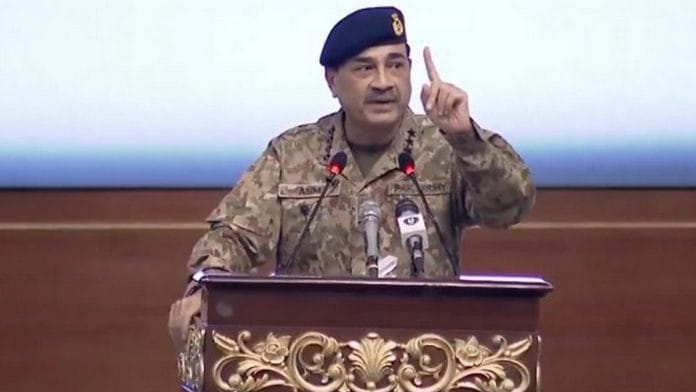



New Delhi: Pakistan Army chief Field Marshal Asim Munir told Shia clerics Thursday that those who “love Iran so much” should go there, in remarks that community leaders condemned as dismissive and inflammatory and that come as Islamabad makes a visible strategic tilt toward the Arabian Gulf.
“If you love Iran so much, then go to Iran,” Munir told clerics at an Iftar gathering in Rawalpindi.
The statement came after clerics pointed to Munir’s warning that “violence in Pakistan, on the basis of incidents occurring in another country, will not be tolerated”. Clerics said Munir’s remarks appeared to blame the protests across Pakistan, triggered after US and Israel killed Iran’s Supreme Leader Ayatollah Ali Khamenei, on the Shia community.
The army chief’s remarks were made on the same day Pakistan joined a bloc of Arab and Islamic countries in condemning Iran’s retaliatory strikes across the Gulf—a move that underscored the country’s shifting regional posture.
Shia leaders present at the gathering said publicly after the meeting that Munir linked the unrest in Gilgit-Baltistan directly to Shia leadership’s influence and held all members of the community collectively responsible for violence carried out by some. Leaders of the community said the framing was both offensive and historically inaccurate.
Shia cleric Muhammad Shifa Najafi said he interrupted the army chief to challenge that characterisation. “Do not consider all Shias responsible for these incidents,” he said in a video statement on his YouTube channel recounting the exchange.
“It is not appropriate to put everyone in the same group,” he added.
Najafi then provided a fuller account of the meeting: “There are Shias in the Pakistan Army as well. The country was formed by Quaid-e-Azam (Jinnah) who was a Shia himself. However, as a result of my interference, there was a slight change in their tone. And he said that, ‘If you love Iran so much, then you should go to Iran. The doors are open’. I am saying this because I think there were a dozen generals and scholars sitting there. There is nothing hidden from anyone.”
The military’s official account of the gathering struck a different note, saying Munir had urged religious leaders to promote national unity and cautioned against sectarian divisions and external interference.
Pakistan is second only to Iran in being home to the Shia community. Though a minority, the community is estimated to make up about 15 percent of the country’s population.
The unrest that Munir referenced began in March, when demonstrations erupted across Pakistan following Khamenei’s death.
In Karachi, protesters stormed the US Consulate, prompting US Marines to open fire; at least 10 people were killed.
In Islamabad, police used tear gas to disperse crowds attempting to march on the Diplomatic Enclave.
In Skardu, protesters set fire to a United Nations office building. Several more people were killed in Gilgit-Baltistan, according to local officials.
The timing of Munir’s remarks sits within a broader shift in Pakistan’s regional calculus. Islamabad has long tried to balance its relations between Iran and the Gulf states, but has in recent months moved perceptibly closer to Saudi Arabia and its allies—including through a mutual defence arrangement—while simultaneously deepening ties with Turkey and Azerbaijan, pointing to the emergence of an Arabian Gulf-oriented strategic orbit.
The shift has not been without internal contradictions. Even as Pakistan joined the Thursday condemnation of Iran, Deputy Prime Minister and Foreign Minister Ishaq Dar separately described the attacks on Iran as “unwarranted” and called for an immediate return to negotiations.
Also Read: Pakistan realigning? PM Sharif extends Eid greeting to Azerbaijan, condemns Iranian strikes
Muni’s doctrine for all Pakistani premis is summed up below based on the day of the week.
1) Friday — On India
“Pakistanis and Hindus are different in every possible aspect of life — religion, customs, traditions, thoughts, and ambitions. We are not the same people and we never will be.”
2) Saturday — On Afghanistan
“Pakistanis and Afghans are different in every possible aspect of life — religion… [aide clears throat] …well, the other aspects. Customs, traditions, thoughts, and ambitions. They shelter terrorists. We do not. We are not the same people — and our artillery will make that point clearly.”
3) Sunday — On Iran
“Pakistanis and Iranians are different in every possible aspect of life — religion… [longer pause] …the Sunni aspects of religion. Thoughts and ambitions, specifically. Iran looks toward chaos. Pakistan looks toward the Gulf, toward stability, toward the future. We are not the same people. The doors to Iran, however, are open.”
4) Monday — On Saudi Arabia
“Pakistanis and Saudis are… actually, we are the same in every possible aspect of life. Religion — identical. Customs — very similar. Thoughts and ambitions — perfectly harmonious. We are absolutely the same people and we always will be.”
5) Tuesday — On Turkey
“Pakistanis and Turks are different in every possible aspect of life — except religion, except shared history, except our matching positions on Kashmir and Palestine, except our mutual admiration for strong institutions, except the drone procurement arrangement. In all other aspects — completely different.”
6) Wednesday — On America
“Pakistanis and Americans are different in every possible aspect of life — religion, customs, traditions, thoughts, ambitions, and basic constitutional freedoms. And yet — we are natural partners. Strategic partners. Partners who share values. Which values specifically is a matter for the joint communiqué.”
7) Thursday — On Pakistani Shias
“Pakistani Shias and other Pakistanis are different in certain aspects of life — loyalties, specifically. Thoughts and ambitions — these must be examined. If your ambitions align more with a foreign supreme leader than with the state, then you may find Iran more accommodating. The doors are open.”
“Chumma” of Ummah is unravelling and how ! At the doorstep of so called protector of Islam called Pakistan ! No sovereign has been a greater hypocrite than the state of Pakistan !