





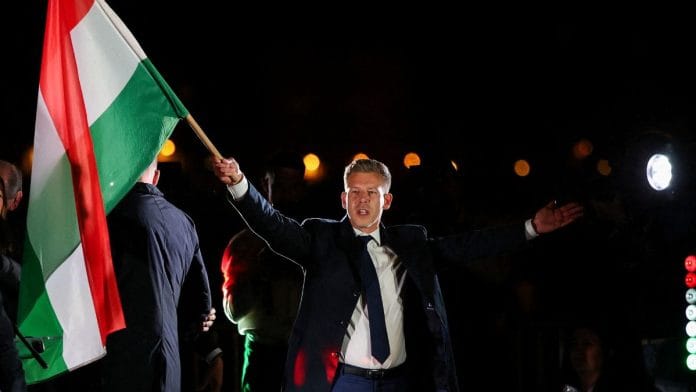



New Delhi: One of Hungary’s most stunning political upsets in its post-communist era has come from insider Peter Magyar—a man who had idolised the elected autocrat Viktor Orbán as a kid, and on Sunday unseated him from power after 16 years.
Orban, the Christian nationalist Far-Right Fidesz leader and the architect of an “illiberal democracy”, was long seen as the Far Right’s “lodestar”. He was Trump’s “fantastic man”, French Far-Right leader Marine Le Pen’s “friend”, and Putin’s “ally”. A Russian intelligence team had even set up base in Budapest to amplify Orbán’s social-media campaign.
The Far Right wanted him to win, the people of Hungary did not.
The longest-serving European leader conceded a “painful” defeat in Sunday’s election. His opponent, Peter Magyar, had a super majority in Hungary’s 199-seat parliament. With nearly all votes counted, Magyar’s party Tisza was projected to secure 138 seats, comfortably surpassing the two-thirds required to roll back Orbán’s constitutional changes and pursue anti-corruption reforms.
Addressing supporters in Budapest along the Danube river, 45-year-old Magyar declared: “Together we liberated Hungary—we have taken back our country.”
The end of Orbán’s 16-year rule is expected to have far-reaching consequences not only within Hungary, but also for the European Union, the Russia-Ukraine war and the broader geopolitical landscape, especially for the Right.
A record voter turnout highlighted the extent to which Hungarians viewed the election as a defining moment for the nation’s future. According to reports, 77 percent of registered voters had cast their votes—the highest turnout in Hungarian history since the collapse of communism in 1989.
Also Read: ‘The EU should allow industry losers to die, not pick winners’
The dark horse
As a child growing up in Budapest, Magyar once kept a poster of Orbán—then a pro-democracy figure—above his bed, inspired by the sweeping changes that followed the collapse of communism. Decades later, he has become the face of a movement that not has only dismantled Orbán’s political dominance, but also challenged the very system he helped build.
His political rise is as meteoric as his party. For years, he was the elite insider—a Hungarian diplomat in Brussels, and once married to former justice minister Judit Varga.
He launched Tisza (The Respect and Freedom Party) in 2024 after a scandal involving a presidential pardon in a child abuse cover-up case allowed him to present himself as both witness and whistleblower. A conservative Centre Right man himself, Magyar called out Orbán for “hiding behind women’s skirts”, and launched a countrywide movement against corruption. His rise was unprecedented.
Rather than engaging with the themes pushed by Orbán of global politics, the war in Ukraine, and claims of Ukrainian hostility, Magyar centred his message on everyday socialist concerns such as the economy, healthcare and education.
While he holds views similar to Orbán on “woke ideology” and national sovereignty, he won a mandate based on his claims to steer clear of corruption. Hungary, according to an annual ranking by Transparency International, is the most corrupt country in the European Union.
What it means for EU, Russia and the Right
Orbán’s defeat is a significant rupture not just in Hungary, but in the wider Far-Right populist movements across Europe and the US, which are likely to have ripple effects. His model of “illiberal democracy” enjoyed vocal support from Trump, but not the EU for which he became “a thorn on the side”.
Magyar shifts that narrative. He has promised to restore democratic checks and balances, repair relations with the EU and to unlock frozen EU funds. He has also maintained that he will ensure “pragmatic relations” with Russia and vowed to end the dependence on Russian energy by 2035.
On Ukraine, he has said he will continue to oppose direct military involvement or accelerated EU entry for Kyiv. However, even if Hungary stops vetoing major EU actions in the European Council, it can become a major breakthrough. In a subtle signal, Magyar in his election campaign had noted that the parliamentary elections would take place on the same day as when the country voted for a pro-EU referendum in 2003.
However, after more than two years of campaigning and the release of a 240-page manifesto, much about what he would actually do in office or how he would counter the control of decade old bureaucratic structures mired in elitism still remains unclear.
Aside from migration, where he has pledged an even tougher stance than Orbán, including scrapping the guest worker scheme, his policy making remains to be seen.
What is clear, however, is that Magyar’s appeal has been rooted less in ideology than in rupture in a moment, when Right wing populism continues to shape politics across Europe and beyond.
It was perhaps put best by journalist and historian Anne Applebaum, who, in an article for The Atlantic Monday, wrote: “Orbán’s loss brings to an end the assumption of inevitability that has pervaded the MAGA movement, as well as the belief—also present in Russian President Vladimir Putin’s rhetoric—that illiberal parties are somehow destined not just to win but to hold power forever, because they have the support of the ‘real’ people. As it turns out, history doesn’t work like that. ‘Real’ people grow tired of their rulers. Old ideas become stale. Younger people question orthodoxy. Illiberalism leads to corruption. And if Orbán can lose, then his Russian and American admirers can lose too.”
(Edited By Nardeep Singh Dahiya)
Also Read: Factbox-How has Hungary changed during Orban’s 16 years in power?