





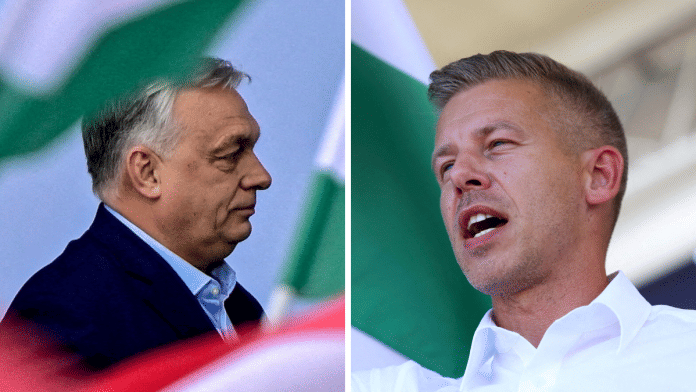



New Delhi: Hungary is going to the polls on 12 April in an important election this summer, with Viktor Orbán, the country’s longest-serving Prime Minister, trailing the former loyalist Péter Magyar in voting intention polls.
According to most voting intention data, the Tisza party and its leader, Magyar, are far ahead of Orbán’s Fidesz. The latest reports show that Tisza’s approval rating is 58 percent, compared with 35 percent for Fidesz.
Orbán has turned Hungary into what he calls an “illiberal democracy.” He has actively defined himself as the defender of faith and traditional Christian family values, against Western liberalism and multiculturalism.
According to observers, during Orbán’s four consecutive governments, Hungary has witnessed a systematic backslide in democratic rule, with the erosion of judicial independence and the control of the media by loyalists, The Guardian reports.
Orbán has repeatedly been at odds with the European Union over his rigid political stances on justice, migration, LGBTQ+ rights, aid for Ukraine, and sanctions against Russia. These clashes have involved Orbán threatening to suspend billions of euros in EU funds.
The Hungarian PM also blocked a proposed $90 billion EU loan to Ukraine, using the country’s veto power to pressure Kyiv into restoring oil supplies through the Druzhba pipeline, a key source of energy for his country. The pipeline was damaged by a Russian drone strike near Brody in western Ukraine.
Furthermore, since 2018, Brussels has initiated Article 7 proceedings against Hungary over concerns of judicial independence and corruption. The proceedings are generally initiated when a member breaches the EU’s core values, which include the rule of law, media freedom, corruption, and minority rights.
Orbán’s closeness with Russia, its continuous purchase of oil and gas and multiple meetings with President Vladimir Putin after Moscow launched the military action against Ukraine, has made him the EU’s most Moscow-friendly leader. In March, Poland and Ireland condemned Budapest for allegedly disclosing Brussels’s confidential information to Russia.
Orbán can also claim the backing of US President, who endorsed him Friday through his Truth Social post, “VIKTOR ORBÁN WILL NEVER LET THE GREAT PEOPLE OF HUNGARY DOWN. I AM WITH HIM ALL THE WAY! President DONALD J. TRUMP.”
Earlier this month, US Vice-President J.D. Vance also went to Budapest to publicly back the Hungarian premier. Standing alongside Orbán, Vance, referring to the Hungarian election, asserted that the EU was responsible for “one of the worst examples of election interference ever seen”.
“The bureaucrats in Brussels have tried to destroy the economy of Hungary. They have tried to make Hungary less energy-independent. They have tried to drive up costs for Hungarian consumers. And they’ve done it all because they hate this guy,” added Vance.
The loyalist who turned hostile
Magyar, a former Fidesz member and a member of Orbán’s inner circle, was thrust into limelight when his ex-wife, Judit Varga, resigned as Justice Minister for co-signing the pardon of a man convicted of sexual abuse alongside then-Hungary’s president, Katalin Novák.
In 2002, Magyar joined Orbán’s party and married one of the political rising stars Judit Varga, with whom he had three children. The couple separated in 2023.
Under Orbán, Magyar served as Hungarian Permanent Representation to the EU and a member of the board of directors at the state-owned Hungarian Development Bank.
However, Magyar distanced himself from Orban’s party and accused it of corruption and state-sponsored propaganda. He also released the wiretapped recording of his ex-wife, who was serving as the Justice Minister.
The two-minute recording was regarding the Schadl-Völner case, which involved alleged bribes paid to former State Secretary for Justice Pál Völner. This brought Magyar to the forefront against corruption.
While showing dismay at Magyar’s action, Varga accused him of committing domestic violence and emotional abuse during their marriage.
In 2024, Magyar took over the Respect and Freedom Tisza Party and transformed it into a major centre-right challenger to Fidesz. In a major change in power, in 2024, Tisza finished second to Fidesz by winning 30 percent of the votes in the European elections in Hungary.
In 2025, Magyar walked 300km from Budapest to the Romanian border to campaign for Hungarian unity, in a process to win Fidesz voters to his side.
During his campaigns, he has promised to track corruption, improve the economy, and improve the standard of living for the deprived sections, including the Roma community. He has also promised to release billions of euros in EU funds, which were obstructed due to concerns over Hungary’s backsliding rule of law.
Magyar also pledged to return Hungary to a pro-EU version while ending the dependency on Russian energy. His other promise is to restore the independence of the media and judiciary.
Hungary’s electoral system
Since 2010, Orbán has made considerable changes in the electoral rules, with seats being reduced from 386 to 199. This change is accompanied by unevenly distributing the size of the constituencies in favour of Fidesz, analysts say.
The system has been designed to give an advantage to Fidesz, as far fewer votes are needed to win in pro-Fidesz districts. Orbán has further made it easy for the pro-Fidesz Hungarians living in nearby countries to vote.
This means that Tisza, which leads in opinion polls, must secure at least a six-percentage point win over Fidesz to reach majority.
Even though the polling average puts the opposition at nearly 50 percent compared to 39 percent for Fidesz, nearly 25 percent of the voters are still undecided.
Paul Gradvohl, a Central European history professor at Paris 1 Panthéon-Sorbonne University, told France24, “This gerrymandering has become a bona fide national pastime.”
“The aim is to use the results of previous elections to take from Peter to give to Paul. In constituencies where Fidesz won by a large margin, less supportive districts have been added, and in return, the opposition has been stripped of seats where it had a chance of winning,” added Gradvohl.
Fidesz’s voter base is largely concentrated in rural areas compared to Tisza, which is popular in cities. Even if Magyar wins major cities and receives more votes nationally, Orbán can still attain a majority in the countryside, as most of the seats are concentrated in rural areas.
Orbán is also more popular amongst the retirement-age voters. According to The Guardian, polls suggest that Fidesz is leading Tisza by 50 percent to 20 percent in some opinion polls However, Tisza is strongly ahead among under-40s and urban voters.
Pollsters further told The Guardian that turnout could reach record heights of more than 80 percent.
(Edited by Vidhi Bhutra)
Also read: India-Europe ties can stabilise the chaotic international order