





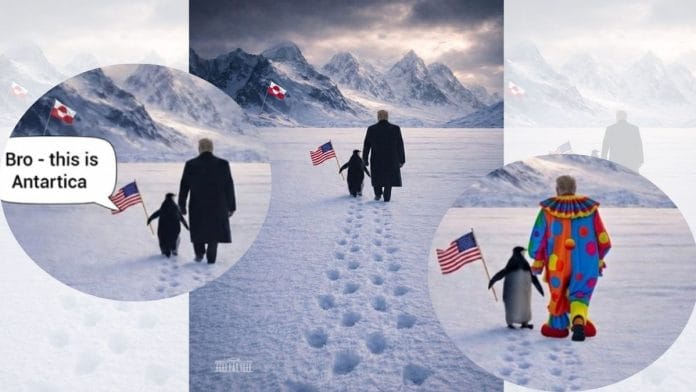



New Delhi: The White House X account (@WhiteHouse) has posted an AI-generated picture of United States President Donald Trump walking beside a penguin holding an American flag in a snow-covered landscape, and towards a flag of Greenland.
The posturing clarifies that Trump has not given up on his obsession with annexing Greenland to make it a part of the United States, despite assurances at the World Economic Forum (WEF) in Davos, Switzerland, not to use military force to acquire the Danish-controlled autonomous territory.
However, many pointed out that there are no penguins in Greenland in the first place.
The overwhelming majority of penguins live exclusively in the Southern Hemisphere near the South Pole. Most of them live in Antarctica, and some can also be found off the southern coasts of South Africa, Australia, New Zealand, South America, and the islands close to Antarctica.
Penguins do not live in the Arctic where they would be highly vulnerable to polar bears, foxes, and wolves. The only place in the Northern Hemisphere where penguins also live is the Galápagos Islands, located off the coast of Ecuador in South America. Since the islands span the equator, a small portion of penguins lives in the Northern Hemisphere, specifically on the northern tip.
This led to the White House being trolled over the post on X. Reacting to the trolling, the White House quoted the original tweet 16 hours after it was put out saying “The penguin does not concern himself with the opinions of those who cannot comprehend.”
Penguins are among those rare species of birds that are completely unable to fly. They lost their flight power millions of years ago, according to scientists. They use their wings to swim and are considered expert swimmers. Their waddling may look clumsy, but their bodies are optimised for swimming and diving at high speeds underwater to deep depths for hunting prey.
Circling back to “penguins in Greenland”, that will likely never happen, that is, until there is some Trump intervention in the animal world.
Who governs Greenland?
The Kingdom of Denmark holds sovereignty over Greenland, which is also the largest of the kingdom’s three constituent parts by land area, the others being Denmark proper and the Faroe Islands.
It is the world’s largest island, located in the Arctic Circle and off the coast of Canada, with a size of 2.2 million square kilometres. It is sparsely populated, with a population of 56,000 people roughly and strategically located between North America and the Arctic.
The democratically elected Government of Greenland has authority over Greenland’s internal affairs, such as economy, social services, and infrastructure. Denmark is responsible for the island’s foreign affairs, defence, citizenship, currency, and monetary policy.
In 2019, Trump publicly floated the idea of buying Greenland. That year, Trump first expressed his desire for Greenland to be within the US borders. Prime Minister of Denmark Mette Frederiksen, however, turned down his offer to negotiate or talk, calling the idea “absurd”.
Time did not dampen Trump’s desire for Greenland. After he returned to the White House, it was reignited. Earlier, in public statements and posts on Truth Social, the President announced that the United States must acquire Greenland for the sake of national security and, also, to keep both Russia and China at a distance. This came despite Denmark being a part of NATO, the American-led military alliance.
It has been theorised by analysts that Trump wants to acquire Greenland for its natural resources—rare earths, copper, nickel, uranium, iron, and fossil fuels. The GDP of Greenland is just above $3 billion, but the value of its untapped resources could be worth trillions of dollars.
Some have pointed out that acquiring Greenland could make the United States the second-largest country in the world. Now, it is the fourth-largest.
Anant Tanikella is an alum of ThePrint School of Journalism currently interning with ThePrint
(Edited by Madhurita Goswami)
Also Read: Trump’s fight for Greenland has shaken his most committed European allies—the Far-Right