





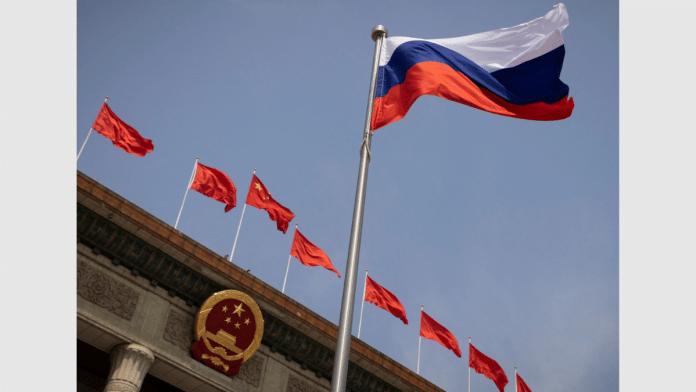



New Delhi: The “no-limits” partnership between Russia and China is helping reshape the international global order, advancing geo-economic fragmentation and accelerating Beijing’s military modernisation with Moscow’s military operational knowledge, says a new report by the Australian Strategic Policy Institute (ASPI).
According to the report published Monday, the partnership announced in 2022 envisions Beijing as a “global order maker” while Moscow is a “global order disruptor”, a combination that makes it a “powerful threat to the West”.
“The Sino-Russian partnership has grown steadily since the end of the Cold War but has ramped up in recent years, as China and Russia both gain confidence in their collective capacity to disrupt, outcompete and defeat the West and reshape the Western-led order, notwithstanding democratic pushback against Russia’s war on Ukraine and China’s rising military aggression and economic coercion, most notably in the Indo-Pacific yet increasingly global,” the report reads.
Russia and China announced a no-limits partnership in 2022, just weeks before Moscow’s military rolled into Ukraine. Since then, Russia has maintained solid economic ties with China, which have helped Moscow stave off the impact of Western sanctions on its economy through the last four years of war.
The report highlights that Russia sees the partnership with Beijing as a part of its desire to “maintain global great-power standing” despite a fall in material wealth, while for China, it is an opportunity to gain a military advantage through closer cooperation with Moscow.
The report said that while China is the major economic and technological power in the relationship, a defeated Russia would weaken China in several ways, including by increasing “the likelihood of the US actually being able to implement its longtime policy… of China being the pacing threat and the Indo-Pacific being the top priority beyond America’s Western Hemisphere”.
The military experience gained by Moscow has led to increasingly complex military exercises being the core driver of the partnership with China, the ASPI report said.
While China’s military budget has grown from $7.7 billion in 1995 to around $250 billion in 2025, its last military engagement was with Vietnam in 1979, where its performance was sub-par.
“In that regard, the joint exercising between China and Russia is comprehensive—and while most analysts agree that China is now the dominant partner in the bilateral relationship, it’s Russian mastery of modern warfare from which China is taking lessons,” said the report.
Also Read: Crypto deal to Texas crude & F-16 upgrades—how US-Pakistan ties picked up in Trump’s 2nd term
The growing military partnership
Russia and China’s defence partnership has grown deeper in the last decade. In the first part of this millennium, the Russian and Chinese militaries held one or two joint exercises every year. That surged to around eight joint exercises in 2014, the year when Russian troops seized the Crimean peninsula from Ukraine.
In 2016, the two militaries held 10 joint exercises, a number they more or less maintained till 2024, when they held 14 joint exercises.
“From 2014, there was a noticeable spike in military engagements, with the exercises becoming more complex, mature and ambitious. That shouldn’t be seen as a coincidence but as a strategic decision taken by Russia and China to take advantage of American and Western preoccupation with ISIS at that exact time,” said the report.
“By 2024, they conducted 14 such exercises despite Russia’s ongoing war with Ukraine; that ability for the axis powers to undertake multiple lines of effort at once was a defining difference from the US and its allies until recently.”
Naval cooperation between the two countries has also significantly expanded, with joint naval exercises held in the South China Sea, the Baltic Sea, the East China Sea, the Sea of Japan, and off the coast of Alaska, indicating the wide geographic scope of the maritime exercises.
In August 2025, both countries held a joint submarine patrol in the Sea of Japan, a further sign of the maturity of naval cooperation, notes the ASPI report. The first joint exercise between the two navies was held in 2009 in the Gulf of Aden.
Sino-Russian defence trade
Since the fall of the Berlin Wall in 1989, Russia and China have seen their defence trade grow. The US and its allies, focused on Saddam Hussein’s Iraq and the West Asian region, allowed Moscow to sell its technologies to Beijing without further Western scrutiny, notes the ASPI report.
China’s military modernisation in the late 1990s led Beijing to reverse-engineer several Russian defence technologies, such as the Su-27 fighter aircraft, which eventually became the J-11 fighters by the end of the last century.
The report said China initially bought entire weapon platforms, but increasingly shifted to buying critical components, such as advanced turbofan engines, to advance its own indigenous manufacturing capability.
Despite the growing ties, mutual distrust also persisted.
“In fact, it was Moscow, not the West, that initially grew wary about selling some of the more advanced platforms to China. And despite the growing partnership of mutual benefit, the distrust also remained mutual—China was unhappy that Russia’s best defence platforms were given to India (China’s strategic adversary) and that there was no voluntary transfer of technology to China,” the report added.
Apart from the Su-27s, China procured Mi-8 and Mi-17 transport helicopters and gunships, as well as the stripped hull of the aircraft carrier Varyag, from Ukraine, which was eventually commissioned as the Liaoning in 2012.
“China bought cheap Russian kit while continuing to reverse-engineer Russian weapons. Simultaneously, China was stealing, mainly through hacking and cyber operations but also through traditional espionage (human intelligence), swathes of Western military and technology, mostly from US firms,” said the report.