








New Delhi: There has been a surge of aircraft flying from the US to West Asia after a second round of nuclear deal negotiations concluded Tuesday between Tehran and Washington, DC, in Geneva.
Multiple reports, citing a US official, said that more than 50 fighter jets, including F-16s, F-22s, and F-35s, as well as refuelling tankers (AWACS—Airborne Warning and Control System) and intelligence aircraft, were deployed over the past 48 hours.
This marks one of the largest single-day aerial movements from the US to the region—likely since the US invasion of Iraq—with the aircraft carrier Gerald R. Ford still en route to West Asia.
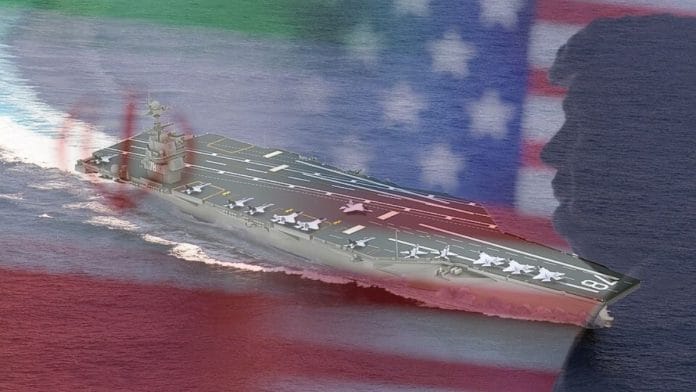
The USS Gerald R. Ford and its strike group, which are scheduled to join the USS Abraham Lincoln carrier strike group in the region, were reportedly redirected from the Caribbean, where they had been participating in operations against Venezuela.
UK Reports, which keeps a track of conflicts in West Asia, posted on X Wednesday: “NEW—Over the past 48 hours, massive movements of aerial assets towards the Middle East have continued. 48 F-16 aircraft, 12 F-22 aircraft, 18 F-35 aircraft, 6 E-3G Sentry AWACS aircraft, about 40 re-fueling aircraft, and at least one RC-135V Rivet Joint strategic intelligence aircraft. Peak preparedness, and this is before the arrival of the American aircraft carrier Gerald Ford.”
According to Foreign Minister of Iran Seyed Abbas Araghchi, the Tuesday talks—carried out under Omani mediation—ended with a “general agreement”, including “a set of guiding principles” and both sides agreed to exchange a potential draft.
On Monday, Seyed Abbas Araghchi had met Rafael Grossi, the head of the International Atomic Energy Agency (IAEA), for a “deep technical discussion”, following which the Iranian media had reported that the second round of talks had entered a “technical phase”.
US officials in conversation with The New York Times have, however, been cautious, saying Iran will provide more detailed proposals over the next two weeks to bridge the gap between Washington, DC, and Tehran. Further, the officials have declined to provide any specifics of the proposed deal.
The first round of negotiations was mediated and hosted by Omani Foreign Minister Badr bin Hamad Al Busaidi. While updating details on the progress in the Geneva talks, he posted on X, “Today’s indirect negotiations between The Islamic Republic of Iran and the United States of America in Geneva concluded with good progress towards identifying common goals and relevant technical issues.”
Also Read: Iran’s IRGC: Ayatollah’s shield against dissent, external threats, now labelled ‘terror group’ by EU
The US’s position
On Tuesday, US Press Secretary Karoline Leavitt, in her media briefing, advised Iran it would be “wise for Iran to make a deal”, considering President Trump was inclined to make the deal through diplomatic means.
Leavitt said, “The President has always been very clear, though, with respect to Iran or any country around the world, diplomacy is always his first option, and Iran would be very wise to make a deal with President Trump and with this administration.”
“He’s talking to many people. Of course, his national security team, first and foremost, and you know who the members of that team are, and this is something, obviously, the President takes seriously,” said Leavitt.
According to CNN, sources familiar with the matter have said that the US military is prepared to strike Iran as early as this weekend, after the recent buildup. President Trump, though, has not decided what to do, the CNN reported.
To discuss Iran, top national security officials met Wednesday in the White House Situation Room, where special envoys—Steve Witkoff and Jared Kushner—briefed Trump on the Geneva talks.
Iran nuclear deal
The Joint Comprehensive Plan of Action (JCPOA), or Iran nuclear deal, was signed on July 14, 2015, in Vienna between Iran and the P5+1 countries, including the US, UK, France, Russia, China, Germany, plus the EU, to curb Tehran’s nuclear programme in exchange for sanctions relief.
The deal came into effect in January 2016, immediately after the International Atomic Energy Agency (IAEA) verified Iran’s curbs. Iran had slashed its centrifuges by two-thirds, capped the enrichment percentage at 3.67, shipped out most enriched uranium, and allowed robust inspections.
However, the US withdrew from the deal under President Trump in May 2018, calling it “defective at its core” for ignoring missiles and sunset clauses. He reimposed “maximum pressure” sanctions, prompting Iran to breach limits starting in 2019.
The US administration under President Biden showed some willingness to revive the deal in 2021. In August 2022, a European Union-drafted “final text” attempted to revive the accord, but it was eventually rejected. Iran and the Biden administration had continued discussions on reviving the JCPOA before the US stopped.
Now, Trump, in his second term, is pushing for a tougher deal. The start in Geneva is looking fragile.
(Edited by Madhurita Goswami)
Also Read: Eight of 16 Indian sailors detained by Iran to return soon, consular access received, confirms MEA