





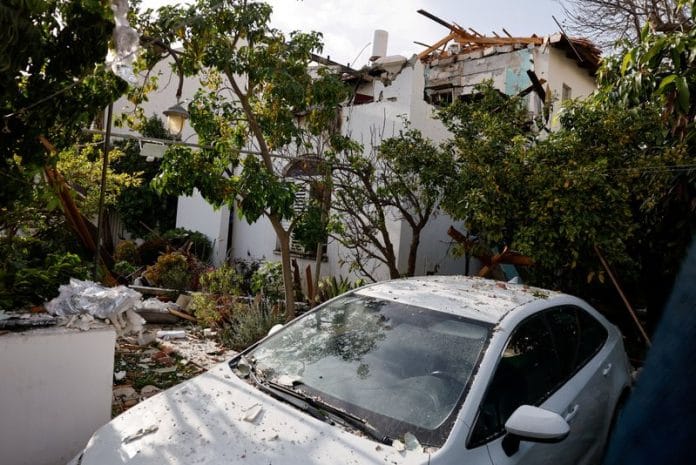



March 20 (Reuters) – Iranian missiles and drones have continued to strike crucial energy facilities and other targets in Gulf countries and the wider Middle East nearly three weeks into the war.
Neutralising Iran’s missile and drone capabilities is a crucial war aim for both the U.S. and Israel, which launched the conflict on February 28, but that may prove very difficult.
Here’s why:
HOW BIG IS IRAN’S MISSILE AND DRONE STOCKPILE?
Iran had the largest stockpile of ballistic missiles in the Middle East before the war, according to the U.S. Office of the Director of National Intelligence.
The arsenal included missiles of different types, with ranges of up to 2,000 kilometers (1,240 miles), capable of hitting Israel, and speeds of up to 17,000 km an hour (10,550 mph), according to Iranian state media.
Among the missiles it has fired at Israel are some with cluster munition warheads that are harder for Israel’s missile defence shields to neutralise.
The size of its missile stockpile before the war was unknown, with estimates ranging from 2,500 by Israel’s military to around 6,000 according to other analysts.
The Arms Control Association says Iran’s missile programme is largely based on North Korean and Russian designs and has benefited from Chinese assistance.
Many of Iran’s missile sites are in and around Tehran. There are at least five known underground “missile cities” in various provinces, including Kermanshah and Semnan, as well as near the Gulf region.
In 2020, it fired a ballistic missile from underground for the first time according to a 2023 report by Behnam Ben Taleblu, a senior fellow at the U.S.-based Foundation for Defense of Democracies.
Iran is also a major drone manufacturer and has the industrial capacity to produce around 10,000 per month, according to the Centre for Information Resilience, a non-profit research group funded by Britain’s Foreign Office.
It pioneered the Shahed drone, a much cheaper alternative to expensive missiles, and sold large quantities of them to Russia for use in the war in Ukraine.
HOW MUCH OF IRAN’S ARSENAL REMAINS?
How much of this arms cache remains could be a key factor in determining the course of the war.
Last week U.S. President Donald Trump said Iran’s ballistic missile capacity was functionally destroyed. U.S. General Dan Caine, chairman of the Joint Chiefs of Staff, said on Thursday Iran still retained some missile capabilities.
“They came into this fight with a lot of weapons,” he said.
Israeli Prime Minister Benjamin Netanyahu also said on Thursday that Iran’s missile and drone capability was “massively degraded” with hundreds of launchers destroyed. Israel was also hitting missile and drone factories, he said.
Iran has denied it is running out of projectiles, with its Revolutionary Guards saying on Friday that its stockpile of missiles had not been depleted and that its production of the armaments continued.
Still, maintaining missile supplies could be difficult for Iran, with little prospect of rearming from major powers Russia or China, and after having supplied some to the allied Hezbollah in Lebanon and Houthis in Yemen, and using some during a brief war last year.
Strikes on Iran’s launchers may also reduce its ability to deploy missiles.
Drones may prove easier for Iran to continue using for longer, and are produced at dual-use plants and other facilities can be retooled to ramp up production, analysts say.
WHAT IS HAPPENING ON THE GROUND?
The pace of Iranian attacks has slowed, Israel and Gulf states have said.
However, missile and drone strikes are continuing, including strikes that damaged energy facilities in Qatar and Kuwait on Thursday, and missiles aimed at Saudi Arabia’s Red Sea oil terminal that were downed.
Even less-intensive missile and drone fire poses a major risk, both to Gulf states and to global logistics chains and energy supplies.
(Reporting by Elwely Elwelly, Anna Hirtenstein and Parisa Hafezi; Editing by Angus McDowall and Gareth Jones)
Disclaimer: This report is auto generated from the Reuters news service. ThePrint holds no responsibility for its content.