





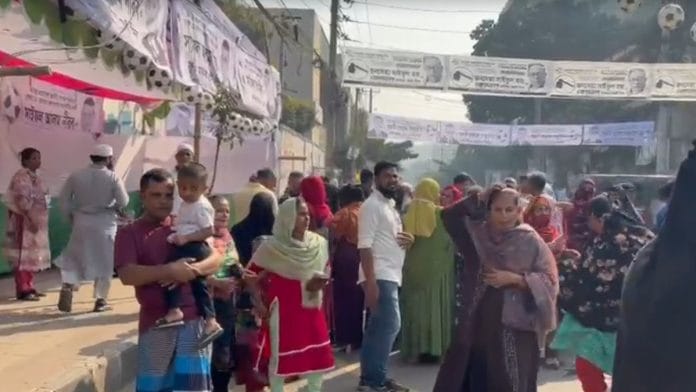



Dhaka: Voting concluded Sunday in Bangladesh’s 13th general election, a high-stakes contest held under an interim administration formed after the mass uprising of 2024 that led to the ouster of Sheikh Hasina. Polling began at 7.30 am and continued until 4.30 pm in 299 of the country’s 300 constituencies where representatives are elected through direct voting. Voting in one seat was postponed following the death of a candidate.
ThePrint visited five polling centres—Gulshan (Tarique Rehman’s family bastion), Dhanmondi (Hasina’s stronghold), Tejgaon, Mirpur (Jaamat stronghold) and Khilgaon.
By 2 pm, turnout in 36,031 centres stood at 47.91 percent, according to data shared by the Bangladesh Election Commission, though figures from 6,620 centres were still unavailable at that time. Analysts predicted overall participation could climb to 70 percent—lower than the 80-85 percent seen in the fiercely contested elections of the 1990s and early 2000s, but strong enough to challenge claims that the vote lacked inclusivity.
For most analysts, this was a low turnout. In 1973, the voter turnout was 51.3 percent. It was highest at 87.13 percent in 2008. In 2024, it was 39.1 percent, but the legitimacy of that election was highly contested.
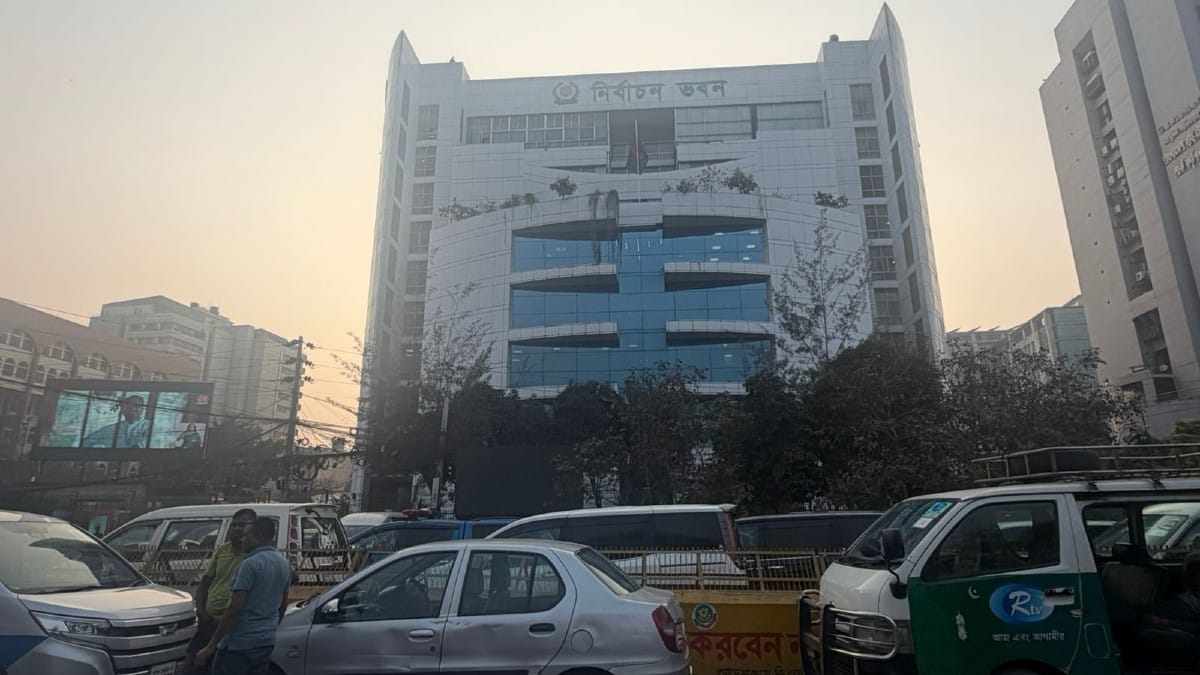
According to analysts ThePrint spoke to, the voter turnout suggests that perhaps Awami League voters did not turn up, some perhaps went for referendum and to ensure their candidate wins.
“The elections were free, fair and credible with limited number of violence but there were attacks on independent journalists, voters, with one BNP member killed. The voter turnout is expected, rather it is more than expected but challenges remain the same when it comes to institutional reforms, human rights and social justice,” said Rezaur Rahman Lenin.
A final turnout approaching 70 percent could indicate not only a competitive race but also mobilisation by voters wary of potential political shifts, analysts said, adding that low voter turnout might be a result of the ban on Hasina’s Awami League. The low voter turnout can be indicative of the ban and how it played out, Lenin said.
Geopolitical analyst Asif Bin Ali said compared to the previous three elections, voter turnout this time is noticeably higher. “Still, it could have been better. Turnout tells us that at least a significant section of society chose to participate and cast their vote, and this is happening after almost 17 years. The last time people remember voting in a relatively free, fair, and participatory environment was in 2008. From that perspective, I would say, we should not be overly satisfied with the numbers, but we should not dismiss them either.”
According to him, the ban on Awami League had a direct impact on voting and voter turnout and the referendum questions. “There was widespread discussion across the country that it was difficult for ordinary voters to fully grasp the complexities of the referendum, so in many cases it became more of a ‘blind vote’.”
Adding, “On Awami League vote itself, I think a certain section of Awami League supporters did come out to vote, but their numbers were not very high. In many places, the boycott seemed to be shaped by local power dynamics and relationships. Some Awami League voters may have participated, but not at a scale that significantly altered the overall picture.”
Also Read: BNP leader killed at Bangladesh polling station, party claims he was trying to stop fraud
A ‘festival-like’ atmosphere
Across Dhaka and beyond, long queues formed early in the morning.
In neighbourhoods such as Tejgaon, Dhanmondi and Gulshan, many voters described the day as festive. “With Allah’s grace, we gave our votes,” one voter in Tejgaon said. “The candidates themselves are also good. We hope whoever wins will bring development.”
Another likened the atmosphere to Eid. “I appeal to everyone to vote,” he said. “It’s like a festival. Please come out and vote for justice.” Many voters said the conduct of the electoral process has been smooth. “There was no problem. Everything happened swiftly,” said a first-time voter in Dhanmondi. “It feels good to exercise our franchise.”
Still, political loyalties and expectations ran high. Several voters expressed hope for an Islamic government that would ensure development and curb corruption. “We want an Islamic government to come, so that there is development, no corruption, and the people prosper,” said a voter outside a polling station in Tejgaon. “It is better to remain united.”
The election has largely been framed as a contest between the Bangladesh Nationalist Party (BNP) and Jamaat, though smaller parties and independents are also in the race.
BNP chairman Tarique Rahman last week publicly sought votes not only for his party’s electoral symbol, the “Sheaf of Paddy,” but also for the “Spade” symbol in Dhaka-12, backing Revolutionary Workers Party general secretary Saiful Haque.
“One of those who stood with us on the streets during past movements is contesting here in Dhaka-12 with the Spade symbol,” Tarique said at a rally in Tejgaon Industrial Area. “A victory for the Spade means a victory for the Sheaf of Paddy. And if the Spade wins, it will pave the way for development of the area,” he added.
Tarique described Saiful Haque as a long-time ally of the BNP.
In Gulshan-2, outside BNP headquarters, supporters gathered in a celebratory mood, many expressing eagerness for a BNP-led government. Rabiul Islam, a voter there, spoke at length about former prime minister Khaleda Zia. “Did you know she was the first to speak about women’s empowerment in this country?”
And in Dhanmondi, once Hasina’s stronghold saw several voters said the BNP was the “obvious choice”, framing the election as a decision between development and censorship.
Women voters turned out in significant numbers across the capital. Rumana Islam, a resident of Dhaka-12, said she voted after a gap of 16 years. “I’m happy that I came from afar to vote,” she said. “It’s a joyful moment that I could vote after such a long time.”
Asked why she had not voted in previous elections, she replied: “Our votes were cast at night. We never got to vote.” This time, she said, it felt different. “Even after so many years, there was no crowding. Various parties are taking part—that didn’t happen before.”
Rumana said she voted for the “Spade” symbol and expressed confidence in both Saiful Haque and BNP leadership. “I think only Tarique Rahman can make a good prime minister,” she said. “It will be good for the country, good for the people.”
Others were more cautious. “It’s not easy to say who will win,” said a voter in Tejgaon. “There is competition between BNP and Jamaat. We will know by the evening.”
‘Opinion divided on referendum’
Alongside parliamentary voting, a referendum question was also put to voters. “I voted no in the referendum,” one voter said in Tejgaon. “If we vote a yes, the constitution would be changed. Why would we want to change the 1972 constitution?”
For many, however, the broader meaning of the election overshadowed individual questions. “We know there will be voting for something good,” said a young man in Tejgaon. “We all urged everyone to maintain harmony. The situation is good.”
The 13th general election carries particular weight as the first since the 2024 uprising.
It is widely seen as a test of whether the interim administration can deliver a competitive and credible electoral process.
In Khilgaon, independent candidate Tasnima Jara—a former leader of the National Citizen Party—drew crowds outside her polling booth. Supporters queued to take photographs with her as she spoke about the need for greater inclusion of women in politics. “This is our chance to ensure more participation by women,” she said.
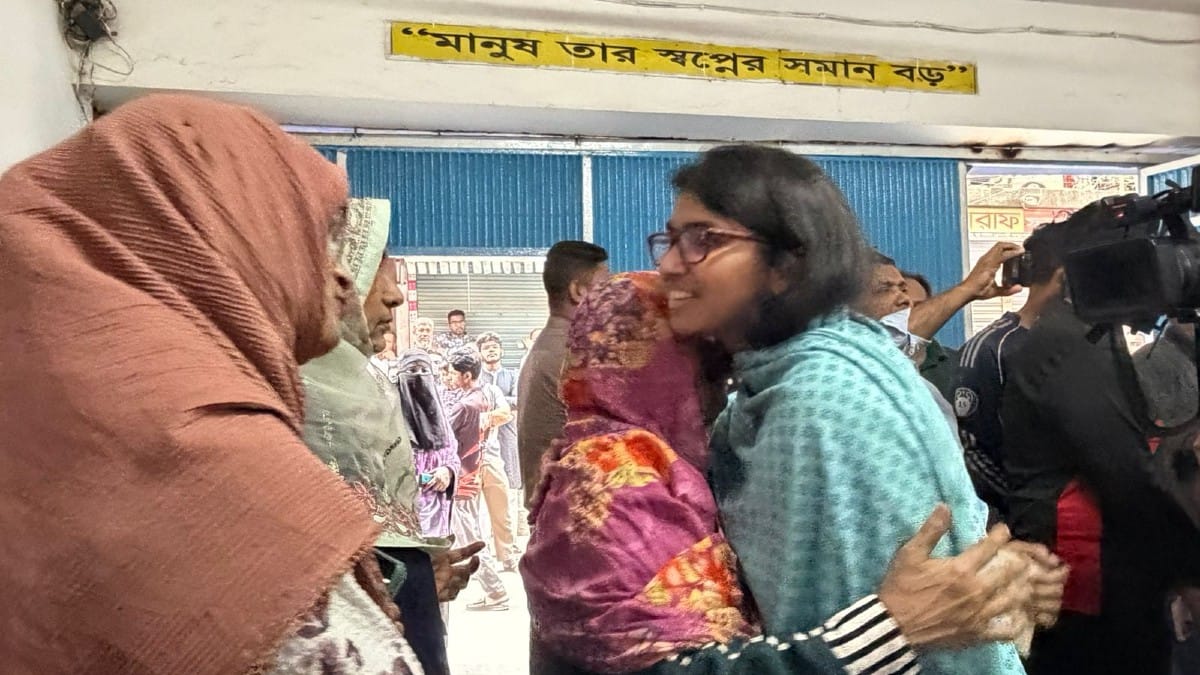
As counting began, turnout figures and early reports suggested robust engagement by voters across political divides. By evening, Bangladesh was waiting to see whether the ballot would mark a decisive political transition—and whether the optimism voiced at polling stations would translate into a new chapter for the country.
BNP chairman Tarique Rahman said his party would accept the election results if the polls are held in a free, fair and controversy-free manner. “If the election is free, if it is fair, if it is without controversy, then why would we not accept it? Of course we will accept it. All parties will accept it,” he told journalists at the party’s Gulshan chairman’s office.
“This election is the most vibrant in the past one and a half decades. It is a historic and unprecedented experience for the new generation,” Jamaat assistant secretary general Ehsanul Mahboob Zubair said at a press conference at the party’s central office in Dhaka’s Moghbazar. Zubair, who is also the party’s media and publication secretary, said voters were seen standing in orderly queues outside polling centres to cast their ballots.
He added that the parliamentary election and the referendum were being held simultaneously, contributing to heightened public participation.
(Edited by Amrtansh Arora)
Also Read: Bangladesh elections: Why Dhaka is key in high-stakes BNP-Jamaat showdown