








In episode 1808 of Cut the Clutter, ThePrint Editor-in-Chief Shekhar Gupta analyses the big picture emerging from the war in West Asia as the conflict completes its second week. There are lessons to be learnt from history— from the Iraq war & US air-campaign then.
Here is a complete transcript of the episode, edited for clarity.
The current war in the Gulf, or let us say the combined war of the US and Israel on Iran, is now completing its second week. What are the highlights? One, that the war continues in its second week. So if anybody had expected a quick capitulation by the Iranians, particularly after the decapitation of their leadership including Ayatollah Khamenei, that has not happened.
The second part is—the campaign is going on from the Israeli and the American side, targeted bombings. At the same time, the Iranians are also striking back with ballistic missiles and also with one-way drones, suicide or kamikaze drones. However, the intensity of the Iranian drones and and ballistic missiles, has come down.
The fighting, however, is going on past its second week, which is something that might have surprised particularly the Americans. The Israelis always said that they saw this campaign as a long haul. Now what is the standout aspect of this warfare or of this war?
This warfare is almost entirely in the air. I would have said entirely in the air but for the fact that some of the vectors, particularly Tomahawk missiles, have been launched by US Navy assets or US Navy ships and submarines mostly from the Persian Gulf.
Some more action has also been taken by US Navy assets in East Mediterranean, particularly the shooting down of the ballistic missile that the Iranians had launched at an air base in Turkey where the Americans keep their assets, including a big radar that the Obama administration had placed there because they were watching threats from Iran at that point.
That radar picked up the signature of this ballistic missile and conveyed it to the US destroyer in east Mediterranean that struck this missile and took it down. Barring these launches by the US Navy, everything from the American and Israeli side has been launched from the air, launched from airborne assets.
Similarly, or maybe you might choose to say, “what similarly, this is a contrast”. You can make your choice because the Iranians do not have an air force. They never had a functioning air force for a long time. They are only launching from the ground.
They are launching ballistic missiles and drones from the ground. They are quite effective, quite deadly. You can see the damage they are causing in many Gulf countries. in particular. Also in parts of Israel, particularly Tel Aviv, Haifa, etc. This is also not as one-sided as the picture sometimes might make you believe.
I will share with you a story from The Wall Street Journal. There are many others but this one is the most effective. Headlined— ‘Iran is hitting the radars that underpin U.S. missile defenses’. So in many places radars and air defense systems that support the Americans and the Israelis have been hit in Qatar, the UAE, Jordan, Bahrain, Kuwait, Saudi Arabia. All of these hits have been carried out by one-way drones.
The Wall Street Journal story, the name jumped up at me, Ravi Chaudhary. That’s why I’m telling you. He’s a former assistant secretary of Air Force, in-charge of installations. He claims that yes, there might have been these hits, but still this has not impeded American ability to counter these missile and drone attacks from Iran.
However, look at some of the major radars and other stations that have been hit. The biggest one is AN/FPS-132, the big radar at Al Udeid air base in Qatar. This is a wide aperture radar, which can track many targets over a long distance. The US only has seven of these operational, besides on the mainland, and these are scattered from South Korea to Europe, etc.
And similarly, another TPY-2 radar, which was working with a THAAD system in Jordan. THAAD (Terminal High Altitude Area Defense) is America’s most effective long distance anti-missile system. Three other radar domes have been seen in satellite pictures as having been struck at camp Arifjan in Kuwait. That’s where the Americans had some casualties, quite a few injuries and six deaths as well. Similarly, a satellite communication centre of the Fifth Fleet in Bahrain has been hit as well.
Now, THAAD is something that the Americans are short of. They only have seven batteries, operational batteries outside. Two are in Guam. One in South Korea, which they are supposed to be shipping or moving now to the Middle East. Two are there in the Middle East. The Americans have placed one THAAD battery each in Israel and Jordan. Besides that, the UAE and Saudi Arabia have purchased their own THAAD batteries. Once again, the Americans could be running short of these missiles in their launchers as well.
So, this is not a 100% one-sided war. The Americans are using and the Israelis are using only air power, nothing else. What the Iranians are doing, they are trying to fight this asymmetrically. And that is the big picture that emerges from the war.
By the way, all the pictures that you’re seeing on social media, a lot of those are AI created. So when you see one, please check it. I do it all the time and I find that about 29 out of 30 are fake or AI created. To that extent the Iranians are really bossing the propaganda game because these look very genuine. These are pictures of Israeli soldiers crying saying, ‘I’m not going to fight this war’ or the American soldiers or pilots saying, ‘I’m not going to bomb Iran,’ etc. A lot of that is not genuine.
Nevertheless, the Iranians have kept a constant fusillade. It’s come down in intensity and numbers, but they are continuing to fight past the second week in this war. However, everything that the Iranians are using is in the air.
The first evidence we saw of Iranians doing something on the ground was actually on the water. That’s when one of these relatively modern instruments of naval warfare struck an American flag tanker, not in the Strait of Hormuz, but near Basra. That’s right, up on the Iraqi coast, in the Persian Gulf.
The ship called Safesea Vishnu had some casualties. At least one of those dead was of Indian origin. That was the first evidence of something on the ground being used, in these cases on water, on the surface. Otherwise, everything is in the air.
Video reportedly shows the moment the Marshall Islands-flagged M/T SAFESEA VISHNU was struck by an Iranian unmanned surface vehicle off the coast of Basra last night. pic.twitter.com/kqj5Dd6cPX
— OSINTdefender (@sentdefender) March 12, 2026
One side, that is Israel and the US, is mostly using manned systems. The Iranians have been using unmanned armed systems to attack both Israel and also American facilities, particularly in the Gulf countries, and that’s where you’ve seen the most damage in Bahrain, Kuwait, Qatar, some in Saudi Arabia, Jordan and the UAE, most of all. This, therefore, will be quite fair in describing almost entirely as air warfare.
What we’ve seen so far is a war in the air. Ground invasion is not going to happen. I would have wagered my phone on it. But for the fact that I’m not so sure how irrational Trump can be. Although I think even by Trump standards, this would be so far out and so irrational that he will not do it. This will mostly remain a war in the air.
Even if the Iranians tomorrow go and block the Strait of Hormuz, a lot of the action against that will take place from the air because even if the US Navy gets involved, they’ll be using their missiles to strike those targets or those areas from where Iranians might be launching drones or missiles to attack these tankers or ships going through the Strait of Hormuz.
Now this is purely an air war. Let’s come to that conclusion. This is an air war. Anything that even the US Navy might have launched is going in the air. The second thing is, from the Israeli and the US side, nothing is being launched from the ground. No ballistic missiles. A few drones were launched by the Americans initially probably from their warships from the Persian Gulf. No more.
The war was started by the Israelis and the Americans. So they had an objective. Now what is the objective? The Israelis have been very clear. They want a regime change, and they want the Islamic revolutionary republic to go. They want a different kind of Iran to emerge from this.
Donald Trump gives an interview every day saying the war is over. “No more targets are left. I don’t know what else to do. There’s no navy left with Iran. There’s no air force left with Iran.” The fact is the Iranians never had an air force to begin with and they hardly had a navy. They had all of four frigates, one of which IRIS Dena was sunk of Galle in Sri Lanka, that we know. So they hardly had a navy.
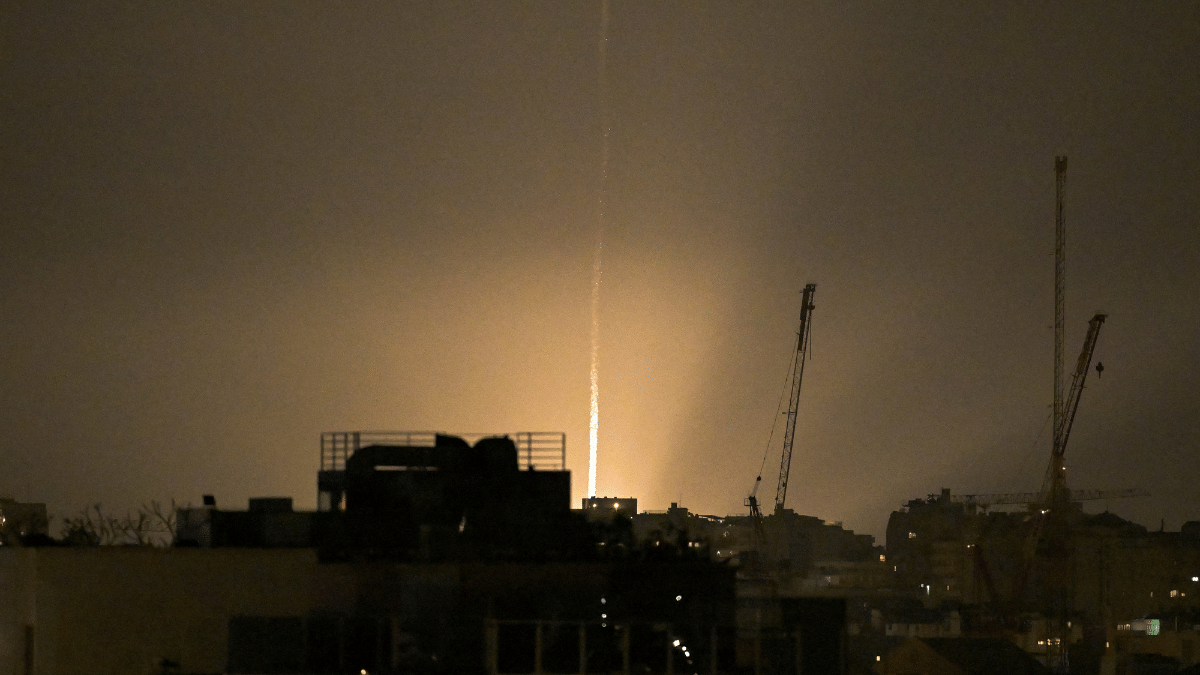
What they had on the other hand was a very large number of ballistic missiles and drones and the capability of manufacturing drones at scale. The target for the American side was, one, to destroy these missile and drone stockpiles.
Second, to destroy as many of these missile launchers as possible. And third, to destroy these factories, most of them underground, where these drones are produced. And Iranians can produce these drones at such a scale that they’ve sold thousands of these to the Russians as well. There you would say, so far, the Iranian capability has been reduced.
Gen. Dan Caine, the Joint Chiefs of Staff chairman, says that ballistic missile launches have come down by 90%, drone launches have come down by 83%. Maybe there’s a difference in percentages. These are claims in wartime, after all. Iranians, however, do not say that they are also firing at the same pace.
They say, and that is what their disinformation is also saying, that what you’ve seen so far was just a cover. That we were firing all of these to confuse radar and surveillance systems, and to tire out, and also to make expend all counter missile batteries, interceptors. And now you will see the really serious missiles coming—hypersonics. And when they come, you will not have a sufficient number of interceptors to stop them.
Also Read: A war in the Gulf, a crisis in Gujarat’s Morbi: India’s ceramics capital counts the cost
That’s where we are. Once again, what is the upshot? The upshot is, can air power win a war by itself. That is the oldest debate since air power was invented.
Stephen Cohen, the American professor of security studies, always used to say all air forces think they can win every war just by themselves because air force is so powerful, air power is so spectacular. They think they can just go and bomb a few places and there’ll be a capitulation and they can win a war by themselves. The ground army say look you can do what you want in the air but unless you have boots on the ground you cannot go and control anything. You need territory to be able to defeat a country or to achieve your military political objectives. That’s an eternal debate. In this case, however, this is purely an air war. Where has it reached?
I will share a couple of readings with you. Both, first of all, by Eliot Cohen. Eliot Cohen headed the study of the air war in the first Gulf War of 1991, produced a large report. He was an intelligence officer and after that he taught at Harvard and Naval War College as well. He’s written these two very comprehensive and, I would say, very balanced articles in The Atlantic.
The first one, the more recent one, which he’s just written a couple of days back, is about the nature of air power now. And I like his description— he says, ‘what is air power?’ A bomber, he says, is like a thunderbolt. A thunderbolt inside an eggshell, widely mobile can go anywhere hundreds of miles but still invisibly tethered to the base. What does it mean? That what the fighter plane or the bomber carries, the explosive or the weapon, is quite lethal. That’s the thunderbolt. But the aircraft itself is very fragile. Just a machine gun can bring it down if the machine can get its fire to reach the aircraft. So it’s like an egg shell. It’s very fragile.
And while it has great mobility—it can get refuelled in the air and can fly from the US, right up to Iran, like those B-2s that bombed Fordow facility, and go back. At the same time, all of its operations are done from the ground. It depends on people on the ground, on radar controllers, electronic controllers. They identify the target. They also identify the threats and they are the ones who also set the software and set up aircraft for operation. So once again air power is a thunderbolt inside an eggshell, very mobile but tethered to the ground. I like that expression.
He says air power is also very different from land power or the navy because land power or the navy, they can also be mobile, but they are still mobile in one general area. Air power, on the other hand, has the ability, it’s unique, to loiter over a place watching for a target. Nothing goes over a target anymore. But from wherever it is supposed to launch at the target because everything is way beyond visual range now. It can still loiter there for a limited time. At the same time, very soon, it can be operating hundreds of kilometres away. That is not something that can happen with the navy or land army.
Again, air power is enormously flexible. It is this mobility that makes it enormously flexible. You can today have a 100 aircraft bombing one target. A few hours later, maybe with different pilots and after refuelling, the same aircraft can be bombing another target a thousand kilometres away. Or maybe 10 different targets in packages of 10 each. And that is the reason that air campaigns for most countries are brief. They are brief, episodic, and then they keep coming back. We saw that in the case of Operation Sindoor as well.
Very few air forces in the world can mount a sustained campaign for a very long time. And there US Air Force is unique because it is so large. It has such a large number of aircraft, pilots, sensors, bases. It also carries on its aircraft carriers assets the size of many national air forces. So, the US Air Force has this unique ability in the world to launch these long-term, only air campaigns.
However, can they win the war by themselves? As he points out to us, pure air campaigns are rare. We saw Operation Sindoor. The first night, India carried out air raids all from Indian side. Then, on the 10th, India again carried out some. On the sixth, seventh night, Pakistanis also attacked Indian aircraft. Then later they tried to attack a couple of air bases and S400 battery. That did not work out. Each side stayed in its own territory and air use of air power became kind of episodic.
In fact, there’s also a history. Because, if you see the Vietnam war, the Korean war, I’m not going as far back, as say, the Second World War. Although if you insist, you can go there and you can see that even in the Second World War, the use of the air force was in conjunction with the army and the navy. And even when the big mass bombing raids were carried out on Germany, and raids were carried out even on factories that produced Luftwaffe aircraft. Until the last day of the war, those factories were turning out more and more fighter planes for Luftwaffe. That showed the inadequacy of air power.
At the same time, defenders of air power would say that Allied air forces by this time had so tired out, so exhausted the Luftwaffe, that when the Normandy invasion took place, Luftwaffe was hardly in any position to offer any credible opposition. This is an ongoing debate. This goes on all the time.
Our own wars—1965, 1971, air force played a key role. Much more in 1971. At the last moment, in Dhaka, they are the ones who, quote unquote, persuaded the governor of East Pakistan, and also General Niazi, to surrender when they sent those unguided rockets almost through the windows of the governor’s house when a big meeting was taking place. That scared everybody into accepting the ceasefire in panic. Their morale was completely broken. So the air force did play a decisive role at critical moments.
However, this was working almost entirely in conjunction with the Army. Now in India that’s also led to a mindset whereby a lot of people in the other forces, particularly the Army, seem to think, “what is the air force? It’s only there for our support”. That is something that late General Bipin Rawat, ex-CDS, also once said. That the air force is a support arm.
That is something that the air force in India will never forget. And that is the argument that will be employed anytime a discussion comes up to set up theatre commands. Because the air force will then say, “Oh, Army guys see us, and also the navy who knows, as support arms.” They think they are the real thing. Once again, the air forces think they can win it all by themselves.
Again, if you look at the American experience, 1991 Gulf War, everybody thought on the American side that they will win that war purely through air power. Thirty-eight days of bombing took place. Bombing took place not just destroying all of the Iraqi armour along the Kuwait border, etc, but also deep inside Baghdad itself.
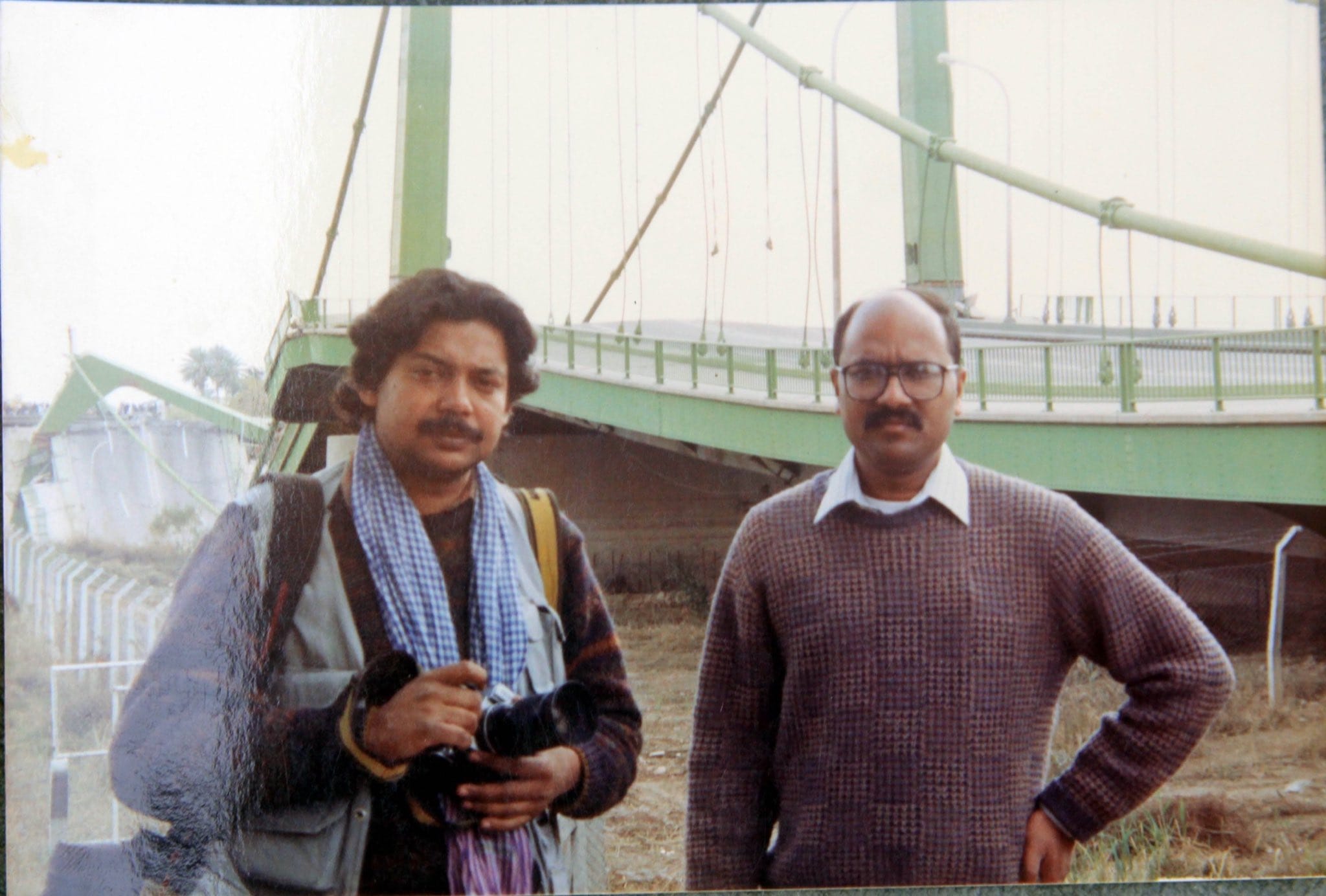
I was in Baghdad at that time with photographer Prashant Panjiar and we heard, all night, doom doom doom, bombs falling. We were staying in the famous Al-Rashid hotel, and in the morning you could see what had been brought down. It was a bridge on Tigris or Euphrates. See this picture taken in front of those bridges. The smart guy with me is Prashant Panjiar.
It was also Saddam Hussein’s palaces. All his palaces were struck in the expectation that that will break the morale of the Iraqi defence forces and also Saddam Hussein himself. That did not happen. I will tell you a story about that, however, towards the conclusion of this episode, not just now. That did not work. After 38 days, the Americans and their allies had to carry out a ground invasion. This was Operation Desert Storm. The second one, 2003, by the Junior Bush, that was Operation Iraqi Freedom that started with the ground invasion and air power working together.
We haven’t really seen a situation, as yet, where air power however dominant and however totally in control. Right now Americans and the Israelis have total air superiority over Iran’s skies. In fact, given the distance at which their weapons travel, they don’t even have to go over Iran’s skies. If they choose to, complete air superiority. Also, they’ve carried out a complete, total destruction of enemy air defence. Or what is called Suppression of Enemy Air Defense (SEAD), or Destruction of Enemy Air Defense (DEAD). That had taken place in June last year itself. So by this time the Iranians themselves were left with no credible opposition to any fighters from the other side.
Of course, sometimes when opposition is not there on the adversaries side, it emerges from your own side. As those three sets of pilots and American jets realised over the skies of Kuwait, shot down in fratricide by friendly fire by an allied Kuwaiti pilot. That’s maybe a joke. That’s maybe partly a joke, albeit a dark joke.
That said, the Americans and the Israelis have zero opposition over Iran’s skies right now. And yet, this fighting goes on for two weeks and we don’t know how long for. That will depend on what Netanyahu sees as his final objective and where Donald Trump thinks he can close this war.
Now, that said, I will tell you a couple more things. One, there is something called BDA, something that Elliot Cohen also wrote about in an earlier piece in 2025 that was about Operation Midnight Hammer.
That’s when the Americans sent those B-2s to attack the Iranian underground enrichment facilities in Fordow. Now Trump claimed that the facility had been obliterated completely. Couple of days later, the Defense Intelligence Agency (DIA) came out with reports and saying that probably the damage was only superficial. Now that caused a lot of trouble and consternation within Trump administration.
Elliot Cohen says that either way these conclusions were too hasty because BDA, what used to be called Bomb Damage Assessment or what is called as Battle Damage Assessment, that is complex. It takes a long time. Pictures take long time emerging. You don’t know what’s happening under something. You might have seen the holes of your ordinance going down but you don’t know what happened inside. You don’t know what was there. That then depends on other intelligence that comes out in the course of time, including human intelligence.
Sometimes, he says, it can take more than one year for some knowledge like that to emerge. And his conclusion is that, on Fordow, the outcome was not what the DIA said. It wasn’t as superficial as that. At the same time, it wasn’t that one word outcome “obliterated’ that Trump used or in terms of what he describes as sycophant-ing bravado by Pete Hegseth, the Secretary of War. This is a patient long-term thing.
The reason battle damage assessment in air warfare is so complicated is because everything is happening so far away from you. And that’s how mistakes are also made. And now it’s very clear, there is no doubt left, that the bombing of the school near the Iranian city of Minab, that is Shajareh Tayyebeh elementary school, was definitely carried out by the Americans. In this case by a Tomahawk launched by a US Navy ship or maybe a submarine, I don’t know. It was followed by one more strike 40 minutes later. So this attack is what is described as a double tap. One blow and second blow.
And why did it happen? It happened now, all the analysis tells us (and I will share with you a story from The New York Times or you can check out many of the others), American media has exposed this that it is possible that the US Navy and Air Force, US commanders used old targeting pictures that they got from the DIA. Because the fact is that this school was part of the IRGC Navy facility right next door. There’s a large Islamic Revolutionary Guard Corps (IRGC) Navy Station of which this school building used to be a part. It ceased to be a part of that sometime between 2013 and 2016.
It’s obvious that in the DIA nobody had updated these pictures. Nobody went to the other sources to check out these pictures, including either at central command or National Geospatial Intelligence Agency, because these resources are available. People were in such a hurry they just went by old pictures. Now I know Trump critics are also saying that this is also because in the DOGE process they threw out a lot of the civilian analysts from DIA. So the pictures that DIA gave they marked a target on this school.
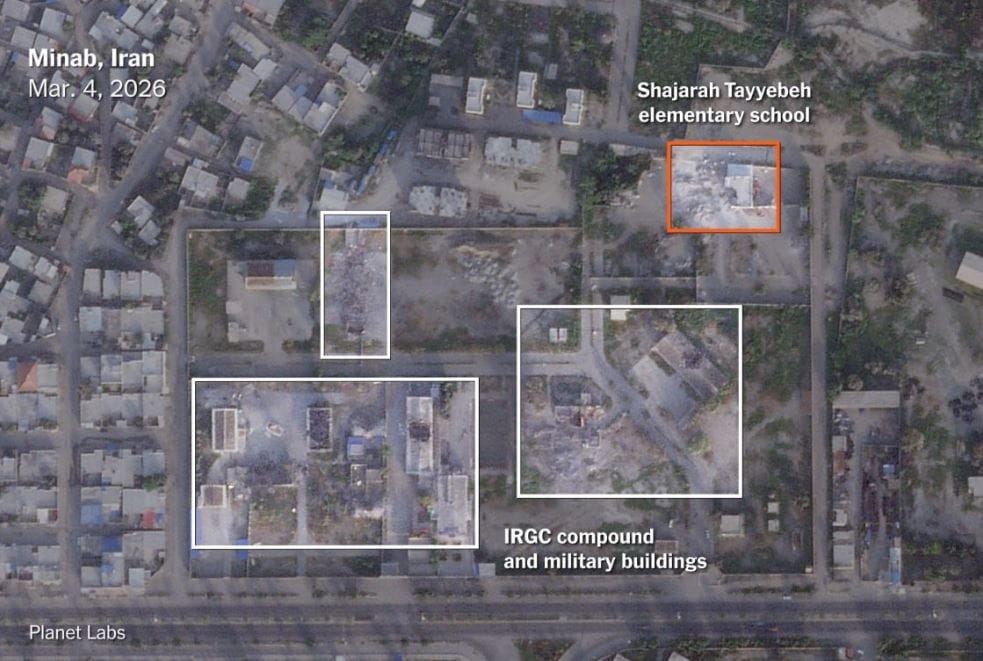
However, the pictures that Planet Labs has now produced, and which American publications, BBC, they’ve all now published, show you playgrounds in the school. These show you that the school building is next to the IRGC campus but it has three open accesses. You don’t do that at anything military. You can walk in and out. It has playgrounds which are marked on asphalt on the ground. It also has remnants of watch towers, which might have been there earlier when it was part of the naval facilities, that had been demolished in the course of time.
So if anybody had bothered looking at a fresh picture, they would have immediately known that this is not a military facility and definitely not part of the IRGCN facility as it probably used to be many years ago. In this case, more than a decade ago.
These are also perils of using air power. And also having the arrogance that I can go and destroy anything so far away. In this case, this has now become, after My Lai, perhaps the single greatest military blunder in history. And this is something that Americans will take some time living now. I don’t think history will ever let them forget it.
Now I told you I will tell you the Baghdad story at the end of this episode. So here it is. In 1991, the first Gulf War. The previous night, a bunch of palaces— Saddam Hussein had multiple palaces in Baghdad— they had been bombed. We were driving past one. And in those countries, dictatorial countries, journalists were never by themselves. They always had a, quote unquote, guide or a minder, as we used to call them, whose job was as much to help you as also to report back on you.
But you always made friends with them. So our guide was Rasheed. So we asked Rasheed as we drove past one of these palaces destroyed the previous night, Prashant asked Rasheed, “Rasheed, do you mind if we stop and take a picture of this palace?”
So our friend and guide Mr. Rasheed grabbed his forehead like this. He was sitting in the front seat and he said, “Habibi, my dear friend, by merely asking me this question, you’ve given me a headache!” I thought this was a story worth telling.
Also Read: Iran war ‘stark reminder’ for conflict resolution framework anchored in South Asia—NSAB chairperson