







By Maya Gebeily, Laila Bassam and Emily Rose
BEIRUT/JERUSALEM, April 16 (Reuters) – Lebanon’s president will not speak to Israel’s prime minister in the near future, Lebanese officials said on Thursday, dealing a blow to U.S. efforts to expand contacts between the enemy states as Pakistan said peace in Lebanon was vital to ending the Iran war.
The U.S.-Israeli war with Iran spilt into Lebanon on March 2, when Iran-backed Hezbollah opened fire in support of Tehran, prompting an Israeli offensive in Lebanon just 15 months after the last major conflict.
“Peace in Lebanon is essential for (Iran) peace talks,” Tahir Andrabi, spokesperson for Pakistan’s Foreign Ministry, said.
The Israeli security cabinet convened late on Wednesday to discuss a possible ceasefire in Lebanon.
President Donald Trump said on Truth Social he was seeking to create “a little breathing room” between Israel and Lebanon, adding the two leaders had not spoken for some 34 years and “it will happen tomorrow,” in a post published late on Wednesday in Washington.
But three Lebanese officials told Reuters on Thursday that President Joseph Aoun would not hold a call with Israeli Prime Minister Benjamin Netanyahu in the near future.
Two of the Lebanese officials said the Lebanese embassy in Washington had informed the U.S. administration of the position before a call between Aoun and Secretary of State Marco Rubio on Thursday.
A brief Lebanese presidency statement said Aoun thanked Rubio for U.S. efforts to achieve a ceasefire in Lebanon.
LEBANON SEEKS CEASEFIRE BEFORE TALKS
The Lebanese government has been sharply at odds with Hezbollah over its decision to enter the war, having spent the last year seeking to secure the peaceful disarmament of the group founded by Iran’s Revolutionary Guards in 1982.
Beirut banned Hezbollah’s military activities on March 2.
Israeli and Lebanese ambassadors held rare talks in Washington on Tuesday but contact between Netanyahu and Aoun would be a major milestone in ties between the two countries, which have remained in a state of war since Israel was established in 1948.
Hezbollah opposes contacts between Lebanon and Israel.
Earlier, Gila Gamliel, a member of Israel’s security cabinet, told Israel’s Army Radio that Netanyahu would “speak for the first time with the president of Lebanon after so many years of no contact between the two countries”.
Aoun had said early in the war he would be open to direct talks but Lebanon’s position is that a ceasefire should precede negotiations.
In a statement on Thursday, he said a ceasefire would be the “natural entry point for direct negotiations” with Israel.
Aoun, who commanded Lebanon’s U.S.-backed military before becoming president last year, said Israel’s withdrawal would be a “fundamental step to consolidate the ceasefire” so that Lebanese troops could deploy to the south.
FIGHTING CONTINUES IN SOUTH LEBANON
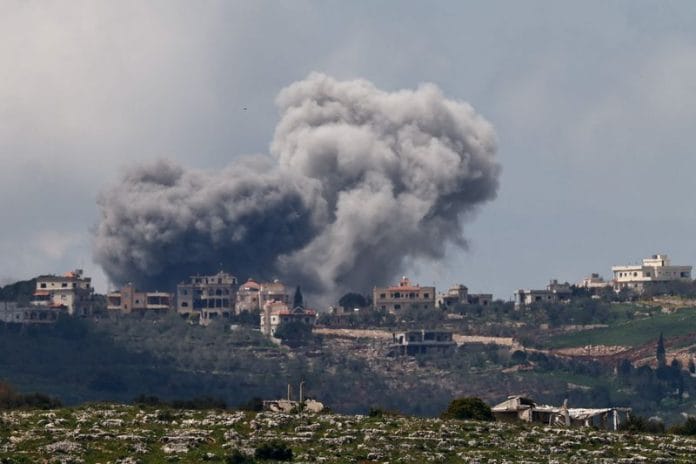
Fighting continued to rage in south Lebanon, notably in the Lebanese border town of Bint Jbeil, a Hezbollah stronghold and strategic prize, which Netanyahu said on Wednesday the Israeli military was about to “overcome”.
A senior Lebanese official said Lebanon believed Israel wanted to secure a victory in Bint Jbeil before diplomatic progress could be made.
An Israeli strike destroyed the last bridge over the Litani River into the south, a senior Lebanese security source said, fully severing almost a tenth of Lebanon from the rest of the country after Israel destroyed other crossings during the war.
Hezbollah announced new rocket attacks at Israel. In Israel, sirens rang out warning of incoming rockets, sending residents of several northern Israeli towns running to bomb shelters. There were no immediate reports of injuries.
Israeli attacks have killed more than 2,100 people in Lebanon since March 2 and forced more than 1.2 million to flee, Lebanese authorities say. Hezbollah attacks have killed two Israeli civilians, while 13 Israeli soldiers have died in Lebanon since March 2, Israel says.
ISRAEL VOWS ‘NO-GO’ ZONE FOR HEZBOLLAH
The Israeli military’s chief of staff said on Wednesday the area south of the Litani would be a “no-go zone for Hezbollah operatives”, reflecting Israel’s declared aim to keep control of a swathe of Lebanon south of the river that meets the Mediterranean about 30 km (20 miles) north of Israel’s border.
Washington expressed optimism on Wednesday about reaching a deal to end the Iran war. The sides agreed a two-week ceasefire in the Iran war on April 8, following mediation by Pakistan.
Israel and the U.S. have said the campaign against Hezbollah was not part of that ceasefire, though Pakistan’s prime minister had said the truce would include Lebanon, as demanded by Iran.
A senior Israeli official and the senior Lebanese official said on Wednesday that Netanyahu’s government was under heavy pressure from Washington to reach a ceasefire in Lebanon.
A senior U.S. administration official said on Wednesday the Trump administration had not asked for a ceasefire, but the U.S. president “would welcome the end of hostilities in Lebanon as part of a peace agreement between Israel and Lebanon”.
(Reporting by Emily Rose in Jerusalem and Maya Gebeily in Beirut, Jana Choukeir and Tala Ramadan in Dubai, Saad Sayeed in Islamabad; Writing by Tom Perry; Editing by Lincoln Feast, Ros Russell, William Maclean)
Disclaimer: This report is auto generated from the Reuters news service. ThePrint holds no responsibility for its content.