





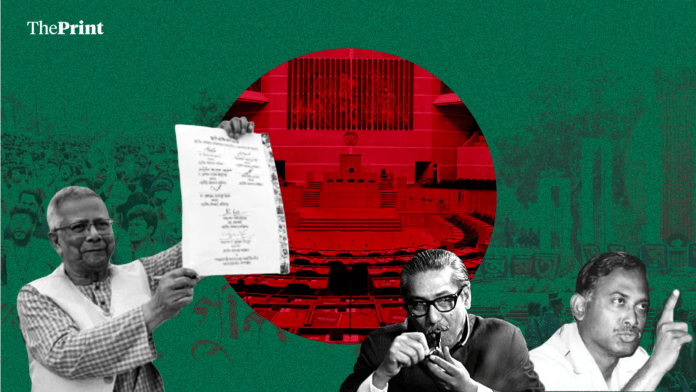



Dhaka: Voters approved an Implementation Order linked to the July National Charter, with 4.8 crore voting yes and 2.25 crore no—about 68 per cent to 32 per cent—as the Bangladesh Nationalist Party (BNP) won the general election Friday.
But the referendum was more than a simple yes-or-no vote. It did not directly ask voters whether they approve the July National Charter in full, nor did it present specific constitutional amendments for approval. Instead, it asked them to endorse an “Implementation Order”—a legal instrument that would trigger a chain of events leading to wide-ranging constitutional reforms.
Of the charter’s 84 recommendations, 47 would require amendments to the Constitution and are therefore subject to referendum. The remaining reforms could be enacted without constitutional change.
Bangladesh’s Constitution currently contains no provision for holding referendums. As a result, a separate ordinance was drafted to regulate the mechanics of the vote: when polling will begin and end, how ballots will be handled, who will serve as presiding officers and how votes will be counted.
But the Implementation Order does more than describe voting procedures. It also sets in motion the steps that Parliament must take if the referendum succeeds, effectively launching a new legislative phase to enact the charter’s constitutional reforms.
The return of a caretaker government
The first reform addresses the formation of an election-time caretaker government.
Bangladesh introduced caretaker administrations through a constitutional amendment in 1996, aiming to ensure neutrality during national elections. Elections held under caretaker governments were widely regarded as more credible than those conducted under sitting party administrations.
The Hasina government however abolished this provision, and elections were held under the ruling government.
The July Charter recommends a detailed and time-bound process for selecting a caretaker government’s chief adviser. A five-member selection committee—comprising the prime minister, the leader of the opposition, the speaker, a deputy speaker from the opposition and a representative of the second-largest opposition party—would solicit nominations from registered political parties and independent lawmakers.
If consensus fails, the process escalates through successive fallback mechanisms, including cross-selection of nominees by rival parties and, ultimately, the addition of two senior judges to the panel. If all else fails, a modified version of the Constitution’s 13th Amendment procedure would apply—with one significant exception: the president would be barred from serving as chief adviser.
Also Read: NCP-Jamaat coalition will reset Bangladesh’s India policy. Dignity first, dialogue second
A bicameral parliament
The second provision would transform Bangladesh’s unicameral legislature into a bicameral one.
Under the proposal, a 100-member upper house, likely to be called a ‘senate’, would be formed in proportion to the votes each party receives in the general election. Parties would submit ranked lists of potential senators in advance; seats would be allocated according to vote share.
Any constitutional amendment would require approval by a majority in this upper chamber.
The referendum text presents this change as a settled arrangement, though it remains subject to voter approval.
Implementation and conflict
The third clause states that parties winning the next parliamentary election “shall implement” 30 agreed-upon reforms from the charter.
Among them: increasing women’s representation in Parliament, electing a deputy speaker and key parliamentary committee chairs from the opposition, limiting the prime minister’s tenure to 10 years total, enhancing presidential authority in certain appointments, strengthening fundamental rights and empowering local governments.
The language appears binding, but implementation may prove complex.
For example, the charter calls for parties to nominate at least 5 percent women candidates in the next election, increasing by 5 percentage points each cycle until reaching 33 percent. Yet in the current election cycle, fewer than 2.5 percent of candidates are women.
Three parties—Islami Andolan Bangladesh, Bangladesh Khilafat Majlis and Bangladesh Nizami Islam Party—had formally objected to the women’s representation provision. Other parties that agreed in principle had nonetheless fallen short of the 5 percent threshold.
Similarly, the pledge to “strengthen fundamental rights” does not enumerate specific rights to be added. Earlier discussions included proposals such as recognising internet access and voting rights as fundamental rights, or creating a formal bill of rights. None of those specifics appear in the referendum language.
Who decides?
The fourth and final clause states that other reforms mentioned in the July Charter will be implemented according to political parties’ commitments.
Unlike the third clause, this section acknowledges implicitly that not all proposals were unanimously endorsed. It allows room for party-specific reservations and interpretations.
BNP leaders told ThePrint that the party supports the referendum in principle, but that once MPs are elected, they will decide which measures to prioritise.
Notably, the winning Bangladesh Nationalist Party (BNP) has already issued a formal note of dissent on parts of the appointment process of the caretaker government, proposing instead that Parliament vote by majority to select the chief adviser.
It remains to be seen what the legal consequences of failing to enact reforms will be, given the removal of an earlier automatic-enactment clause after 180 days. The clause was removed to avoid constitutional challenges and address concerns about maintaining parliamentary legitimacy.
(Edited by Shashank Kishan)
Also Read: Tarique Rahman’s BNP looks set for landslide win in first Bangladesh polls after Hasina’s ouster